Re: Allergy

People with allergies can be the butt of jokes. When schools had to design policies around the potentially deadly outcome of peanut allergies in children, controversial comedian Louis CK got headlines because he suggested that “If touching a nut kills you, maybe you’re supposed to die.”

Today, I was tempted by a fresh black cherry. When I am exposed to certain foods I can get allergic reactions that could include; a runny nose, sneezing, coughing, shortness of breath, swelling, itchy palate, or red eyes. I can relate to the ads on television during allergy season promoting their product’s efficacy in removing all these sorts of symptoms. I know about the risk of certain foods, but that cherry looked so red, ripe, and delicious. I ate it and felt fine, for ten minutes, then I got all the reactions I just described. I didn’t die, but I was a noisy, mucus-filled mess for half an hour. ’Twas not a pretty sight.

I didn’t always suffer from the A disease. In my twenties, I moved from southern to northern Ontario and that particular summer was apparently the worst pine pollen bloom of-all-time. The yellow powder was smeared on vehicle windshields, it coated clothing hanging outside to dry, and was a sticky icing on the surface of lakes and rivers. I can’t see how anyone could avoid having their lungs clogged by this powdery air. From that bio-hazard summer to this day I can start sneezing over unknown elements in the air, or in the beverages I drink, or on the animals I pet, or in some of the foods I ingest. It’s a crap shoot.

Many medications are available for allergy relief. My doctors have prescribed many remedies (the best being codeine) and I have settled on a formula of antihistamine, decongestant, and anti-inflammatory to reduce most of the symptoms, most of the time. Sometimes I can predict what might bring on an attack and take the necessary pill(s) in advance. I always carry a tissue in my pocket. It’s usually damp.

The first thing I’m asked when going to a hospital is, “Do you have any allergies?” I want to be dismissive but I usually say it’s only seasonal. When I sneeze (loudly) in a grocery store aisle I want to go to customer service to tell them to assure everyone with an announcement, “It’s just allergies folks!” I fell in love with a woman who took out a Kleenex after her first bite of food, from our first restaurant meal, just as I did too! It’s breezy to be sneezy, when you’re in love.

Jeff Bridges was in a film about a plane crash. Surviving this ordeal, he finds that he no longer has a severe strawberry allergy. In joy, he becomes fearless in attitude, thinking he was somehow blessed by the tragic experience, making him immune to normal human frailty. There are many ailments that afflict our species. Within the great spectrum of illness I know that I am lucky to only have a response to a few allergens. It’s not likely to kill me.

Re: Account

To have an account is one thing. To hold yourself or others to account is another. Like many words in the English language, a single word can have multiple meanings. This is what this word means to me. It may evoke different thoughts or even have different meanings for you. The fun is in the interpretation, not necessarily the dictionary’s standard.

Last week I was sitting in a parking space waiting for my bride to return with a bag of yummies from the grocery store. A car pulled up in the space beside me, a woman got out of the driver’s side leaving the car running. A man was sitting in the passenger seat with his window open. I was too far away to suggest he turn off the car without shouting and sounding aggressive. The fumes from the exhaust came through my open window. The woman returned a few minutes later and, to my surprise, stooped to look at the tire of her car which was just opposite my window. I quietly asked, “Why did you leave your car running?” Well, I was bombarded with all sorts of answers/excuses from both of the car’s occupants. In summary, they thought I was choosing something minor to “bitch” about.

The incident made me think of times when I try to be accountable for my choices. Holding myself to account is not easy in a complicated world. I am aware of making daily decisions about what is best for myself, my partner, my situation, and the world in general. Sometimes priorities are made that seem inconsistent with my own needs or the greater good. Small things, like leaving a car running, can add to larger things, like global warming. When and how we decide to practise our principles is not easy. I wonder to what degree do we have a responsibility to remind others to be accountable. Shouting at a politician seems easy but when our neighbour appears to be doing harm we might fear coming across as The Accountability Police.

When my sons were small I advised them on ways to be financially accountable. I taught them about bank accounts, credit dangers, and saving for a rainy day. My wife kept a monthly ledger to show how money comes in and money flows out. As banking technology changed they taught me about ATMs, bank cards, email transfers, and other online services. I was once a slave to doubt about whether I would ever have enough money for my needs or wants. But by taking things all into account, I slowly learned to balance the fears of loss with the reality of my good fortune.

Holding myself to account means I must judge my choices based on a variety of factors. Commenting on other’s behaviour is a potential minefield of explosive consequences. Everyone has had moments where they have wished they had said something. Who hasn’t glared at a parent of crying/misbehaving kids! Like it or not we are all accountants of our life experiences. No one can judge us better than ourselves.

Re: Cult

Some words contain words. Cult is part of culture in more than just structure. There are elements of cultism in every culture. Citizens of a culture make the decision to embrace what is practised, or not. The essence of a country’s culture is demonstrated by how resources are allocated to promote the larger values of the collective. Sometimes these tribal desires to belong can conflict with our individual wants, wishes, or needs.

When folks agree to do similar things together a connective thread is created. I like to think of that as the art of living. Defining a culture is how societal groups are formed. Individuals in families may often repeat to each other “This is the way we do things.” Teams often bond over the wish to be united so that literal goals can be achieved. After a tragedy, a city might suggest that the way forward would be by recognizing common values. I remember, after the bombing of marathon runners in 2013, newspapers promoted solidarity by printing headlines; Boston Strong! What fascinates me is the border between a healthy culture and a restrictive cult.

Throughout history people have collected into groups for protection, efficiency, or the pursuit of a shared experience. Religions are built on this desire to belong to something greater. Few of us want to be alone in our beliefs or occupations. Unions, fraternities, and sororities have been an essential part of the workplace so we can feel like comrades of industry. Military institutions have aspects of cult conditioning within their training. When you belong to any group you have to give up a bit of yourself for the greater good.

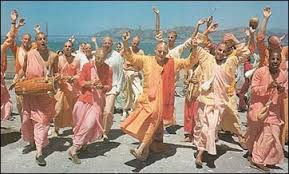
With the fracturing of our understanding of cultural mainstays comes doubt over what is important. Factions, sects, and brotherhoods become more important when traditional ideas of the common good are muddled. Cults begin to grow, fracturing the confidence populations once had for their society’s documents of legality, equality, and fraternity. When I read of organizations having a crisis of culture it worries me that fundamental values have been twisted to suit the needs of the powerful. Most people will think of cults with a capital C as those practising life on the fringe of religiosity. The rules of belonging in a cult-like setting are very oppressive of individual freedoms. In some cases you are coerced to deny your own history in order to begin life under a new set of guidelines. Life in some 60s communes was like this, and I have concluded that being involved with any religion is cultish.

Communal systems can get complicated when group and personal needs conflict. To some degree educational institutions are designed to indoctrinate our children to the ways of the national interest. In Canada, our ten provinces and three territories have their own policies, procedures, and legislation within the framework of the larger federation. All regions have their own priorities and practises (especially Quebec, and lately Alberta) yet we all call ourselves Canadian.

Cultures must evolve to survive. I would celebrate a global culture of peace as a priority.

Re: Drawer

This word must be hard for ESL students. I taught elementary school kids and they would have more trouble with words if they were hard to pronounce. Drawer has a sound like shore when it’s used in sentences about places to put things. But an artist can be a draw-er, which makes me think of someone involved with practising law, which puzzles me even more because that person is a lawyer, which is consistent with someone who works with wood who might be a called a sawyer. Poor students! Imagine the questions if I assigned The Adventures of Huckleberry Finn and his friend Tom who explored the Mississippi River while dressed in muddy cotton drawers!

My dad was a drawer. He would draw on his life experiences to tell fabulous tales. In that sense he was a collector of curiosities & thoughts, in another sense of the word he actually drew stuff. He used a pencil to sketch or a brush to add colour to his surroundings. His drawings were his perception of the world, put on paper. He was sometimes commissioned to replicate a favourite dwelling. One house-proud person was so delighted by his pastel reproduction she exclaimed, “That’s exactly how I see it when I’m turning into the driveway.” When he told me this story and showed me the photo he had taken, I noticed he had left out a telephone pole, and a hydrant, from his final sketched landscape. I understood he was a drawer in that instant. He allowed that the homeowner would draw her own conclusions, all the while anticipating her human need for fantasy.

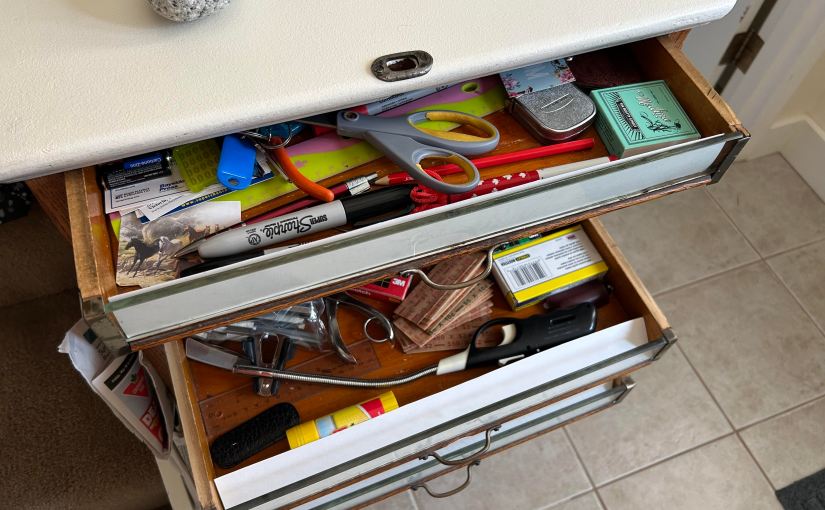
Everyone has a junk drawer, sometimes in the kitchen, sometimes in the bedroom. Like a magpie we collect stuff and toss them here for when we think we might need them. Even things that have no use. If you can’t afford a place with an attic or basement crawlspace, a drawer will do to hide those old love letters, secret things, or stuff not worthy of the knickknack shelf. My mom had a glassed-in corner curio-cabinet with shelves that could be pulled out for closer examination. She kept her thimble and teaspoon collections in these suede-lined drawers. I can picture her in my childhood memory excitedly drawing on a cigarette as she talked about the origins of these treasures. She let the ash fall where it may.

Thanks to my dad’s influence, story telling later became a big part of my teaching curriculum. I often read fairytales to instigate study of other subjects. I remember one student designing an efficient water well, for a science fair project, after hearing Diamonds & Toads by Charles Perrault being read in class. Together, other students did their research and discovered there were many fables based on the drawing of water from wells. My essay is about to draw to a close. Let your imagination wander.

Re: Oneupmanship

I find it appropriate that ‘man’ is found in this word, because it is masculine aggressiveness that usually interrupts a collaborative approach to a problem. Males tend to want to feel superior over their brothers at work or at play. I’ve seen women take a dominant stance in meetings so I suppose women are not immune to the desire of besting their fellow sex. Meanly, I think, we use different words for when a woman wants to show-up her competition by being catty, a bitch, or any other word that references the animal world.

I am forever puzzled by this need, that some have, to make themselves seen at someone else’s expense. I’m not perfect but I don’t feel comfortable if my success means my fellow human has taken a backseat on this bus we call life. I’ve tried to learn from my mom’s mistake. She was a master of oneupmanship. She practised on my dad, then went hunting in the community for fresh victims (‘fresh meat’, she called her prey). She would delight in taking-the-mickey. She was ruthless in municipal politics. Even in her last days at a nursing home she would search the corridors of her ward for a newly-placed health aide to tease. Relentlessly. To tears! Making fun of others is no way to have fun. Topping others is no goal for me.

I have taken joy in seeing my name on the cover of my self-published book. I didn’t want to go through the soul-sucking process of finding a publisher who might see value in my words. I didn’t need to be recognized by an established publisher to give my work credibility. I found value in myself. Some might call that ego. I call it confidence. I can endorse myself. I don’t need to pass someone else’s test. I am among thousands of thousands of writers who have something to say. Artists have something to give. Most folk don’t want to evangelize their take on life. Most of us don’t have an axe to grind. We elevate ourselves through expression. We just put it out there, in hopes of being seen and understood, not by lording-it-over another.

Oneupmanship is aggression. Brinkmanship is the next level of ferocity. Lots of United States citizens must admire the antics of Donald J. Trump to bring him to national prominence, and dominance, for a second term as POTUS. I think The Donald is successful due to his brinkmanship; this man will not stop until his target is cringing in the corner, begging for mercy. Trump’s other characteristic is self-aggrandizement. This poor excuse for a human being will take any opportunity to say how great he is, how he’s the best ever, how no one has seen the likes of him before. On this last point many can agree; not since Hitler have we seen someone so able to con the masses into complete subjugation. It would be laughable if it didn’t cause so much pain.

Our world is teetering on the brink. Let’s try a little stewardship for a change.

Re: Outcome

I don’t remember when I first learned about compound words. Every word has a certain power when used effectively. A hyphenated word brings an idea together quite nicely while two or more words that are smashed together can be particularly enlightening. For a planner like me there is something very satisfying when all my organizing, mapmaking, list-making and future gazing creates an outcome that fits the contents of my imagination.

Our personal stories are often crafted to have outcomes that put us centerstage. In our vision of life, past or future, we tell our tales of adventure, defeat, disappointment, shame, honour etc. within the context of how we wish To Be in the world. I went on a much needed four-day holiday with my partner to an island retreat. I hadn’t anticipated getting lost in this fairly remote place, but I did, get lost. But it was temporary. A stranger appeared, literally driving out of the nowhere woods. I leapt from my car, waving my arms to stop him from going further along the dirt track. He smiled, led us to our destination only five minutes away, then vanished in a shower of small stones. The outcome, besides my embarrassment, was a good story of my fallibility.

At the Pearly Gates of Heaven, so it is said, you will discover the outcome of your existence. Someone will have kept a notebook of your transgressions and accomplishments. You will be judged. Of course you will likely disagree with the assessment. You will have kept your own ledger of regrets, misdemeanours, sacrifices, and awards of distinction. This island paradise I visited was Eden-esque; it certainly felt like heaven. While there, I talked with a young fellow about the importance of family. He was determined to tell me about how his life changed after becoming a father. He said he couldn’t have anticipated such a marvellous outcome as his crying fragile baby, turning into the boy that he so dearly loved.

For business types, the outcome is only read as the bottom line. The great Hudson’s Bay Company, established as a cornerstone for Canadian commerce back in 1670, recently died. From my point of view it was a case of neglect by rich folks less interested in history and more in profit. The outcome: Bankruptcy. I pushed my mother-in-law around our local HBC in a wheelchair. She commented on the bare aisles and naked mannequins. We both thought that the space felt like a garage sale. Our outcome: A feeling of loss.

On this temporary island of welcomed respite, my wife and I watched the tides filling and emptying a lagoon twice daily. We could gaze out our shorefront window and intentionally develop a new rhythm; one defined by more natural needs and intentions. Time felt less important here, we tended to ignore our digital handcuffs. The inbox and outbox of our manufactured world lost meaning. Our existence in this curious world felt familiar. The outcome of this experience has yet to be fully determined, but there can be no limit to our imagination.

Re: Triage

I like words that are used between languages. There must be no borders with communication. Triage is a French word that means to separate out, or to sort. I think sorting is a good thing, in a medical context or any other. When I sort my feelings I’m better able to communicate my thoughts. I can see what is most important after even a bit of reflection and attend to it first, with a plan of action.

My wife is a nurse. She brings her training, attention to detail, and compassion to various situations throughout our days together. We’ve started watching the television series called The Pitt. This is one manic show! Where I find the director’s techniques fascinating, my bride gets pumped by her familiarity with the emergency room intensity. I’m left panting by an episode’s end, and she is energized. We have fun deconstructing the scenes with me asking tons of questions about accuracy and medical procedures.

In the heat of a hospital emergency room it must take everything you’ve got to decide who is the most in need of attention. All your personal prejudices must be back-filed. You would have to suspend your personal opinions. Focussing on the goal of saving lives is paramount. But I marvel how anyone can keep their heart from interfering with their head when it comes to making choices. In most situations, I must first consider my heart, before allowing logic to enter.

Our planet needs a triage event. We need to decide what is important on this home called Earth. There is plenty to indicate our globe is sick and needs attention. I’ll imagine Climate Change as a first priority. Back in 1970, the USA sponsored the first Earth Day, we got a flag and a thumbs up for concern over lack of environmental awareness. In 1979 the first World Climate Conference was arranged by the United Nations, by then we had lots of data showing we knew that things were going to get gnarly on our planet. Still, we left the patient in the waiting room. By 1995, with things not decided, The Conference of Parties (COP) held the first of 29 (and counting) annual conferences to get a U.N. consensus on how to help an exhausted planet. I read the news today (Oh Boy!) and it’s not looking good as data shows the melting glaciers do not have long to exist. The patient is going to die before getting a bed for continuing care. Our Earth has been left in the metaphorical hospital hallway to await its fate while we capitalist, nationalistic humans worry over who is going to pay the bill.

It comes down to priorities. Setting goals is hard in business, harder in personal life and hardest when it comes to international solidarity. It’s easier for me to think of the planet as I do my partner. She will always come first; my life and happiness depend on her health. Once her needs are met I can move on to other matters.

That’s life.

Re: Announcement

Bugles once announced the arrival of invited guests to a fairytale ball. A red carpet is still occasionally used to indicate the presence of VIPs at a notable function. I’m a cinephile so I like the grand entrance of Hollywood movie stars as they strut their stuff and take their places before the year’s winners of an Oscar are revealed. The envelope please!

Folks love to be the first to tell the Big News. Others love to be the first to hear an announcement of importance. I haven’t been to a wedding in a while so I wonder if the tapping of the drinking glass is still the start to delivering a toast; to the bride, to the groom, or later whoever happens to be still in the banquet room. Parties are times of announcements, pronouncements, or opportunities to gossip. We all love hearing the latest news, especially when it makes us happy.

Recently I published my first collection of newspaper columns. I sent a copy of the beautifully bound book to the library in my old hometown. They accepted it with grace and sent me a picture of it sitting on a shelf, where book lovers might see it. A bit of me is in general circulation! I felt like trumpeting my accomplishment from the highest hilltop. Perhaps I was a Town Crier in another lifetime, reading from the scroll provided by the palace; ‘Hear ye, Hear ye! Gather round all who wish to be enlightened, informed, or otherwise amused.’ Newspaper boys used to shout, ‘Read all about it!’ Most news comes online now but you can still find artistic cards that are decorated to announce a birth, death, wedding, illness, or achievement. With the Canadian postal situation being in a state of disarray, one wonders how long the tradition of handwritten messaging will continue. Yet it still holds that even a word of condolence can feel like a gift when delivered to the mailbox right outside your door.

Announcements, good or bad, generate a buzz that we human bees transmit with glee. There was talk for weeks after Queen Elizabeth died. The recent meeting between our new PM Mark Carney and that Donald fellow had all Canadians feverish with expectation. People leaned in, metaphorically at least, to catch any body mannerisms or speech inflections that might reveal the truth behind the politics. Honestly though, it’s often hard to collect the courage to make a personal announcement.

Spreading the news can be premature. No one wants to let the proverbial cat out of the bag. Something may change between the time you choose to share your thoughts and what you’re anticipating will come true. There have been many times when I’ve said, “Guess what?” Then finding myself regretting giving the message. No one wants to jinx the future, even if we understand that we have no power over what comes next. The new world order, our personal world order, will evolve regardless of our excitement to be the herald of happiness or the bringer of bad tidings. It comes down to sharing what matters to us. That’s what counts.

Re: Inflammation

It’s entirely possible that a person can have inflammation of the psyche. I know because I have been feeling it lately. My symptoms include: Redness of the face when ever I see a picture of The Donald, Swelling of the chest as I pace about the rooms of my vindictive mind imagining what might be an appropriate punishment for these perpetrators of injustice, Pain in my brain as I try to rationalize how the state of the world came to be so scary for my grandchildren. I fear that I have lost control of my moral compass. Most alarmingly, my soul is feeling the heat of all these conflicted emotions.

The political world has been set on fire by our faux leaders, billionaires, and capitalist conglomerates. Meanwhile many parts of the natural world are aflame with the results of human induced climate change. The Anthropocene was a recent term used to define humankind’s dominance over our planetary systems. I suggest that our planet’s destruction at the hands of Homo sapiens is rapidly resulting in a new geological period. Let’s call it The Inflammatory Age. It’s clear to me that everything on this globe called Earth is suffering from a sickness quite like the illnesses that spring up in our body systems. Earth has been keeping the score of multiple abuses to its structure. Constant extraction of its minerals, pollution of its water, air, and lands have taken a toll on its health. Warring nations have been inflaming the hearts and minds of youth to the point they are absorbing the negative energy and losing all sense of peaceful solutions. When does acute illness, become chronic; leading to death or extinction?

My health care advisors tell me the inflammation in our physical body is responsible for many of our ailments.  With every infection, inflammation of the nearby cells is initially involved as a protective measure. It could make things worse however, complicating the healing process. The original injury is therefore harder to manage. Sometimes through my life I have felt feverish for no apparent reason. My joints get swollen and uncomfortable. Pain relievers can help me through these spells of an aching body. This fever can be brought on by stress which can be a contributing factor to my discomfort. If our body is electric, and of a chemical nature, then it’s no wonder we short-circuit every once in a while during the natural course of living.

A bull cannot be inflamed by the sight of red. He is tortured into a rage by the constant twisting of the matador’s cape. So too am I enraged by the antics of people intent on bullying for the sport of it all. The answer is not by fighting fire with fire. Not in my peace-loving book anyway!

Once upon a time during Covid-19 our provincial health officer, Dr, Bonnie Henry called on our population to be kind, be calm, and be safe. She sensed that fear inflames during times of crisis. I agree with that wisdom: Inflammatory comments don’t help, only hinder, our return to healthy living.

Re: Talk

When a boss says, “Let’s have a chat.”, you know there is trouble ahead. I would prefer a request like, “I’d like to talk something over with you.” The latter suggests a mutual desire to solve a problem. Too many times the person wanting to have a discussion has already mapped out the attack strategy so that you’ll eventually hear, “There’s nothing you can say that will change my mind.” The situation, talk-wise, has come to a dead end.

That seems to be where we are in the world right now: At a dead end. The UN is a global talk opportunity between nations. There are many words spoken at many meetings with many reams of paper, and many talking points are recorded during discussion after discussion. This is where the phrase, ‘talk is cheap’ comes to mind. As I review the records of politicians there seems to be only a few who actually walk their talk. One exception is Manitoba Premier Wab Kinew. Since taking office he has shown that election promises can be kept. If he were talked about within the pages of The New Yorker magazine I bet he would be in the profile called Talk of the Town.

Bonnie Raitt sings a great version of Shirley Eikhard’s song, ‘Let’s Give Them Something to Talk About’. It’s a catchy hit primarily about gossip, which is a somewhat seedy form of talk that gets people into trouble sometimes. I like being talked about in a way, because it makes me feel folks are thinking about me. But I wouldn’t want to be slandered or have people think I’m different from what I may pretend to be. When TEDtalks first became a thing, I fancied myself giving a lecture where everyone would take notes and discuss the finer points in a coffee shop afterwards. Then I had a dream imagining that very scenario with the audience talking while I was speaking and I woke with a sweat, and a radio voice in my head moaning “Talk, Talk, Talk, all you do is Talk!”

A debate is high level talking where ideas are proposed and a ‘Winner’ is chosen for their eloquence and astuteness while in the hot seat (or a hot podium). In a panel discussion I usually find myself nodding off after the opening remarks. Political debates are the same snore-fests. I know I’m supposed to be paying attention but I’m wishing all the time that if I just had a pamphlet I could figure it out for myself.

I wouldn’t call myself a talkative person. After a stimulant I might get excited enough to run-on. There was this time I met someone I admired and I rallied many coherent thoughts and blasted them in a non-stop fashion leaving me sort of breathless and sadly with nothing left to say. I’ll never forget the look on the face of the person who absorbed all that enthusiasm. I reminded myself later to be more careful with my words. That said; I love talking happy-talk.