Re: Levidrome

During COVD19 lockdown I became one of those people who relearned the joy of jigsaw puzzles. In fact puzzles of any kind are great for stimulating the mind and distracting you from dark or worrying thoughts. A Levidrome is one such puzzle that I came across while tweeting on social media. Levidrome is a new word that is reminiscent of the word Palindrome. We know a palindrome is a word that can be spelled the same backwards or forwards: Anna, Otto, toot and sees are palindromic words. But what happens when a word is spelled backwards creating an amusingly different word? https://www.youtube.com/watch?v=jpZ3bh1R6Kk

This boy named Levi figured out that stop spells pots in reverse. He asked his dad why there wasn’t an English word for this phenomenon and the word Levidrome was invented to fill the void. From then a movement grew to get this word in the dictionary, any dictionary. Connections were formed on social media and elsewhere. Folks from all walks of life (even the multi talented William Shatner) joined the campaign. Oxford Dictionaries had this to say: https://www.youtube.com/watch?v=JJkV9HwtM4k

School teachers from various world locations have reported that they are using Levidromes in classrooms. Creativity is stimulated when playing with words and much has been learned from these activities. A song has been composed by Lola Parks to entertain, simplify and enlighten. 

To date I have been unsuccessful in getting this new word and its concept accepted by the people at Wikipedia (apparently something about promotional restrictions which somehow does not conform to their policies). Maybe someone else with more experience on that platform will have better luck. Being a cheerleading kind of guy I’ve been  levidroming with other levidromers to keep the word in the public eye and to have fun coming up with new Levidrome pairs. It’s a truism that when you discover something new, it makes an appearance in unexpected places. The 1994 film Reality Bites contains a scene where one of the cast humourously discovers a Levidrome pair. https://www.youtube.com/watch?v=SQVw58aDt3Y .

Some puzzlers have invented crafty clues to challenge the search for Levidrome answers. Some have found ways to use other languages to expand the reach of young Levi’s idea. These riddles sometimes take the form of poems or narratives. For example this riddle sounds like an opening to a short story: In the kitchen Amy was in charge, the celery was not cut small enough so she chopped it again.’ The Levidrome answer is: Decider/Rediced. Someone has made a list of Levidrome pairs and posted it online at https://www.levidromelist.com/. There are more than 500 English words that have been discovered so far.

Who knows what new forms levidroming might take? Even ale drinkers are getting in on the Levidrome action. A local brewery appropriately named a special batch of beer, ‘Regal Lager’. I enjoyed this review of the brew by a frosty imbiber. https://www.youtube.com/watch?v=kRjD8OZJnr8

Re: Performance

I miss performances. The COVID19 pandemic has created an environment where culture has been a victim. China’s lunar new year holiday celebrations were affected. Italy and Spain curtailed their street cafe traditions. European countries lost their football community. I have a friend who lives for sports and he mourns the absence of watching a high performance team. He and I were both shocked when the summer Olympics in Japan had to be cancelled. What a blow to all the athletes who were robbed of the chance to perform, after years of practise, for a coveted medal of Gold, Silver or Bronze.

A large part of my enjoyment in life comes from attending a play, a dance or musical performance. I’m always awed at the work it takes to bring a piece of art to the stage. It’s thrilling to witness a one of a kind performance. I take great delight in watching young artists get their first taste at a role. When I was in elementary school I took part in public speaking competitions and my sister excelled at baton twirling. Together we once auditioned for a youth talent competition at our local television station. Our parents would admit, after we came off the stage, that they experienced sheer terror over a potentially bad outcome. We were just delighted it was over so we could go to the promised dinner and movie.

We have a performing arts college in our community and many theatre companies ask the students to perform with more veteran actors as part of their course work. These shows validate the effort it takes to make a performance count for something special. I wonder how these student actors will realize their dream of performing in front of a large audience, when large crowds are scary places to be, even while a death dealing virus is on the loose. 

The most uncomfortable times in my teaching career were when I had to undergo a mandatory performance review. Working with senior teachers during the practice teaching sessions at Teacher’s College was tense enough, but being under the watchful gaze of a principal for a week created performance anxiety. Even when I felt I performed well it was hard to deflect the feeling of judgement. Performing artists must have very thick skins.

Television can fill the need to watch performers showing their skills. There is a plethora of talent shows on all major networks right now. The monotonous commercials get in the way of me engaging with the backstory behind each performer. Sometimes I tire of the need producers feel is necessary for me to know the details of each of the artist’s lives. Like a magic trick, sometimes I just want to be amazed by the performance, without knowing the details of how, why or what came before it. 

I was recently moved to tears by this work from the genius of Lars Von Trier. The power of performance is breathtaking, the magic of creativity is spellbinding, the result is inspiring.

Re: Cliché

With the COVID19 pandemic, clichés are going viral: ‘We’re all in this together’, ‘The new normal’, ‘Flatten the curve’, ‘Social/Physical distancing’. Everyone is catching these phrase viruses. Clichés are just phrases that were once respected for their originality and meaning yet in these compacted times, a phrase, however helpful, can easily become worn out from overuse. Then people may stop paying attention.

My former father-in-law wrote the book on clichéd discourse. He revelled in bromides such as, ‘Love your enemies:It drives them crazy.’ He enjoyed teasing actor friends with the worn platitude, ‘Break a leg’. He preferred the banality of weather talk over conversations that challenged his one sided view of things. He sometimes sat me down and issued a string of trite phrases that blurred into a single slurry of thought, like this memorable one after I asked for his daughter’s hand in marriage. As I recall he said something about; ’The blushing bride, bury a hatchet, at loose ends, busy as a bee, depths of despair, easier said than done, the fair sex, calm before a storm, to the bitter end, in no uncertain terms.’ We shook hands after this confusing monologue, which I took to mean he was blessing our union.

I’ve always thought that clichéd statements were examples of lazy speech, much like swearing. I discouraged my sons from wearing out words while trying to say what they were feeling or thinking. When my wife and I went on a cruise, we agreed beforehand to steer dinner table conversation away from clichés like; ‘So, where are you from?’ or ‘What do you do for a living?’ or ‘What’s your story?’ Or, the worst of all; ‘Is this your first cruise?’ Instead of using these banal queries we tried something refreshing like; ‘How do you express your artistic side?’ or ‘What would you find hard to live without?’ Or even a cymbal clasher like, ‘Who do you love most?’

Clichés can be considered the comfort food of language. A cliché will sound familiar and therefore safe. We often speak them to get quick acknowledgement of our ideas and a sense of where the other is at, in their view of the world. A cliché spoken and received may identify your level of understanding or establish you as part of the club or tribe. For example, when we want to show support for soldiers we speak of their ‘supreme sacrifice’. We often acknowledge grief by sending ‘thoughts and prayers’.

Over time, we might cultivate phrases that become the proverbs or slogans by which we live. My favourite is, ‘Plan for the worst/Hope for the best’. The truism, ‘You get what you pay for’ will quickly establish a point of view. ‘Every cloud has a silver lining’ holds bits of sage wisdom, however the language we use to describe our complicated lives requires more than hackneyed old sayings. Insight can be found in some clichés yet I’d hate for them to disguise the whole truth about me or the world.

Re: Hate

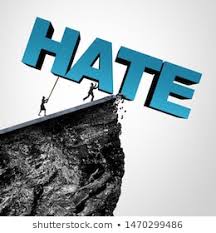
I actually hate Hate: It scares me. Hate is normally directed towards others on our human evolutionary tree who we don’t believe belong, neither on our branch, our tree, nor even roaming around our savannah. Hatred springs from intolerance. This strong feeling can produce behaviours that damage relationships, families, communities and nations.

Love is often considered to be the opposite of hate. I prefer to think of these two feelings as residing on different spectrums. Apathy, Indifference or Ambivalence would likely be found on the other end of the Love scale. On a second spectrum, Hate on one side might be opposed by Peace. Mahatma Gandhi well demonstrated that the compassionate promotion of peace could resolve hatred. His practises in a time of change in a divided India during the first half of the twentieth century persuaded millions of people to reject hatred.

Hate has always been with us. It is sustained by each generation. As a human feeling it resists corrosion. The language for its expression sometimes changes yet the result is similarly dangerous. Currently countries are struggling with a resurgence of nationalism, racism and tribalistic reactions to local or national problems. Hate crimes have been defined, and legislation written as a response to outrages committed by the intolerant few.

The internet has been a wonderful invention that I can fortunately embrace in my lifetime. I enjoy the way its structure permits a free exchange and expression of ideas. Yet hate is found here. On various social networking platforms it is easy to find hateful comments that are passed off as reasonable or comedic opinions. Hate mail has become illegal in several countries as a result of suicide claiming the victims of this horrid form of harassment.

I have felt hatred. I once called a nasty Principal ‘Raisin Head’ in front of my young sons. I hate the current President of the United States. I have hated human behaviours, like arrogance, hypocrisy and bullying. I’m not very tolerant of people who have great wealth. I ranted over billionaire philanthropist Bill Gates ‘controlling the agenda’ of health response and I said I hated him. My friend was shocked, “I never saw this side of you.” I was angry. That’s not always my response to hateful feelings, usually I retreat and ignore out of fear of this strong emotion.

Passionate feelings can get mixed up with other stuff going on in one’s head, so it can be hard to sort everything out. Recent protests due to government requirements to quarantine over COVID19 realties have shown that some people just hate being told what to do. https://www.cbc.ca/news/world/protesters-michigan-whitmer-coronavirus-covid-19-1.5551373

I hate being in crowds. The unpredictability of human nature makes me nervous. Shouting from a group can cause an alarm response in my heart. I can be timid yet I will speak out if I feel the cause is just. I would and have rallied against Hate. I try to keep a close watch over my prejudices so I may steer around them when they produce hateful notions.

Re: Pause

Thankfully I haven’t had to suffer physically from the COVID19 pandemic: Thus far, at least. Like many, I have found myself with lots of time to reflect. Looking back from some future time I may coin the quintessential phrase for this period of human time. Perhaps something descriptive like; Culture Paused.

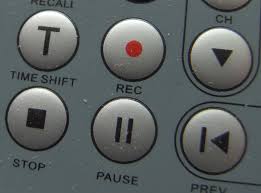
Long before the remote control device was invented I was hitting my own personal Pause button. An Adam Sandler movie called Click explores this attempt at managing your life. https://www.youtube.com/watch?v=zZNC5emNyEQ . Time travel is suggested in the film yet for me, the Pause button was most creative. Going into Pause mode in my life is about zoning out. During moments of inner exploration I’ve come up with some astounding notions, however one button on a remote is boring, so I’ll add two others to better represent my experience: Yes, No and Pause.

Yes: Is full speed ahead and don’t turn back! Embrace life and fulfill your wishes. No: Is life as negative, a dull pit where even thinking is viewed suspiciously. Pause: Let’s digest, regurgitate, forecast while chewing on some serious cud! These three settings on my remote control are an internal function, not a response to others. Importantly, “No!” is an appropriate answer to an outside directive. I can say no readily even when I am in my Yes internal setting because I don’t want someone or something to stand in my way.

My Yes moments generally come when my partner can share my curiosities. These are mildly manic times when I felt supported to try new things, experiment with new opportunities. I have jumped into marriages, leapt into fatherhood, changed dreams to accommodate unexpected passions, embraced new places and methods. I was not thrill seeking yet I surfed on high levels of confidence that opened pathways to new adventures.

My No periods have been awful times when I denied my own personality. Time would march on for others while I made excuses to get out of stuff. I lied with a “Maybe” or “Let me get back to you.” I retreated to places that kept me from decisions. I preferred to reside in my hollow. The No button, on my device, represented guilt, failure and insignificance. I can recognize myself in stories of people who admit they have given up on life. They are in a No time. I too have once said No to life. I’m forever grateful to those who stood by me as I found my way back to Yes.

Young or old, there are times in our lives when hitting the Pause button is meaningful. Fascinated by my own hands and how they fit together palm to palm, I once confounded my grade six teacher when I asked (during the middle of an unrelated lesson) if I could exert enough pressure to expel all the air from my hands so that they would remain locked together. Perhaps forever glued, without adhesive! He asked me to continue my experiment while sitting in the hall.

I like to think that perhaps my question gave him pause.

Re: Character

Actors who play supportive roles in movies or plays are sometimes referred to as character actors. Even though Robin Williams has played the lead in films, I like the way he brings out the personality of the characters he plays. Mr. Williams is also adept at caricature. His imitation of cultural icons by vocal and physical impersonations is hilariously accurate. People who mime others surely must have great skill in observing a person’s characteristics, beyond the obvious ticks, accents and mannerisms.

I often wonder how we get our particular character traits. Some must come to us genetically, while others are likely crafted over time from our connection and responses to mentors, neighbours, coaches, teachers or friends. I have a quiet character. I am quite patient, faithful, persistent and optimistic. Those are some self-perceived personality traits of a positive nature that I hope others recognize in me. I don’t know if I’d be brave enough to ask someone how they might characterize me. I might not like an honest answer.

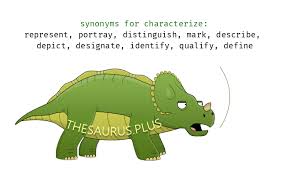
As an elementary school teacher, I have asked my students to choose an animal that has characteristics that might best match their personalities. I have also asked them to tell me their favourite comic book superhero. One autistic fellow refused to play this game of self identification unless he could choose a dinosaur that best represented him. This matchmaking with a safe non human character lead to some great lists of characteristics and of important values like courage, fairness, cooperation, kindness, honesty and determination.

Sometimes we recognize our character in another and rejoice in the knowing. I remember a conversation I had with a complete stranger that entered into this realm of soul connection. It struck both of us as profound and later he brought me a book called The Aquarian Conspiracy saying mystically, “You are one of us.” Much later I watched the film Avatar and relived this moment from my past when one of the animated characters said, “I see you.”

Sometimes I’ve wished that another person’s character would change so that I would find them more agreeable. With maturity I realized that I would have to change my ways or find a path of acceptance when it comes to individual differences. I still love stories where the central character sees the light and vows to behave in a more positive manner. I wish that this would happen with President Trump most days, but I’ve had to conclude that some characters are immutable.

The content of one’s character is an important matter in any historical age. Men and women of virtue, from all walks of life, have provided us examples of how to live productive and compassionate lives. Who hasn’t heard Martin Luther King Jr. speak these words on the significance of character. https://www.youtube.com/watch?v=Wxc6iqRC-n8

We look to influencers who can show us the way to our best selves. Hopefully each of us can then model an example of exemplary character that ripples ever outward.

Re: Work

Work is forever in a state of flux. In the past three hundred years we’ve gone from farming/market communities, through industrialization, to the technological revolution and now the gig economy with the challenges of AI on the horizon. In the past a boy might only follow in his father’s footsteps, career wise, or he might pursue a calling and enter a religious order. Girls were further restricted in occupational choice. For some a life’s work is one of service with little or no remuneration, other’s may pursue professions that provide financial rewards.

I viewed my work as a teacher as employment that enabled me to have job satisfaction, a wage that afforded me a comfortable living as well as time for my family. This workable arrangement allowed me what is now commonly referred to as Work/Life balance. I rarely thought of my work as a chore, more like a practice that I continually improved upon. I knew some colleagues and friends whom I would call workaholics. Any workplace can have those types who seem to be singularly focussed on pleasing the boss, getting it perfect, climbing the ladder, making money or retiring early. I was never wanting to sacrifice my home time in the name of professional ambition.

Life at home was not without its work component. My partner at the time revelled in being called a homemaker, a position without pay but one of considerable value. It was easy for me to contribute to the home-work since she had managed the job so well. Working from home means something different today, but my jobs back then were helping to raise three boys, being a home handyman, and chipping in on daily household chores. This may sound like Leave It To Beaver, https://www.youtube.com/watch?v=sgtiPOk83Ek . I would say all five of us had a very solid working relationship. As my lads got older, they found their way to contribute to the labour that is necessary within a family environment.

The COVID-19 pandemic is giving the world pause to rethink its cultures of work and play. I was amazed at my ignorance regarding a news bite from Northern Italy where people in a certain village were always without a regular paying job. The reporter referred to this arrangement as ‘informal work’. With the coronavirus lockdown they could no longer go about their town and scrounge for temporary tasks to provide cash, as was their custom. Would we all not feel safer as a society if governments could recognize the value of a guaranteed income? I feel lucky everyday for the pension my career has provided.

With my working life behind me I can play. I sometimes need a guide. My grandchildren wake each day knowing how to play naturally. They step from their beds and explore their world without inhibition. Their bodies move almost continuously. As they absorb their surroundings each touch and sniff brings them awareness and learning. Their young minds work intuitively at building relationships between their inner and outer environment. Work & Play in harmony.

Re: Best

Those of us who are competitive or ambitious want to be more than better; we want to be Best. The urge to ‘Be Best’ would get the attention of the current First Lady of the United States of America. Ms. Trump is determined that her program, despite the poor grammar, will be valuable for child development. Comedian Randy Rainbow suggests a different conclusion.

I’ve never had the honour of being the best man at a wedding. Somedays I feel better than others. I’ve been told I am a good neighbour. I believe in the presumption that the best is yet to come yet I also realize that Good is often good enough. When I’m not feeling my best it’s usually best for me to meditate or take a nap rather than transfer my mood to someone else. I try to be better everyday but I know I’ll never be perfect ‘cause that would make me Best and who am I to say I’m better than you anyway.

Grammatically speaking I see the value of superlative and comparative adjectives. They aid the writer who’s into description. Philosophically however, I resist thinking in these terms. I don’t like the feeling of dominance that Super brings to Superlative. And without a clear criteria for comparative points of view how can you have a satisfying conversation? For example is it the Best Poutine Ever because of the crispness of the fries, the squeak of the cheese curds or the savouriness of the gravy? Just what are we arguing about here!

Discussing the qualities of film is always a lively debate in my family, especially when it comes to the Oscar pick for Best Picture in any given year. Here’s the top pick from 1946: The Best Years of Our Lives. https://www.youtube.com/watch?v=1yc5PugV4mk . It’s not your average overacted late forties melodrama! When I revisit this film I’m stunned by these performances. Others may be stunned in another way by the slower story-telling pace of the film. Before an argument begins it’s probably best to say that choosing best of anything is subjective, at best.

Speaking of controversy, I had this jingle in my head as I shaved yesterday. “Gillette! The best a man can get.” The catchy tune came from this 1989 advertisement which seemed harmless for its time. https://www.youtube.com/watch?v=ThDBf14qPsc
Recently the same company got into hot water for attempting to send a message in this post #metoo age about how men could be better behaved.

The 45th President of the United States has been called many things. This sophomaniac continues to convince voters with his braggadocio attitude that he is the best choice for your vote in this election year. He has called himself the “Greatest president God ever created.” New red ball caps may need to be embroidered ‘God Knows Best’. My anxiety levels need lowering so I’m hoping that beastly Trump gets bested in November.

Re: Change

“Be the change you wish to see in the world.” is a quote attributed to Mahatma Gandhi. When I think of the word Change the most available quote that comes to my mind is one my mother used to say often; “A change is as good as a rest.” She was referring to getting yourself out of a routine. Being in a rut is not a helpful place to be when you are on the road of life. I believe my mom was right; choosing a different path can bring refreshment, even enlightenment.

Not all change is welcome. In these changing times brought on by COVD-19 we can feel that change to our very livelihood has been inflicted upon us. Change is easier to handle when you are the creator of it or even if you have a stake in it. When someone else brings change there is a tendency to grumble. In our community we have a Grumpy Taxpayers Association who regularly criticize any change that our elected municipal officials legislate. Specifically they are concerned about the cost of things. In that regard I can relate. I often find myself gazing at the loose change in my hand and wondering how quickly it loses its worth.

Like cities throughout time, our downtown has its share of panhandlers. One fellow in particular gained some notoriety by the manner of his shout to passersby. “Spare a little change.” was his plea. You could hear the long drawn out word ‘Cha-i-n-ge’ a block before nearing him and for blocks further along. He was a veritable institution on one corner and when he relocated it caused a buzz in the community until word got out that he was working a corner closer to his new home. Throughout his time collecting coin he saw an abundance of pennies and nickels, then dimes and quarters. Regardless of the amount his cadence was never changeable.

Our change has changed. Inflation is ever changing the value of change in everyone’s pockets and purses. Where I used to keep a jar for quarters, I now have a plastic tub for loonies and toonies. I haven’t changed how I process my change even though the worth of it has declined. I still feel a childlike thrill when I save enough change to roll into a special paper sleeve designed for its respective denomination. A cylinder of nickels will total two whole dollars, a roll of quarters will create the equivalent of ten bucks and, hold your breath, a single tube of toonies amounts to $50! I’m old enough to remember my excitement as I walked to my corner candy store with a roll of pennies quickly growing warm in the grip of my tight little fist. A large bag of jujubes, caramels, liquorice and jawbreakers would soon be mine.

Change in the 21st century happens faster than it takes for a soft caramel to melt in your mouth. As always, there will be things we can change and things out of our control. Peace will come from knowing the difference.

Re: Life

The virus COVID-19, like others of its kind, is not a living thing. It can’t respire. It can’t metabolize nor can it make other viruses. One of several key elements to life is being able to replicate. Since a virus has limited genetic material it requires a host to reproduce. Humans can be that host. Our cells take what is lifeless, replicating new specimens that can be transmitted to other living things through our mucus: A case of deadly biological complicity. Yuck!

In these days of pandemic we are searching for a lifeline. It’s frustrating to think that the best an average citizen can do is to stay home, thereby avoiding the infection and the consequences of spreading the contagion. Our lifestyles have drastically changed, even as we count ourselves lucky if we haven’t contracted the virus. Worldwide, medical professionals labour to bring life giving care to those who are stricken. We see the lifeless bodies of those mortals who have succumbed to the infection being taken from the chaos of underfunded, understaffed and underprepared hospital emergency spaces in increasing numbers and we wonder if there will be life after this Coronavirus. We wonder if life can ever be liveable again.

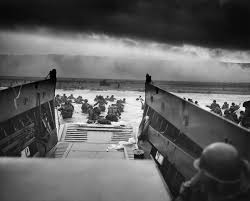
My parents used to subscribe to Life magazine. Pictorially and textually I learned much from leafing through those pages. As a teen I started collecting Time/Life books; thin well bound volumes on a multitude of subjects in history, science and nature. I used the books for research and for wonder. Like all who are youthful I believed that there were keys to bringing justice and harmony to the world. Just as the periodic table of chemical elements has order, I figured once humankind came up with a plan that worked for all then we would experience heaven on earth. I have always felt lucky that I haven’t had to personally experience the effects of war. In my lifetime I haven’t had to adapt to massive change; until now.

We say that we make or earn a living when we refer to going to work. It’s a financial context that doesn’t include other aspects of life. I prefer the rarely used word, Livelihood, to describe all of the things we do as we build our unique existence. In the presence of the economic shutdown that is one result of the pandemic, survival is paramount. After the crisis I hope our society takes a hard look at what matters most in life. We must eat. We must be housed. Our planet must be clean. We must have equity. We must know joy. We must feel peace and purpose. We’ve been taught that life is what you make it. It’s up to us to create a life worth living. https://www.youtube.com/watch?v=WBNChSa-rkA

Confronting death can make you hyper aware of life. Those who climb mountains often site that as a reason for the risks they take on the edge of things. Perhaps now, humans throughout the world will unite in a common definition of what constitutes a life well lived.