Re: Art

Re: Teeter-totter

Playgrounds are a big part of children’s lives. When my boys were small we lived in a house directly across from a small parkette. It had a teeter-totter, slide and sand area. As the boundaries for their play expanded from their own front yard, crossing the street, all by themselves, was a longed for objective. I have fond memories of setting up a camp chair on my lawn and witnessing this early bit of boyhood adventure, just across the divide of our quiet residential street. Curiously, my sons’ favourite activity was transporting handfuls of sand to the top of the slide, giggling as the grains slid down the slippery slope. Once I watched my eldest try to walk up and over the teeter-totter. He made it up to the centre point and then, all wobbly (and with my heart racing) he jumped to safer ground.

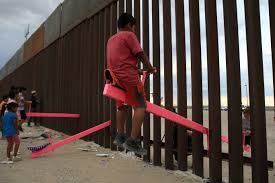
Rarely seen in playgrounds anymore, the seesaw or teeter-totter has always seemed a strange choice for a kids’ park. It’s a dangerous piece of equipment! It’s made of hard materials. A certain level of balance is required while sitting in the tiny seat and holding the pokey handlebars. It’s one piece of playground equipment that requires another person in order to have productive fun. The choice of partner may also be a challenge since size, agility and communication skills are important considerations. Trust is also a big factor as you must have confidence that your teeter buddy will know the right time to get off their end, slowly, preventing the one in the air from crashing to the ground.

Seesaw is derived from the French ci-ca, meaning this or that. I love the broader philosophical view here: either this or that, up or down, here or there, you or me. A teeter-totter has a fulcrum like a set of scales. In order for this equipment to work properly a degree of justice must prevail so that one person isn’t forever stranded in the air, awaiting a fateful decision. In practise, this machine is a type of lever (one of humankind’s first tools) and yet metaphorically a seesaw has the potential to pry you out of your comfort zone, enabling you to gain a different perspective. The ride can be a thrill as you may pretend to be part of a circus act of tumblers, jugglers and acrobats. Add danger at your pleasure, equivalent to your level of imagination.

Certainly cheaper and with fewer moving parts than a roller coaster, a teeter-totter is also a handy metaphor for mood. Your state of being may fluctuate: ‘I’m feeling down today.’ Or ‘Hey my prospects are looking up for a change.’ Or ‘I think I need more balance in my life.’ I have often seesawed my way through life. I’ve been grateful for the partners I’ve had, on the other end, lifting me up, then with a push getting me grounded again.

Recognizing the value others bring to my play has not always been easy for me. Achieving balance is a knack that takes practise.

Re: Spy

When is a spy different from a whistle blower? Or an investigative journalist for that matter. When we think of spies we think of deviousness, subterfuge, plotting and secrets to be discovered. There’s irony here: A spy is asked to uncover things whilst doing undercover work. A spy has to keep a secret in order to unearth one. The side that has the spy network is happy when results are obtained, the other side shows disgust that their privacy has been invaded. Spying rarely produces the win-win scenario much sought after in modern international politics.

The Cold War, begun in 1947 and not really over until the dissolution of the U.S.S.R., was originally about maintaining a balance of power between potentially warring nations. In order to achieve that, everyone had to be on an equal footing so espionage was an accepted practise. Some spies were imprisoned, if caught. Some disappeared. Many, like Sir Anthony Blunt, despite being considered a traitor by his countrymen, was not prosecuted due to the sensitivity of his proximity to the British Royal Family. https://www.youtube.com/watch?v=HFl7NdzOOZg&list=PLkmRedTjok3Sfpkq9AhhCXHr675gI9RJd&index=52

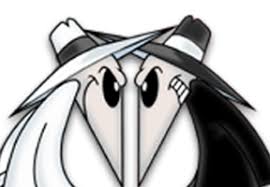
As a young fellow I loved reading the short graphic tales in MAD Magazine called Spy vs Spy. https://www.youtube.com/watch?v=onR7PD3Grc0. The cute characters, one white and one black, would basically chase after each other, laying traps, throwing cherry bombs while neither came out the clear winner. When I was older, my dad introduced me to Ian Fleming’s pulp fiction tales of James Bond. When the film franchise began I knew from the start I would be a life long fan. My mother relished being a sort of spy. She enjoyed ferreting out weaknesses in people and then holding the information, ‘over their heads’. She was once a personal assistant to a private investigator and went on stake-outs that my father frowned upon, until he was needed to pose as an ‘Englishman’; a role he played during a tense weekend in Hell’s Kitchen, a sketchy part of New York City.

We live in a time where security cameras are common. Privacy is hard to find, yet we expect transparency in government and business. Corporations might lose their new product’s edge if a design secret or release date becomes common knowledge. A brave few who work in industry, the military or in politics feel it is socially responsible to reveal insider information. Jeffrey Wigand may have singlehandedly changed the way North Americans thought of cigarettes. Journalists Woodward & Bernstein told Mark Felt’s Watergate story, which brought down a U.S. President. Daniel Ellsberg, Karen Silkwood, Juliann Assuage, Bradley(Chelsea)Manning, Edward Snowden are familiar names of people who have revealed truth to the public.

Whistleblowers, like spies, are frequently vilified yet they report they are acting according to their conscience. Even though the ‘top secrets’ exposed are shocking/dangerous/controversial, the informers feel they are acting in the public interest and fulfilling a personal directive that supersedes conventional authority. History may reveal the rightness of their tales, but at the very least we can be grateful for their courage.

Re: Privilege

COVID continues and I’m binge watching the television series The Crown. Talk about privilege eh? I feel lucky to have something to occupy my thoughts amidst the luxury of NOT having coronavirus. The portrayal of the British Royal Family shows characters who are the epitome of privilege. Setting aside their vast wealth for a moment (and I don’t do that lightly), I ranted privately on how someone could be given the right to rule simply because of the circumstance of their birth. The reign of Queen Elizabeth II parallels my time in history since she ascended to the throne the year I was born. My British parents were working class and yet still had an affection for the “goings-on” at Buckingham Palace. My mom thought that Edward VIII did the right thing by abdicating and “leaving all that nonsense behind.” As the episodes of The Crown unfolded I often shook my head in a socially egalitarian way, yet before I got too judgemental about the Windsors I couldn’t help but take stock of the ways I have been privileged.

Firstly, I’m born a white skinned male. Enough said? I’ve had the privilege of a solid education. I held a career with public status and enjoyed an income healthy enough to support a family of five. I can’t help but wonder how others may see what I’ve done with my privileges. I do believe with privilege comes responsibility yet I recognize I have been selfish at times with my talents, my resources and my energy. Someone once told me that I “present well.” I’m sometimes embarrassed by the privileges I have not earned, however it’s been a privilege to help maintain the society within which I have been able to thrive. I try not to abuse the gifts that have been bestowed on me. I sincerely feel that privilege never gives me licence to be rude or disrespectful.

Birthright does not always enter into the success of an individual’s life, hard work and talent can place you in a privileged, enviable position. It’s true, those who work hard deserve something special for their efforts. However I also judge the way the wealthy few exercise their privilege. When I think of today’s 0.1%: Jeff Bezos, Elon Musk, Bill Gates, Mark Zuckerberg, for example, it’s clear they represent the new royalty. Their individual wealth gives them privileges far beyond anyone currently entitled to a crown.

When dog walker Amy Cooper famously ranted in Central Park she abused her privilege. When Ted Yoho swore at Alexandria Ocasio-Cortez he assumed his privilege would protect him. Ms. Cortez later stood in Congress on a ‘point of personal privilege’, and gave a moving speech related to human rights.

Sometimes it is clear where the line between privilege and right is drawn. The United Nation Declaration of Human Rights includes 30 rights felt to be essential to human life. They are often disregarded, usurped or dismissed by those who claim privilege, however these rights are inclusive, irremovable and do not depend on where, how or to whom you were entrusted at birth.

Re: Chips

I’m always on the lookout for great fried potatoes. At least once a week my mom used to cook up a dangerous mess of chips in a stove top pot. She used lard which she kept in a container in the fridge. This fat was never thrown out to my knowledge; she clarified it regularly through a strainer, then cheesecloth. The hand cut potato slices were chilled in the fridge overnight then put in a wire basket which could be clipped to the side of the hot fatpot to drain. The chips were slippery with the oil and ever so tasty with salt, vinegar or ketchup.

When someone refers to fried potatoes as ‘fries’ I immediately think of the McDonald’s variety. However, they are not the ‘chips’ I remember from my childhood. Fast food fries are usually pasty, dry and unappetizing to me. They are probably a long way from the Belgian pommes de terre frites that WWI American soldiers were reported to love. I’ve ordered steak and frites in a fancy restaurant and was underwhelmed with that fried potato version. I’m particular about my chips.

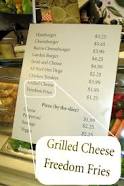
In 2003 there was an amusing international kerfuffle involving the term French fries. A politician in the United States named Bob Ney got himself in a knot over France not agreeing to the Iraq War and took exception to French fries being offered in his cafeteria so he had the item relabelled on the menu as ’Freedom fries’ to make a childish point. Mr. Ney is clearly an example of someone who might walk around with a chip on his shoulder. Here is Lera Boroditsky showing how language and this coined term was used to politicize the event. https://www.youtube.com/watch?v=YL8cZ6nmWPg .

What I love about the English language is the variety of ways I can use the same word. Wood chips don’t elicit a watery mouth (except perhaps if you are a beaver) yet those kind of chips conjure a smell of resin and the damp basement where my father would create carvings out of pine logs. I’d like to say I’m a chip off the old block but I don’t carve or make potato chips. I content myself with ordering the popular side dish when I’m checking out a dining spot. It’s hard to not think about chips, and get a craving, because the word is used in so many ways. Children of my generation laughed at the adventures of Chip&Dale. https://www.youtube.com/watch?v=wlmdWP0Y8e4 . Go to a casino and you need a supply of chips. Better keep a chipper attitude because your friends might accuse you of being too ‘chippy’. I try not to let what others think of me to get me down so I just let the chips fall where they may. I even had a childhood friend whose nickname was Chip.

The frequent use of the word chip, in many contexts, makes me hungry. Lately I’ve found the best chips from food trucks, but they’ll never match the batch from me mum’s fryer.

Re: Move

A fellow my age moved into our complex last weekend. He had a small rental moving van, his daughter and another young fellow were helping. I introduced myself and welcomed him to the neighbourhood. He puffed, “ I’m getting too old for this moving business. Next time I’ll pay someone.” Like me, he had concluded that he was coming to the end of his moving on, moving in, moving out options. I figure my next move will be my last. I’m no longer as young as Billy Joel when he recorded this ode to movement; then again neither is he.

Many of us can describe multiple moves within our lifetime; some comical, some hair-raising, some ill advised, some work related, some to upgraded digs and others for practical reasons only. We move because we can and we move when we have no choice. In our youth we can relish the feeling of being on the move; people to see, places to go. Couch surfing is a great descriptor of an adolescent’s freedom of movement. A backpack and a place to lay your head are all the requirements needed for adventure. When we get older our joints are less moveable, we’ve accumulated things and we’re settled into our routines. The movement that becomes most important is that of our bowels, preferably on a regular basis.

I’m emotionally moved more frequently these days. A song might move me to tears. A conversation might move me to action. I can be moved by a single line in a film. I find moving pictures, or movies, to be aptly named. Who doesn’t laugh at the movements of Charlie Chaplin, the physical humour of Dick Van Dyke or Melissa McCarthy. I found Earnest Hemingway’s A Moveable Feast yawn inducing yet his poignantly perfect The Old Man and the Sea continues to feed my emotions and my thoughts.

“Move it!” would be something my mom would shout when she was exasperated with my sister and me as we lollygagged before a trip. Getting in the car usually meant a long uncomfortable drive in hot muggy weather to visit someone we didn’t like. We had several household moves during my childhood, always to find a dwelling my folks could afford to rent. My favourite move was to a falling apart farmhouse which had a chicken coop where my job was to collect the eggs every morning. Later we moved up, status-wise, to actually owning a small semidetached house in suburbia, which unfortunately took me away from all my high school friends. I’ve only cried harder twice more in my life. In my case it’s probably not coincidental that emotion contains the word motion, i.e. movement.

My latest move came after retirement, to a land of milder climate. I’m no longer moved by the sight of gently falling snow, nor angered by the need to shovel the driveway. I’ve removed all reference to winter. This home finds me moved by the plaintive call of the gull and the beauty of the seashore.

Re: Phone

Change is exasperating. It’s never just one thing that changes. Dominoes will fall! Lately my three year old phone failed to do what was expected. Being a smartphone made it a smart aleck. The problem seemed to be that it refused to communicate with other digital devices in my home. I tried password changes, account changes and rebooting (an old fashioned term?) But it was all for naught. By using the word naught I guess I’ve firmly placed myself in the pre-computer era. And that, despite my best efforts to remain tech savvy, is the problem with my general attitude concerning The Phone. I rant. Yet really I stand bewitched by this technology.

My dad would send me off on adventures when I was barely in my double digits with these instructions: Do you have coins in your pocket? Have you got your handkerchief? Call home if you have trouble. Calling home in those days meant finding a phone booth, which I learned how to use quite early in my life. Any call from a booth could connect me with the home phone, and if I was out and about someone was always home. Safety assured.

Safety is the number one reason parents in the tech era buy phone plans for their children. Safety is also the top reason adults cite for switching from home phones to cell phones. The phone was a lifeline for me in the late fifties and is truly a must-have for Generation Alpha. Needing a phone for emergency use is one thing, but now it is clear phones are so much more. The term smart phone is apt; mini computers they are indeed. With storage capacity, links to other digital devices, connectivity with more than just your mom is assured. The camera capability of a smart phone has changed communication; we can send a text of our meal, or hold police to account for their actions. We can start a Movement.

I’m in awe over how it has changed our culture, and I’m also intimidated. I’m trying. I’ve come to terms with the need to regularly update my device. I still talk English on my smartphone even though it has gone through several iterations of operating systems. My smartphone has regular conversations with my other digital devices so that things can continue to function. Somehow that doesn’t make me feel more secure. For old folks, being hacked has taken the place of falling down as the number one anxiety. Forgetting a password is tantamount to losing our wallets.

And yet we soldier on. I was one of the first on my block to buy a computer. I’ve had an early Star Trek phaser-like flip phone. I no longer have a land line. I know how to Facetime, Skype, Zoom and Tweet. I’ve just installed a new device that makes my television smarter so that I can stream new entertainment catalogues. My old phone will have to be replaced with an updated version. Like a little lost ET, I still need the comfort of knowing I’m able to call home. https://www.youtube.com/watch?v=6xZif3WmG7I

Re: Side

An argument I had with someone long ago involved the use of this question, delivered at maximum volume, “Whose side are you on anyway?” It was really a one sided yelling match with someone who felt unsupported. I didn’t know how to answer the question. I still don’t because choosing sides makes me uncomfortable. Waging war is all about picking sides. Wayne Dyer once said, “When you live on a round planet, there’s no choosing sides.”

As a young boy I enjoyed the mythic stories of King Arthur and his Round Table. By definition the table lacked sides; no left, no right, no head, no foot. Political equality in theory and practise. Every knight’s opinion counted and there was no need to forge allegiances. There I go being naive again. Every kid learns early how to choose a member for his/her side or team and often it has less to do with talent and more about hard to define things like loyalty, friendship, or expectations. The business of Sides usually is about favours earned or collected: You scratch my back, I’ll scratch yours.

And that’s when things can go sideways since one side often perceives that they are not getting an equivalency. Strong emotion then comes into play as the one on the other side feels let down, “I thought you had my back!” There may be good reason for someone to be construed as a turncoat. Sometimes a person’s principles dictate a different path from their usual comrades. Friendships aside, there are times when it’s important to diverge due to conscience.

Imagine being a staunch Trump supporter because you’ve always been a Republican in the United States. Perhaps your view of things from his side is now starting to unravel. Perhaps The Donald is making you question your loyalty to the Party of your ancestors. You may be virtually beside yourself with the dilemma of how to vote this November. Your country’s core values are being questioned at an international level. This particular decision to choose sides is way more crucial than what side of the bed you might prefer.

Heads or tails. The coin is tossed in the air. It has two sides and you are encouraged to choose. Yet often in life things can seem like two sides of the same coin. Environmental concerns and the use of fossil fuels are linked. In Canada we feel that Peace, Order and Good Government are not mutually exclusive.

A celebrity’s fan base can have members that vary from mild appreciation to rabid exclusivity. A Fan is often called on to take sides based on their celebrity’s announcements or positions on things unrelated to their particular talent. A celebrity may ‘go too far’ and alienate previous followers. Taking sides is serious business. Taking sides can sometimes involve an oath, of love or of fealty. Promises made aren’t necessarily kept for all time. Circumstances change, new data disturbs the parameters from which the original decision was made. An awakening!

Siding with truth, is something with which I can find fidelity.

Re: Preserve

Preserve and Conserve are words often used interchangeably, yet each will evoke a different feeling within the spoken or written context. As a result, their subtle separate meanings can feel rather jammy in your head. When I’m writing, sometimes I want the exact word that will deliver my point, other times it’s just fun to mess with all available synonyms to create a mood rather than a message.

My former wife was into preservation, of fruit, of vegetables, of well used bits of fabric which she turned into kid’s clothing and patchwork blankets. She loved the process of conservation. She maintained detailed genealogical records and worked hard to sustain the values she found in her local church. She was proud of her choice to be a modern example of a Homemaker. I built a cold room space that was stocked with the many varieties of her jams, jellies, pickles. I made my own wine from berries picked from our yard, preserving their goodness in a different way. We both worked at preserving the culture of family mealtime.

Human communities value conservation efforts so we set up wildlife preserves. A conservative thinker will often choose the preservation of jobs over the conservation of natural resources. Often we work hard to maintain an institution because we want to preserve a way of life that has become our very identity as a society. Here is Old Fezziwig in a scene from A Christmas Carol, asserting his believe in the ways of old. https://www.youtube.com/watch?v=Qy_G0wvlJXU

Planting a tree is an act of preservation and conservation. We are sequestering carbon dioxide, creating habitat, and providing shade for future generations. We can’t know what the future holds but we know trees are an important part of the picture. Doing art is conservational and the results may be found in a conservatory. Taking aspects of our culture and portraying it in any artistic form is a statement about our present reality and a message for our future unknown selves.

If preserving history means never updating our understanding of its context, then I’m with the people who are currently tearing down the statues of former slave owners. https://www.youtube.com/watch?v=JVELtGOaqxY. I’m into sculptures as an art form but not to iconify individuals. Death belongs in the past and must be documented within the past: Not as a roadmap for the future, but as a story book of how things were.

As a society we sometimes hold on too tightly to outdated things. We give too much credence to conserving tradition when considering how we want our future to look. I believe there is no truth to the phrase; “Those who forget the past are doomed to repeat it.” We humans just keep being human regardless of our memory of history. Unfortunately, our nature drives our actions more than our intellect.

Preserves come with an expiry date. If used beyond that point we risk our health. Our current climate crisis suggests we have failed to conserve our valuable resources. Our pantry is being depleted of the things we need and poisoned for lack of stewardship. We are losing sight of the garden.

Re: Distraction

Covid Pandemic, Climate Crisis, Trumpian America, Rainy Day Mondays; are some of the persistent bad news realities of our current world. Sometimes it seems like staying in bed all day is the right choice. Logically we can’t escape from these inconvenient truths so we thrash about trying to find a distraction. Even for a moment the respite a distraction provides can seem like a holiday from inevitable doom. There is good news to find these days, but you have to be watchful. It’s also incumbent on us all not to be like Rachel Dratch’s character, Debbie Downer. We all know someone like her can be as negatively infectious as any virus. https://www.youtube.com/watch?v=qse8erP8zEk

A friend once told me she devoted one day a week as a ‘techno-free’ 24 hours. She eschewed devices that brought her news, while choosing to distract herself by walking around town, meandering in parks, or hanging out at a coffee shop watching others. She also loved to read, my favourite distraction, and would often bring me wonderful suggestions that helped me broaden my world view. I admire these approaches to shutting out the busy world. It’s way healthier than was my sister’s distraction of choice: alcohol. There really is nothing that can make problems completely disappear, unless you are a magician.

A magician is skilled at the art of distracting the audience. This talent has been called The Art of Misdirection: While you are busy looking here, the trickster will do something over there. This brings distraction to an art form and I find it so very amusing. As a child I marvelled at the escapes of Harry Houdini. I loved watching the sleight of hand of Canadian Doug Henning and the theatrics of American illusionist David Copperfield. Recently I have been turned on to the unbelievable close-up work of the British magician called Dynamo (Steven Frayne) and stunned by master pickpocket Apollo Robbins, who is able to distract the audience so well one begins to doubt one’s own common sense. https://www.youtube.com/watch?v=GZGY0wPAnus

Along with word pursuits, watching others is a favourite distraction for me; bless those entertainers. Some people are distracted by the joys of cooking and eating, not me. I can lose myself in a challenging crossword and have been known to stare out to sea for great lengths of time. Thinking really is my favourite distraction. I’m contented getting lost in my thoughts. It’s a form of meditation; I just have to be aware that as I ponder, I dwell longer on positives. For example; our newspaper recently reported that in one month 170 people had died in our province from drug overdose while in that same month, in that same province, 415 births had been recorded. How does one deal with those two numbers?

People have been distracted by music throughout history. Music can bring a moment of peace, while directing our attention to a more promising land.
Curtis Mayfield led us well. https://www.youtube.com/watch?v=VOXmaSCt4ZE

Re: Death

I’ve been thinking about death lately. Daily COVID19 updates will do that to a person. It isn’t the fear of death that has gotten to me, but the inevitability of it. Recently I dreamt of my childhood apartment, home to four: I walked about the small rooms.  Bedding was in a tumble, wiring was exposed. I called out for my parents and sister. I woke with a start. 

Today, I am the sole survivor. When will the grim reaper come for me, like in Ingmar Bergman’s classic film, The Seventh Seal. https://www.youtube.com/watch?v=NtkFei4wRjE

It’s natural to be uncomfortable with the subject of death. During my years as an elementary school counsellor I listened carefully to many children who had questions about life and death. I participated in death and dying workshops at Kings College at Western University in London, Ontario. My experience led me to offer sessions on grief with members of my United Church congregation. During an ‘Art Healing’ afternoon, one young fellow captured a positive note by making a button with his slogan, ‘Death is Interesting’.

Film producers deal with death in a variety of ways. Some confront it with a collage of blood spattered bodies, bullets flying and body count so disproportionately high that viewers soon become desensitized to dead people. Death can be treated comedically, like in this bizarre feature starring Hollywood’s leading lady of drama, Meryl Streep. 

Speaking of zombies! The undead hold a special place in the imagination of many people. I don’t share that fascination but I can appreciate the walking dead as an undying metaphor for racial discrimination. I admit to a curiosity for death whenever it has appeared in my life. I’ve witnessed several people die. I’ve only had a death wish once and luckily was clutched from the jaws of death. I’ve seen five productions of the play, Death of a Salesman and watched Dead Poet’s Society at least six times. Once, I took a death defying leap off a waterfall, diving into a small natural pool many metres below. I’ve also tempted an early demise by eating a serving of Death by Chocolate. I’ve had my share of la petite mort, a French term for orgasm, relating to the notion that climax provides a loss of consciousness equivalent to a small death.

The quote, “Nothing is certain except death and taxes.” is attributed to Ben Franklin. Death is clearly a part of life. I appreciate cultures that integrate that reality into their social observations.The Aztecs had Death Day festivals that have been continued by Mexicans and other cultures as The Day of the Dead or Día de Muertos. The belief that the departed are never really far from us is comforting. Two wonderful animated feature films that explore this healthy view of death are; The Book of Life https://www.youtube.com/watch?v=mCSljmwNs_U 

Coco https://www.youtube.com/watch?v=d_5DD9G89rI .

Death need not be something to fear.