Re: Hero

In a recent New York Times crossword I found the clue ‘Rescuer’ and it had me stumped for most of the puzzle. A four letter answer was required and it started with the letter H. Finally solving the other words forced me to see it was HERO. I spent the rest of that afternoon thinking about what a hero is to me.

Words are fascinating in that they require a definition. Discovering the meaning of a word can be tricky depending on context within a sentence, the tone of voice of the speaker, grammatical origins and even body language can be an important criterion for understanding. My first thought regarding the word Hero was not concerning rescuing, although I see it now. Perhaps it is because almost everyone these days is referred to as a hero. The term is so ubiquitous that it reminds me of the trend to present a Participation Award to anyone who shows up for an event.

If I was rescued from certain death I might refer to my saviour as a hero whether they be male or female (the feminized word heroine is simply awful). From childhood onward, people who have done heroic deeds have enthralled me. Boys of my age would have read tales of knights rescuing damsels, of sheriffs bringing justice to the American west, of explorers sailing the seven seas, or of ball players making baseball diamonds sparkle with their talent. As I got older my definition of an act of heroism became more philosophical and broader in scope to include those who challenged the status quo. These ‘idea heroes’ may not have been active in a physical sense, but their abstract thinking made them stand apart from the crowd.

Hero is an overused word and doesn’t belong with every expression of gratitude. Confusing fame or institutional power with heroism gets me in a bit of an anxious knot. Comic book heroes won’t save us. Some modern songs suggest we crave, even worship, the idea of a personal hero. https://www.youtube.com/watch?v=bWcASV2sey0

Media personalities are often over quoted merely due to their celebrity. I wonder why the military profession is automatically tagged as being heroic. I’m not even sure bravery is a prerequisite for being a hero; determination certainly, and a sense of selflessness but most rescuers report they didn’t feel courageous at the time of the call for help.

I believe extraordinary constructive behaviour is heroic. Citizens who make an unselfish contribution to their communities are heroic. I would label some Olympic level athletes heroes just as I would someone who has devoted their life to an artistic passion. Folks might begin their personal list of heroes with Martin Luther King Jr., Mahatma Gandhi, Sylvia Pankhurst, or Linus Pauling. Pick a professional discipline, set some criteria, define parameters and let the list making begin! The debate might get heated determining which of those named are either Noteworthy, Great, or Truly Heroic. Be prepared to be convinced when someone asserts, “My dad is my hero.”
Re: Bank

Where I spent my formative years there was a small river that wound its way to Lake Ontario. Its banks were muddy, with tangled roots grasping for water. I hid plastic toy soldiers amongst these fibrous tendrils, lit small red firecrackers to imitate war. It felt safe here, with my back against the wall of cool earth, watching the creek water smoothly trickle past my feet.

I have Scottish ancestry so I feel a yearning kinship while humming the lilt from ’On the Bonnie, Banks of Loch Lomond’. https://www.youtube.com/watch?v=gb8AGuD2uOI

One of my favourite television shows from that time was the hypnotic black and white classic, ’Tales of the River Bank’. The creators seemed to imagine exactly what was on my mind as I used small toys to create a miniature world. https://www.youtube.com/watch?v=-VTn6VlUXNA

I took to television with an eye for more than entertainment, like many in a previous generation had immersed themselves in books. While I did find comfort and escape in reading my mind quickly awoke to world issues. I chose stories that spoke of adventuring to different lands on the open sea. I could bank on authors like Farley Mowat to set a pleasing compass course by spinning tales of non or near fiction. His stories of man and nature contrived to inspire and are so relevant to today’s angst over the decline of Earth’s natural resources. In early adulthood, I wept through parts of ‘A Whale for a Killing’ and later gasped at the abundance that once was found off The Grand Banks off Newfoundland in ‘Sea of Slaughter’. In high school my Student Aptitude Test results indicated I was destined to be either a Banker or a Lighthouse Keeper. Hardly occupations for my adventurous spirit! When my mom found out I clearly remember her show of disappointment while my father made a joke of it by saying, “I wouldn’t bank on it son.”

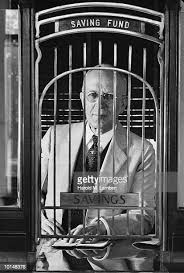
In the northern Ontario town where I spent my career my neighbourhood bank had a history dating back to Gold Rush days. When I first strode in to open an account I was awed by how much it reminded me of the banks depicted in the film Butch Cassidy and the Sundance Kid: Lots of wood, brass and a mammoth safe standing sentinel in a corner. It’s hard to believe that this was in the late nineteen seventies! Two tellers sat behind antique looking arched frames with vertical bars. There was a small safety deposit box room at the very back but the only other room was one accessed by a heavy oak door on which was carved the manager’s name.

I enjoyed having my bank book stamped and updated while chatting with the tellers. When a new bank branch of chrome and glass was built into a modern mall nearby, some new fangled ATMs were installed. My sons taught me how to use them. It took time for me to feel safe along the walls of this bank.

Re: Sense

With the luck of my second marriage, I acquired a ‘Special Mom’. She has a quiet, accepting presence that I appreciate whenever I get the chance to be with her. I watch her and discover nuggets of wisdom. She has lived long enough to share many treasures, among them, common sense.

Many might agree with the notion regarding ‘common sense’ as being anything but common. It’s a sense that seems to grow as the traditional senses diminish. Caution is part of this sense as well as patience. I feel for those who have lost one or more of the tradition five: Taste, Sight, Sound, Touch, Smell. Losing one of these gems will necessitate adjustments I don’t know if I’m brave enough to face. But age does create new challenges to overcome.

I remember a childhood talking game that proffered which sense you could manage without. In order to help us decide, we might playact with a blindfold, stuff Kleenex up our noses, plug up our ears, or wear thick gloves. We were young scientists and needed props to facilitate our silly investigation. I felt that being blind would create the greatest amount of trauma. I’m mildly claustrophobic and being without vision added to that closed in feeling. In fact I remember feeling fear the first time I saw someone walking on the street with a cane.

In that way I think Emotion is a sense. It comes from the heart. When we speak of feeling something, it is beyond our physical senses. I feel that Emotion is the sixth sense that is so often stated in fiction. If it is suggested you are using your sixth sense you are likely tapped into something you can’t quite explain yet you know there is truth to what you are experiencing. You are engaging with intuition, such a misunderstood sense. Like an ‘Empath’ in some space SciFi story you are sensing something ‘out beyond’ even though others can’t detect it with their lesser senses. Spiderman would know what I’m talking about.

We link our senses to our emotions with our language choices. We might have a ‘Bad taste in our mouth’ after an uncomfortable event. We could be ‘blinded’ by love. Perhaps we feel that we are ‘out of touch’ with a current reality. Someone’s idea may illicit, “That smells fishy to me.” At the end of a tiring experience we can feel we have ‘carried the weight of the world’ on our shoulders. Western medicine is slowly becoming aware of what Eastern practitioners have know all along: our sensual experience can focus attention where it is needed.

We know we are alive when our senses are engaged. Depression is often characterized as a state where senses were numbed. Depression is the closest we get to death while still breathing. I think the experience of the senses is the whole reason for living.

My mother-in-law has poor vision and weak hearing yet I haven’t sensed that her reality has got her down. That’s a comforting thing for me to witness.

Re: Lifetime

I went to a funeral gathering to honour a champion of our community. It was my first outing involving a collective in a long time due to Covid19 restrictions. The crowd spilled out from the community hall into the adjacent garden where extra chairs and a PA system had been set up so the speakers could be easily heard. It was an event of a lifetime.

The deceased was a lady who had become one of my first friends since retirement. My wife and I would often see her taking an active role in our city. She would always smile as she told her latest news and thoughts. Over my lifetime I have met few who have shown such grace and citizenship. She led by action and demonstrated how an individual can make a difference.

My young niece wants some tips regarding retirement plans. She is focussed on keeping her working lifetime as short as possible. Unlike many in my generation who have spent a lifetime waiting to finally do those dreamed of things, this hard working woman wants to build that future now.

Most of us give our labour with a hope that we can emerge in a better place, with a goal accomplished. Watching athletes compete at the Olympic Games this summer I’m reminded that sometimes the best laid plans sometimes must be deferred. These games were postponed for a year which disturbed the competitors’ schedules, likely causing angst over lifetime achievement plans. When earlier Olympics were boycotted by some countries I remember feeling empathy for those crushed by the reality of years spent training to get in peak form only to be thwarted by a government’s decree. Some may have lost lifesavings in the endeavour. I’m happy to see some of my tax dollars being used as a lifeline to support these determined individuals.

Somethings can be described as lifetime events such as the birth of a child, a death, a career achievement, a sporting medal or an election victory. Imagine the feeling you must have if you are credited with being someone’s lifesaver. We can claim responsibility for some singular lifetime moments yet not all momentous occasions are entirely in our hands. Recently a town close to me had a record breaking heat wave. It was reported as a ‘Once in a Lifetime’ weather event. As a kid these phenomenon might have been called a ‘freak of nature’. Now, as a people, we are realizing that many of these weather anomalies are very much of our own making.

An ad on television added to my train of thought. “Buy a lottery ticket and all your dreams may come true.” boasted the promoter. My niece wouldn’t rely on that advice. My deceased friend saw value in human currency to find a lifetime full of rewards. Luck or misfortune can sometimes sit beside you at life’s card table. Sometimes you’d be wise to walk away to play a different game. In the long game of a lifetime, a dream come true is a yearning that has been answered.

Re: Itch

What is an itch and why do we have it? I could google my lead question but it isn’t really a question and I rarely do any research other than a quick Siri type throw away inquiry because I have to satisfy an itch of the curiosity sort. Suffice to say that I’ve been itching to write about itches because they are among the few basic things that humans have in common with other animals.

Let’s agree that the origins of itching are elusive. I suspect a link to the Missing Link can be made whereby living together in caves created an environment for pests. Once bitten or bored into, Neanderthals would scratch to remove the parasite, otherwise they might fall prey to infection, disease, even death. Maybe these ancient humans didn’t die out from war with Homo Sapiens but because they couldn’t invent an efficient scratching protocol. This must be the source of our ancestral behavioural DNA as though some distant memory compels us to attend to our itches: That’s my theory anyway so I’ll pick away at it for now.

If you refuse to acknowledge an itch I don’t think it ever goes away. Itchiness can be a symptom of physical disease, yet psychologically an itch is an urge: To find out. To start a fight. To get going. To get started. Or, to leave your spouse, as in The Seven Year Itch.

https://www.youtube.com/watch?v=fJgC549mpRk

An Itch can be a form of curiosity and while you are scratching you just might come up with an amazing idea. Kids love to scratch. As with passing gas, it is a continuous source of amusement. Surely the title of The Itchy & Scratchy Show from The Simpsons was inspired by this fascination with moving fingernails across our skin. One of my children’s favourite camping songs was ‘Flea, Fly, Mosquito’ nicely rendered with all its silliness in this youtube video by Arlo & Alro’s dad of Tiny Mule Songs.

https://www.youtube.com/watch?v=BC6Ey_QyGQw

Dogs and cats have very satisfying lives, I can imagine, because they are always licking, scratching or rooting around looking to please themselves. No one tells them to go moisturize! I can relate when I watch films of chimpanzees, grooming each other with scratches and nibbles. It looks naturally healthy to be itchy from time to time. At the Imax a few months ago I watched as scientists recorded, ‘for the first time in the wild’, a grizzly bear stopping to satisfy an itch in the middle of its back by rubbing against a spruce tree. I’m no different. I love a good scratch. I’m quite dependent on my wife for getting at those hard to reach places. I have gone all consumer-ish and invested in some ‘money back guaranteed’ quality backscratchers ‘as seen on TV’. I’ve been told that attending to an itch (especially in public) is the epitome of bad manners. Yet we can feel collectively encouraged when someone says, “You scratch my back I’ll scratch yours.”

Re: Open

Like many folks, the Covid19 situation has often made me feel trapped. I have felt the need to close up rather than be open to the world. With my second dose of vaccine I’ll let myself be open for the excitement of adventuring, open to possibilities, open to the future again.

I like thinking about the future. Being open-minded can mean you don’t fear what may come. I eavesdropped on a conversation between two seemingly opposite souls on the beach the other day. One was opening up about fears of conspiracy regarding vaccine effectiveness while the other was open to the suggestion yet reluctant to conclude the malevolent intent espoused by her friend. While I’m looking forward to opening up a conversation with a complete stranger I suspect I won’t have much tolerance for the whiners or hate promoters found in any crowd.

Choosing to become a parent is one of the most openly futuristic things you can do. You never know what you sign up for as a parent. That amazing moment that comes after the announcement, “I’m pregnant.” is all about the future. I have only imagined what a woman must wonder as she opens herself to another human literally occupying her space. Pregnancy is a time when possibilities and probabilities merge in a confusing blend of ifs. Love, hope and patience are among traits most needed before the grand opening of the birth of a child.

Shirley Bassey captures what I’m trying to say in this version of ‘What I Did for Love’.

https://www.youtube.com/watch?v=eml_XI7C69s

In adolescence I enjoyed books that opened my mind to ideas. Classic books about an imaginary future (that phrase seems like an oxymoron) inspired me to wonder. It didn’t matter if they were dystopian or utopian in their content, I opened the pages to find a possible world. I’ve added titles to my library as I’ve gotten older: Future Shock, 1984, Fahrenheit 451, Brave New World, Oryx and Crake, No Logo.  Fiction or Non, even pseudo history propelled me into thoughts of what might be. For example, Chariots of the Gods once made my head swirl with imaginings of an alternative world.

When I owned my own little bit of suburban landscape my favourite thing to do in a gardening way was plant a tree or two. As I tamped down the ground around the roots of my sapling I opened my heart to the future. Logically I knew I wouldn’t be around to see this maple or that ash make it to full maturity, so I was literally giving a gift to those who might come after me.

Eager politicians and business folk talk of a great Reopening from the restrictions imposed by the pandemic. Many are discussing what a post covid19 world might look like. I hope we can point towards tomorrow with a determination to do some things differently. The future must always be open for discussion. I’ll kiss today goodbye hoping for an open hearted tomorrow.

Re: Treasure

I think of the word Treasure in an emotional fashion like Adventure. I can imagine going on a voyage and discovering, at the end of my quest, a treasure most spectacular: That’s the little boy inside me, treasuring a moment of imagination. I want to believe anything is possible. And treats are like treasure. Like pirate’s booty, often buried for later.

Financially speaking, my parents were lower class. When holidays or birthdays came around there was always a feeling of stress in the house. Once my folks actually told us not to expect anything under the tree that Christmas. I learned to treasure what I had. Sometimes our parents surprised us with treats, gifted just because they had extra money that week. I remember treasuring a chemistry set presented this way, right out of the blue, like magic. Much later I remember a trip to Canadian Tire with my dad. I was looking for a single drill bit for a project I was working on. He bought me a deluxe set which I still treasure as much as any legacy he may have left.

I follow a fellow on Twitter who has made it his mission to reduce litter in his neighbourhood. He posts photos of the haul from the walk around his block. On one excursion he picked up a plastic lid that may be one of the first Tupperware toppers. Someone’s garbage is another man’s treasure is a phrase that comes to mind. He finds value in his personal project and the community sometimes joins him in this unselfish voluntary labour. My Nanna would have called  this good citizen, David Boudinot, a treasure.

Some people rise to the status of ‘National Treasure’: Sort of like a popularity contest yet hopefully due to merit. Cirque du Soleil once had that label in Canada. Other groups and people of note have been recognized as being treasured by their fellow citizens. Not to be confused with a National Treasury, which is a place where gold used to be stored as a country’s monetary standard. The success of a country was often measured by wealth of this nature. I often wonder if some countries with fewer ‘material things’ feel impoverished. Or do they have another measure of treasures that would teach me something I don’t know about value.

As a retired person with a successful career behind me, I am treasuring the fruits of my labour. Financially I’ve been luckier than my parents. My eldest son and I got into a deep dialogue around the topic of success and how it is measured. I still treasure the moments I had with him as father to son and now I place great value on our adult friendship. His generation has not had the easiest road to career style employment as my generation. In my eyes he has succeeded, regardless, in finding treasures along the way.

When I downsized I gave away many things I once thought were treasures. Now I look to time as a treasured gift to spend freely.

Re: I

I is a word and a single letter that carries a lot of punch. I is declarative: I was! I am! I will be! Translated to Latin: Ego eram, ego sum, I erit. Whenever bullying teachers asked rhetorically, “Just who do you think you are?” I always wanted, but lacked the courage, to respond with a preteen snarl, “Me, myself and I!”

There is a certain trinity to who we are. Christians are taught that Jesus was the father, son and holy ghost all rolled into one being. Sigmund Freud contended that all individuals are psychologically composed of an Id, an Ego and a Superego. I especially like the last term because it sounds and looks like a comic book hero. When I think of my responses to people and events I often consider whether it’s my inner child, my parent voice or my authentic adult self that is creating my thoughts.

In the context of the power of the word I, its homonyms are cool to think about too. Aye is something you shout with positivity when you are casting an oral vote or voicing agreement with your pirate captain.  Eye is the centre of things, as in a storm, calming, focussed. An eye is a body’s tool to gather information. William Shakespeare wrote that the eye is the window to the soul.

A single letter as a word with meaning is startling to ESL students. Only one other letter in our 26 word alphabet is a word unto itself. The letter A is what I used to call a helper when I taught early readers. Officially referred to as an indefinite article, the word A is important when distinguishing the difference between say, A baby and THE baby. Watching an episode of the British television series Call The Midwife, I was amused to hear the nurses refer to the newborns with the single word ‘Baby’. What a lovely declaration to start a wee one’s life!

During classes that I took to prepare myself for working as a Guidance Counsellor, I learned a lot about using the word I and I encouraged the students I worked with to use it when they started a sentence: ‘I don’t like what Johnny’s doing at recess.” “I feel bad when Jenny says that to me.” During these dialogues it became chaotic if most of the sentences began with the word You: “Ah, you said!” “You took my things!”

In previous generations talking about yourself was discouraged, even frowned upon. It was thought that if you proclaimed that you were good at something then your head might swell. Whenever my mom thought I was getting too big for my britches she used the Biblical quote, ‘Pride goeth before destruction and a haughty spirit before a fall.’  She didn’t think a person could be an I, without being selfish.

Sir Paul McCartney, here in an interview with Stephen Colbert, speaks well about the reality of his fame while being aware of his kid self and the lazy adult persona, Paul. Let it be.

https://www.youtube.com/watch?v=vdGlGwlgxTk

Re: MAGA

Make America Great Again. As acronyms go, this one will certainly go down in history. I imagine the famous Pearl Harbour speech by FDR, paraphrased in my head; “This policy slogan will live in infamy!” The directive MAGA, in reality, may also win a prize for best example of irony as the USA’s reputation as a great compassionate country is in tatters across the globe and its people have never been more divided in purpose.

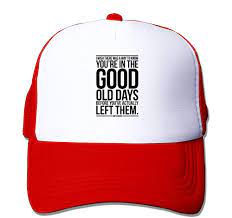
The acronym will always be associated with that single term US President, Donald J. Trump. MAGA was borrowed from his predecessor Ronald Reagan whose phrase was less demanding and more invitational in tone, “Let’s MAGA!” Both of these jingoisms are representations of the idea that the ‘good old days’ were better than what we have now and ‘by golly by gum we’re gunna make them happen agin, dagnabbit!’ In fact, the thought went that if you were not in favour of getting back to the way we were, then you were un-American.

Trouble is the present day flows by like that River Zen, where you can’t possibly sample the same water once it has passed you by. As that theory continues; You aren’t even the same person! But try telling that to someone who thinks everything is turning out all wrong. At this point I’m wondering where all the visionaries have gone. Maybe I’m not facing in the right direction. I need a hat!

Campaign slogans aside, the wearing of baseball caps can be an identifier; of a favourite team, a philosophy of life or just a cheeky observance. I don’t have a head for hats but I would wear a cap with YOLO on it if I was invited to a Wear a Cap party. Since I don’t believe in an afterlife it’s important that I observe a ‘you only live once’ philosophy. I don’t have FOMO because I am one of the lucky ones while the majority of the world’s people are, in fact, missing out on a lot of basic things.

In our family, my sister and I were expected to act in a certain way every December 25th. It was a Make Christmas Great Again effort so that our mom could ‘get that feeling’. The stress was intense. Every detail had to be acted out. I have mixed emotions when I watch the film Christmas Vacation because of the prescribed nature of the holiday. It scarred us as kids. I believe it was a factor in my sister’s untimely death.

Personal memory plays a big part in our belief that life was better before: Before cars, before computers, before contraception, before electricity, before appliances, before feminism, before guns, before stand-up comedy, before plastic, before welfare cheques, before oil. We filter out what interferes with our conception of the facts. Sometimes the filter is so fine only a few things stay relevant and our point of reference gets permanently clogged.

Psychologists may do well to advise us to get a filter change every two years or 10,000 thoughts.

Re: Private

When I first started writing this blog my only followers were my friends and family. I remember my niece asking; “How can you write about such personal things?” I told her that I didn’t think I was giving away any secrets. “But what about your privacy!” She countered. Well, I told her that there are some things I consider private and I guess it matters only to me what I might consider to be a secret. I honour the people in my life by never telling their private story, only mine. Their secret is safe with me.

Most cultures have body boundaries. Privacy comes with a perimeter. When there is little room for privacy, we may be cautioned not to look, out of respect. Children are taught early what parts of their body require coverage in public. Modesty is often determined by these early codes of conduct. An uncovered window is a privation for some and a source of liberation for others. In this way privacy suggests a space that surrounds us but it can also be within us; as in the privacy of our own thoughts, where no one may enter.

Comedians make a joke of this sort of conundrum by saying things like, ‘What happens in Vegas, stays in Vegas.’ My mother warned me early in my life that what happened in our house was no one’s business but ours. She would often say things like, “This is a private matter between your father and me.” Keeping a secret involves information. Information that someone else might want. I never thought anything that happened in my family would be of interest to anyone, anyway.

Privacy is a big issue in the www. world. Our devices are becoming so linked that it is harder to police your own privacy. We are told that if we have nothing to hide then we have nothing to fear, yet our private stuff is entrusted to a Cloud.

There are many instances in life where the difference between private and secret gets fuzzy. For example, after a death you often hear family members requesting that they have privacy, out of respect for their grief. The death is likely known in the community, so that much isn’t a secret. Yet sometimes the circumstances surrounding the death may become a closely guarded secret by family members who feel that the cause of death itself is a private matter.

Many Canadians have kept the realities of the Indigenous Residential School System like a secret. Privately, many things were done in these state sanctioned institutions that have brought grave dishonour unto a people. Awful secrets cannot stay private for long. Secrets like these must be uncovered so that all may find healing. Original intention does not matter. Excuses don’t count. A healthy society is responsible for making amends. All citizens have a right to privacy and in that private space a determination must be found to eliminate secrets. For secrets are like lies, impossibly fragile and destructive even before they come to light.

Truth must come first.