Re: Death

I’ve been thinking about death lately. Daily COVID19 updates will do that to a person. It isn’t the fear of death that has gotten to me, but the inevitability of it. Recently I dreamt of my childhood apartment, home to four: I walked about the small rooms.  Bedding was in a tumble, wiring was exposed. I called out for my parents and sister. I woke with a start. 

Today, I am the sole survivor. When will the grim reaper come for me, like in Ingmar Bergman’s classic film, The Seventh Seal. https://www.youtube.com/watch?v=NtkFei4wRjE

It’s natural to be uncomfortable with the subject of death. During my years as an elementary school counsellor I listened carefully to many children who had questions about life and death. I participated in death and dying workshops at Kings College at Western University in London, Ontario. My experience led me to offer sessions on grief with members of my United Church congregation. During an ‘Art Healing’ afternoon, one young fellow captured a positive note by making a button with his slogan, ‘Death is Interesting’.

Film producers deal with death in a variety of ways. Some confront it with a collage of blood spattered bodies, bullets flying and body count so disproportionately high that viewers soon become desensitized to dead people. Death can be treated comedically, like in this bizarre feature starring Hollywood’s leading lady of drama, Meryl Streep. 

Speaking of zombies! The undead hold a special place in the imagination of many people. I don’t share that fascination but I can appreciate the walking dead as an undying metaphor for racial discrimination. I admit to a curiosity for death whenever it has appeared in my life. I’ve witnessed several people die. I’ve only had a death wish once and luckily was clutched from the jaws of death. I’ve seen five productions of the play, Death of a Salesman and watched Dead Poet’s Society at least six times. Once, I took a death defying leap off a waterfall, diving into a small natural pool many metres below. I’ve also tempted an early demise by eating a serving of Death by Chocolate. I’ve had my share of la petite mort, a French term for orgasm, relating to the notion that climax provides a loss of consciousness equivalent to a small death.

The quote, “Nothing is certain except death and taxes.” is attributed to Ben Franklin. Death is clearly a part of life. I appreciate cultures that integrate that reality into their social observations.The Aztecs had Death Day festivals that have been continued by Mexicans and other cultures as The Day of the Dead or Día de Muertos. The belief that the departed are never really far from us is comforting. Two wonderful animated feature films that explore this healthy view of death are; The Book of Life https://www.youtube.com/watch?v=mCSljmwNs_U 

Coco https://www.youtube.com/watch?v=d_5DD9G89rI .

Death need not be something to fear.

Re: Levidrome

During COVD19 lockdown I became one of those people who relearned the joy of jigsaw puzzles. In fact puzzles of any kind are great for stimulating the mind and distracting you from dark or worrying thoughts. A Levidrome is one such puzzle that I came across while tweeting on social media. Levidrome is a new word that is reminiscent of the word Palindrome. We know a palindrome is a word that can be spelled the same backwards or forwards: Anna, Otto, toot and sees are palindromic words. But what happens when a word is spelled backwards creating an amusingly different word? https://www.youtube.com/watch?v=jpZ3bh1R6Kk

This boy named Levi figured out that stop spells pots in reverse. He asked his dad why there wasn’t an English word for this phenomenon and the word Levidrome was invented to fill the void. From then a movement grew to get this word in the dictionary, any dictionary. Connections were formed on social media and elsewhere. Folks from all walks of life (even the multi talented William Shatner) joined the campaign. Oxford Dictionaries had this to say: https://www.youtube.com/watch?v=JJkV9HwtM4k

School teachers from various world locations have reported that they are using Levidromes in classrooms. Creativity is stimulated when playing with words and much has been learned from these activities. A song has been composed by Lola Parks to entertain, simplify and enlighten. 

To date I have been unsuccessful in getting this new word and its concept accepted by the people at Wikipedia (apparently something about promotional restrictions which somehow does not conform to their policies). Maybe someone else with more experience on that platform will have better luck. Being a cheerleading kind of guy I’ve been  levidroming with other levidromers to keep the word in the public eye and to have fun coming up with new Levidrome pairs. It’s a truism that when you discover something new, it makes an appearance in unexpected places. The 1994 film Reality Bites contains a scene where one of the cast humourously discovers a Levidrome pair. https://www.youtube.com/watch?v=SQVw58aDt3Y .

Some puzzlers have invented crafty clues to challenge the search for Levidrome answers. Some have found ways to use other languages to expand the reach of young Levi’s idea. These riddles sometimes take the form of poems or narratives. For example this riddle sounds like an opening to a short story: In the kitchen Amy was in charge, the celery was not cut small enough so she chopped it again.’ The Levidrome answer is: Decider/Rediced. Someone has made a list of Levidrome pairs and posted it online at https://www.levidromelist.com/. There are more than 500 English words that have been discovered so far.

Who knows what new forms levidroming might take? Even ale drinkers are getting in on the Levidrome action. A local brewery appropriately named a special batch of beer, ‘Regal Lager’. I enjoyed this review of the brew by a frosty imbiber. https://www.youtube.com/watch?v=kRjD8OZJnr8

Re: Performance

I miss performances. The COVID19 pandemic has created an environment where culture has been a victim. China’s lunar new year holiday celebrations were affected. Italy and Spain curtailed their street cafe traditions. European countries lost their football community. I have a friend who lives for sports and he mourns the absence of watching a high performance team. He and I were both shocked when the summer Olympics in Japan had to be cancelled. What a blow to all the athletes who were robbed of the chance to perform, after years of practise, for a coveted medal of Gold, Silver or Bronze.

A large part of my enjoyment in life comes from attending a play, a dance or musical performance. I’m always awed at the work it takes to bring a piece of art to the stage. It’s thrilling to witness a one of a kind performance. I take great delight in watching young artists get their first taste at a role. When I was in elementary school I took part in public speaking competitions and my sister excelled at baton twirling. Together we once auditioned for a youth talent competition at our local television station. Our parents would admit, after we came off the stage, that they experienced sheer terror over a potentially bad outcome. We were just delighted it was over so we could go to the promised dinner and movie.

We have a performing arts college in our community and many theatre companies ask the students to perform with more veteran actors as part of their course work. These shows validate the effort it takes to make a performance count for something special. I wonder how these student actors will realize their dream of performing in front of a large audience, when large crowds are scary places to be, even while a death dealing virus is on the loose. 

The most uncomfortable times in my teaching career were when I had to undergo a mandatory performance review. Working with senior teachers during the practice teaching sessions at Teacher’s College was tense enough, but being under the watchful gaze of a principal for a week created performance anxiety. Even when I felt I performed well it was hard to deflect the feeling of judgement. Performing artists must have very thick skins.

Television can fill the need to watch performers showing their skills. There is a plethora of talent shows on all major networks right now. The monotonous commercials get in the way of me engaging with the backstory behind each performer. Sometimes I tire of the need producers feel is necessary for me to know the details of each of the artist’s lives. Like a magic trick, sometimes I just want to be amazed by the performance, without knowing the details of how, why or what came before it. 

I was recently moved to tears by this work from the genius of Lars Von Trier. The power of performance is breathtaking, the magic of creativity is spellbinding, the result is inspiring.

Re: Cliché

With the COVID19 pandemic, clichés are going viral: ‘We’re all in this together’, ‘The new normal’, ‘Flatten the curve’, ‘Social/Physical distancing’. Everyone is catching these phrase viruses. Clichés are just phrases that were once respected for their originality and meaning yet in these compacted times, a phrase, however helpful, can easily become worn out from overuse. Then people may stop paying attention.

My former father-in-law wrote the book on clichéd discourse. He revelled in bromides such as, ‘Love your enemies:It drives them crazy.’ He enjoyed teasing actor friends with the worn platitude, ‘Break a leg’. He preferred the banality of weather talk over conversations that challenged his one sided view of things. He sometimes sat me down and issued a string of trite phrases that blurred into a single slurry of thought, like this memorable one after I asked for his daughter’s hand in marriage. As I recall he said something about; ’The blushing bride, bury a hatchet, at loose ends, busy as a bee, depths of despair, easier said than done, the fair sex, calm before a storm, to the bitter end, in no uncertain terms.’ We shook hands after this confusing monologue, which I took to mean he was blessing our union.

I’ve always thought that clichéd statements were examples of lazy speech, much like swearing. I discouraged my sons from wearing out words while trying to say what they were feeling or thinking. When my wife and I went on a cruise, we agreed beforehand to steer dinner table conversation away from clichés like; ‘So, where are you from?’ or ‘What do you do for a living?’ or ‘What’s your story?’ Or, the worst of all; ‘Is this your first cruise?’ Instead of using these banal queries we tried something refreshing like; ‘How do you express your artistic side?’ or ‘What would you find hard to live without?’ Or even a cymbal clasher like, ‘Who do you love most?’

Clichés can be considered the comfort food of language. A cliché will sound familiar and therefore safe. We often speak them to get quick acknowledgement of our ideas and a sense of where the other is at, in their view of the world. A cliché spoken and received may identify your level of understanding or establish you as part of the club or tribe. For example, when we want to show support for soldiers we speak of their ‘supreme sacrifice’. We often acknowledge grief by sending ‘thoughts and prayers’.

Over time, we might cultivate phrases that become the proverbs or slogans by which we live. My favourite is, ‘Plan for the worst/Hope for the best’. The truism, ‘You get what you pay for’ will quickly establish a point of view. ‘Every cloud has a silver lining’ holds bits of sage wisdom, however the language we use to describe our complicated lives requires more than hackneyed old sayings. Insight can be found in some clichés yet I’d hate for them to disguise the whole truth about me or the world.

Re: Hate

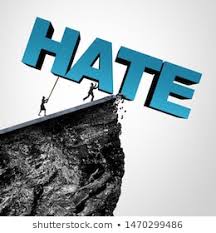
I actually hate Hate: It scares me. Hate is normally directed towards others on our human evolutionary tree who we don’t believe belong, neither on our branch, our tree, nor even roaming around our savannah. Hatred springs from intolerance. This strong feeling can produce behaviours that damage relationships, families, communities and nations.

Love is often considered to be the opposite of hate. I prefer to think of these two feelings as residing on different spectrums. Apathy, Indifference or Ambivalence would likely be found on the other end of the Love scale. On a second spectrum, Hate on one side might be opposed by Peace. Mahatma Gandhi well demonstrated that the compassionate promotion of peace could resolve hatred. His practises in a time of change in a divided India during the first half of the twentieth century persuaded millions of people to reject hatred.

Hate has always been with us. It is sustained by each generation. As a human feeling it resists corrosion. The language for its expression sometimes changes yet the result is similarly dangerous. Currently countries are struggling with a resurgence of nationalism, racism and tribalistic reactions to local or national problems. Hate crimes have been defined, and legislation written as a response to outrages committed by the intolerant few.

The internet has been a wonderful invention that I can fortunately embrace in my lifetime. I enjoy the way its structure permits a free exchange and expression of ideas. Yet hate is found here. On various social networking platforms it is easy to find hateful comments that are passed off as reasonable or comedic opinions. Hate mail has become illegal in several countries as a result of suicide claiming the victims of this horrid form of harassment.

I have felt hatred. I once called a nasty Principal ‘Raisin Head’ in front of my young sons. I hate the current President of the United States. I have hated human behaviours, like arrogance, hypocrisy and bullying. I’m not very tolerant of people who have great wealth. I ranted over billionaire philanthropist Bill Gates ‘controlling the agenda’ of health response and I said I hated him. My friend was shocked, “I never saw this side of you.” I was angry. That’s not always my response to hateful feelings, usually I retreat and ignore out of fear of this strong emotion.

Passionate feelings can get mixed up with other stuff going on in one’s head, so it can be hard to sort everything out. Recent protests due to government requirements to quarantine over COVID19 realties have shown that some people just hate being told what to do. https://www.cbc.ca/news/world/protesters-michigan-whitmer-coronavirus-covid-19-1.5551373

I hate being in crowds. The unpredictability of human nature makes me nervous. Shouting from a group can cause an alarm response in my heart. I can be timid yet I will speak out if I feel the cause is just. I would and have rallied against Hate. I try to keep a close watch over my prejudices so I may steer around them when they produce hateful notions.