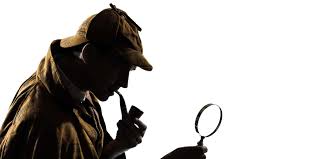
Re: Suspect

A new Superman movie came to theatres recently. I went to see it with my bride because I’m fond of the fictional character and wondered how a current director might envision his place in this threatened world we live in today. The usual suspects were present, bringing me comfort, humour, and a symbolical resolve. I concluded that all might be well with the world. I had a suspicion that the new director was trying to show modern relevance. It was a weak attempt, but my hope remains.

My mom could always catch me in a lie saying “You look suspicious.” Modern research involving children under the age of one suggests that suspicion is innate and responsible for keeping us safe as a species. Apparently we are wired to pick out The Other from a line-up of random strangers. This discovery is comforting and frightening at the same time. It’s a nature/nurture debate. I always thought we were wary of strangers by being taught through scary fairy tales. I always believed that other cultures became fearful of other cultures because of their biased programming. As a result when I became a parent and a teacher I was always careful that I wasn’t sharing my own prejudices with my youngsters. And yet; there’s DNA!

Films about aliens implant the idea that we must look for the difference that identifies the stranger among us. Sometimes this is obviously comical. I’ve been watching the television series Resident Alien and this question of human difference is in every episode. Quite often the obvious human characters are more freakish in their behaviour than the actual guy from outer space. Early on in season one, we laugh as the police are trying to find a culprit for a murder, and their search leads them down one wrong path after another. The finger pointing is endless.

In the real world news we are exposed to political suspects in an endless parade of good-cop/bad-cop antics as leaders try to expose or twist the truth to their advantage. The classic strategy is to use fear to divide us into sides, then once we are yelling at each other reason goes out the window. I’ve never enjoyed mystery or crime novels for the simple reason I don’t want to spend my leisure time (let alone any time) trying to figure out who-done-it. Trumpism (fascism with a new name) quickly recognized that Power must find Suspects in order to buy into people’s desire to see that government has control over the situation.

I had a period in my life where I devoured the tales of Sherlock Holmes as told by Sir Author Conan Doyle. Holmes was a detective who took an exacting, measured approach to his detective work. He was sceptical of the usual suspects. His methodical work was based on physical evidence and he refused to jump to conclusions (that was Dr. Watson’s department). In a similar way I respected the real life director Alfred Hitchcock whose suspense films involved carefully crafted clues to amuse the armchair detective.

In real life, I’ve suspected that being suspicious about my suspicions is often a circular trap that inhibits me from finding the actual truth.


Re: Outcome

I don’t remember when I first learned about compound words. Every word has a certain power when used effectively. A hyphenated word brings an idea together quite nicely while two or more words that are smashed together can be particularly enlightening. For a planner like me there is something very satisfying when all my organizing, mapmaking, list-making and future gazing creates an outcome that fits the contents of my imagination.

Our personal stories are often crafted to have outcomes that put us centerstage. In our vision of life, past or future, we tell our tales of adventure, defeat, disappointment, shame, honour etc. within the context of how we wish To Be in the world. I went on a much needed four-day holiday with my partner to an island retreat. I hadn’t anticipated getting lost in this fairly remote place, but I did, get lost. But it was temporary. A stranger appeared, literally driving out of the nowhere woods. I leapt from my car, waving my arms to stop him from going further along the dirt track. He smiled, led us to our destination only five minutes away, then vanished in a shower of small stones. The outcome, besides my embarrassment, was a good story of my fallibility.

At the Pearly Gates of Heaven, so it is said, you will discover the outcome of your existence. Someone will have kept a notebook of your transgressions and accomplishments. You will be judged. Of course you will likely disagree with the assessment. You will have kept your own ledger of regrets, misdemeanours, sacrifices, and awards of distinction. This island paradise I visited was Eden-esque; it certainly felt like heaven. While there, I talked with a young fellow about the importance of family. He was determined to tell me about how his life changed after becoming a father. He said he couldn’t have anticipated such a marvellous outcome as his crying fragile baby, turning into the boy that he so dearly loved.

For business types, the outcome is only read as the bottom line. The great Hudson’s Bay Company, established as a cornerstone for Canadian commerce back in 1670, recently died. From my point of view it was a case of neglect by rich folks less interested in history and more in profit. The outcome: Bankruptcy. I pushed my mother-in-law around our local HBC in a wheelchair. She commented on the bare aisles and naked mannequins. We both thought that the space felt like a garage sale. Our outcome: A feeling of loss.

On this temporary island of welcomed respite, my wife and I watched the tides filling and emptying a lagoon twice daily. We could gaze out our shorefront window and intentionally develop a new rhythm; one defined by more natural needs and intentions. Time felt less important here, we tended to ignore our digital handcuffs. The inbox and outbox of our manufactured world lost meaning. Our existence in this curious world felt familiar. The outcome of this experience has yet to be fully determined, but there can be no limit to our imagination.

Re: Murder

The board game called Clue invites players to find out who committed murder. The box says it is a family game for ages 8 or older. My sister sent a colour videotape version of the game to my family of three boys years ago. I had just purchased a modern VHS player but still owned an old black and white television set. Colonel Mustard was hard to identify.

Killing someone is deadly business and sometimes grotesquely profitable, yet we are fascinated by tales of murder and mayhem. I grew up watching The Three Stooges swearing they’ll murder someone, “I’ll moidelize ya!” ‘Murdelize’ comes up in old cartoons too. It was all just meant to get a laugh from a five year old, I guess.

https://www.youtube.com/watch?v=6xsch0xj7lU

During my last years of high school I chummed around with a fellow who introduced me to CO2 gas pistols. They were loaded with harmless metal pellets. We used to walk the creek in our neighbourhood aiming at signs and stray tin cans. Pop bottles were best to hit because of the shattering glass special effect. On one of these ramblings my buddy aimed at, and killed, a pigeon that he spied innocently cooing at a railway crossing. Later the next year when I was away at university I learned that he was in a bar fight, murdered a guy and went to prison.

As an adult I wonder how there are classifications for murder. Surely there isn’t a rational reason for creating a spectrum for murderous intent. It’s one of the few areas in my personal philosophy when I won’t accept a shade of grey. I guess you have to be a lawyer to understand the degrees between accidental homicide and mass murder. In between those two extremes I could put manslaughter (the strangest of terms), but where would institutional execution fit, or war even? I don’t distinguish a difference between war and murder on a massive scale. War is murder. And murder is war at the personal level.

In the U.S.of A., we read of people getting away with murder on a regular basis. From my bench it appears as if money, connections or a crack legal team can get you off from pretty much any crime. White folk seem to win their case in court a greater percentage of the time. In the city where I live there is a fellow, by my reckoning, who has got away with two murders. Both of his victims were fringe members of society. A blind eye was turned.

‘Thou shalt not kill’ is only in the middle of the list that Moses reported was important to God. Those holy tablets rank kicking a ball on Sunday as being more consequential. I bring up God since he/she is often used as justification for state sanctioned killing. Yes, I get that sometimes you must defend yourself but the whole ‘God is on our side’ is used to rationalize even Genocide!

“Why?” you may ask. Now, I haven’t got a clue.