Re: Poetry

I believe that Art (the essential practise, not the person) saves the world. From what, you might ask. Well, some may deny it, but the world would be a darker place without Art in its many forms. And I’m not talking about the art only accessed through galleries, theatres, or museums. I’m referring to the art that comes from within us; that creative process that can drive our imaginations. Art is found in nature, is replicated by human, and is a particle of the soul. By definition, Art was present at the moment of creation, and will remain to be witnessed long after humans have become extinct.

Poetry is an art form; an item on a page to be read, an expressive line to be spoken, an incantation to soothe, or a melody to be sung. Poetry is a practise, a methodology, and a natural response to our environment. A poem is often the first piece of writing read aloud to young children. When a mother sings a lullaby to her child, she is evoking a rhythmic talisman of love that was born centuries before and will light up lives for centuries to come. Blessed are the children who are encouraged to find the Art within.

Having said all this grand stuff I don’t wish to be imagined as this poetry-reading exclusionist. I don’t believe that a poem a day will keep the boogey-man away. However, I have been calmed by coming across a poem in a magazine, written on a subway wall, or copied onto a social media posting. I have written, mailed, or sung poetry for my lovers, relatives, friends, and once for an enemy. The latter poem –– scribbled in a rage of hateful words on a scrap of paper, spat on, torn into tiny pieces, buried in a muddy stream bank and stomped on –– was never delivered. Poems can relief stress. Poems can heal. Practising poetry can be a form of meditation. Poetry helps us to become our best selves.

I could list poets who have inspired me to recognize that I contain multitudes. Poets, who suggest that we have value because we are unique, need to be heard. Shel Silverstein comes to mind: My skin is sort of brownish/Pinkish yellowish white/My eyes are greyish blueish green/But I’m told they look orange in the night/My hair is reddish blondish brown/But it’s silver when it’s wet/And all the colours I am inside/Have not been invented yet.

During my teaching career, I scheduled poetry time as part of each day. Regardless of the age of my students, joy was found during these periods of word fun. No poem was judged better or worse. Nothin had to rhyme. We all laughed or sighed at the combinations of noun, verb, adjective, adverb, or nonsensical words. Playing with words using pen on paper can be like scribbling on a sketch pad. The outcome is not as important as the process. All you need is your imagination, a few moments, and the encouragement to begin.
Re: Tale

A tale can be like a story, but perhaps it will contain deeper sentiment, as in the great work of Charles Dickins, A Tale of Two Cities. A tale can be as old as time or it can be something you tattle. In the spectrum of fiction, a tale can sit safely beside a yarn, which is something a sailor may spin about an adventure at sea. Fable, legend, and myth will also be found on this imaginary language spectral line.

The telling of a tale requires picturesque language allowing us to suspend any disbelief we may have with the narrator. Unlike non-fiction stories that must rely on facts to communicate an account, fans of tales want to be convinced that what happened, actually could have happened. This manufacturing, to me, is not lying but colouring by using what we know with what-might-be. I like revisiting the Sarah Conner story in the Terminator film series. She’s like a princess, but a princess with purpose: a tale of, and for, future times.

I loved reading fairy tales to my kids as I once loved being read Grimm-like fables when I was a child. Cinderella popped into my head recently as an example of the possibility of time travel. It was a Back to the Future mind spin where I rationalized the need for the glass slipper lady to return home by the time the clock struck twelve. H.G. Wells’s classic futuristic novel Time Machine is an early attempt to suggest that travelling through time could be achieved, with the appropriate clockwork technology. I wondered if perhaps Cinderella was a time warp artist, riding in that magical pumpkin-ish looking coach. Her only fault might have been she didn’t coordinate the return-time better with her fairy godmother/timekeeper.

In my version of Cinderella, she discovers a way to end her despair entirely by leaving her old world behind. I picture my Cinderella being trapped in long days at Walmart, greeting others who have interesting lives, while she is mired in the drudgery of retail. As I see it, time travel only gets messy when we actually come in contact with our own lineage. Maybe you could come and go through the ages as long as we kept it out of the path of your own timeline. For example you could see the court of Cleopatra but not visit your grannie when she was three. Perhaps my Cinderella wouldn’t lose a shoe but a watch, and this is why she forgot the time paradox: you can’t be in two places at once. Marty McFly discovered that timing was everything or else the future would not exist as only he alone could tell it.

Dreaming, like what I’ve been writing here, is tale-telling. There must never be punishment for it, unless it’s intended to deceive or hurt another. We can believe in old-wive’s tales to the point where their value continues to inspire new discoveries in STEM research. The truth must always remain the goal, but I see no harm in embellishing the facts, for story’s sake.

Re: Drawer

This word must be hard for ESL students. I taught elementary school kids and they would have more trouble with words if they were hard to pronounce. Drawer has a sound like shore when it’s used in sentences about places to put things. But an artist can be a draw-er, which makes me think of someone involved with practising law, which puzzles me even more because that person is a lawyer, which is consistent with someone who works with wood who might be a called a sawyer. Poor students! Imagine the questions if I assigned The Adventures of Huckleberry Finn and his friend Tom who explored the Mississippi River while dressed in muddy cotton drawers!

My dad was a drawer. He would draw on his life experiences to tell fabulous tales. In that sense he was a collector of curiosities & thoughts, in another sense of the word he actually drew stuff. He used a pencil to sketch or a brush to add colour to his surroundings. His drawings were his perception of the world, put on paper. He was sometimes commissioned to replicate a favourite dwelling. One house-proud person was so delighted by his pastel reproduction she exclaimed, “That’s exactly how I see it when I’m turning into the driveway.” When he told me this story and showed me the photo he had taken, I noticed he had left out a telephone pole, and a hydrant, from his final sketched landscape. I understood he was a drawer in that instant. He allowed that the homeowner would draw her own conclusions, all the while anticipating her human need for fantasy.

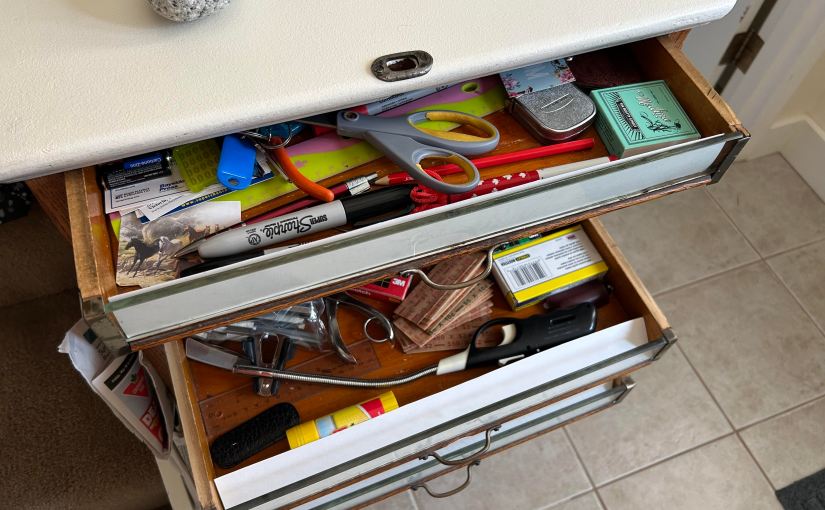
Everyone has a junk drawer, sometimes in the kitchen, sometimes in the bedroom. Like a magpie we collect stuff and toss them here for when we think we might need them. Even things that have no use. If you can’t afford a place with an attic or basement crawlspace, a drawer will do to hide those old love letters, secret things, or stuff not worthy of the knickknack shelf. My mom had a glassed-in corner curio-cabinet with shelves that could be pulled out for closer examination. She kept her thimble and teaspoon collections in these suede-lined drawers. I can picture her in my childhood memory excitedly drawing on a cigarette as she talked about the origins of these treasures. She let the ash fall where it may.

Thanks to my dad’s influence, story telling later became a big part of my teaching curriculum. I often read fairytales to instigate study of other subjects. I remember one student designing an efficient water well, for a science fair project, after hearing Diamonds & Toads by Charles Perrault being read in class. Together, other students did their research and discovered there were many fables based on the drawing of water from wells. My essay is about to draw to a close. Let your imagination wander.

Re: Comedy

My mom used to tease. My sister, father and I found her intentionally mean jokes discomforting. Consequently I learned that having a laugh at someone else’s expense was not comedy. John Cleese, of Monty Python fame, posted a message on Substack regarding the difference between affectionate teasing vs nasty teasing. I took exception to his exceptionalism because I’d seen the devastating results of my mom ‘taking the mickey’ out on innocent angels. It’s no surprise that her favourite comedians were Don Rickles, Joan Rivers, and Rodney Dangerfield. Mom was dead before Ricky Gervais made a name for himself through insults, but I’m sure she would have liked his style. Teasing, Insults, Swearing, and Sarcasm can be found in my Book of Humour under the chapter titled: Cheap Shots.

Humour is subjective. Art is required to be judged by the individual. It’s how we figure out that our mouth is not the only place where taste can be discerned. And, of course, it’s impossible for all to agree on what comedy means, anymore than we can be uniform in our response to the flavour of olives. My love of humour tends toward the silly and the slapstick. I don’t understand how my bride absolutely hates silly comedy yet she loves scatological humour. To me, the silliness found in Monty Python sketches is innocent and wise at the same moment. The Three Stooges enthralled me as a child with their antics of mayhem. Later, I laughed at the absurd body language of Jerry Lewis, Dick Van Dyke, Rowan Atkinson, and Jim Carrey.

My favourite actors are also comedians. Sometimes the line between pathos and buffoonery can seem gauze-like. Robin Williams mastered this dichotomy as did Jack Lemmon before him. Humour is perhaps the most provocative art form. The double entendre found in most witticisms sets up a conflict in the mind, making it difficult to decide the truth. Stand-up comedy is challenging in this way as it reminds me of the court jesters of centuries ago trying to please the royal master while playing to the impoverished masses. Editorial cartoonists like Michael deAdder perform a similar function of pillorying political figures to make an inconvenient truth apparent. In these cases we might join in mocking laughter; “The joke’s on you!”

Comedy has to catch you at the right moment. This year is the 50th anniversary of that comedic phenomenon Saturday Night Live. Lorne Michaels deserves credit for creating this iconic television show and nurturing hundreds of comics in the process. Dark, silly, political, sexual, racial, religious and physical humour are blended like a box of specialty chocolates. The spontaneous nature of the sketches, the improvisations, can land with a bang or a plop. Something coming off funny can depend on the mood of the audience as much as the skill of the performer.

What strikes your funny-bone may be arbitrary, yet comedy is necessary to our mental health. It’s no accident that situational comedies on television have been a staple of that medium. We need to laugh most when the situation seems most dire.

Re: Opposite

War is the opposite of art. In the midst of compelling, heart-wrenching photos of the current wars in Gaza and Ukraine, art is being dimmed just as surely as lives are being extinguished. Art creates, while war is nothing but destruction. Art defines the best in humanity, while war denigrates mankind with every rocket launched, with every bullet fired, and with every anti-personal device exploded.

To be opposite is to be opposed. Opposition plays a key role in incidents of unfairness. When one side dominates it is right for the minority to speak up in rebellion. A call to arms is required if dialogue is downplayed, demonized, dismissed or otherwise disparaged. Everyone has a right to be heard and understood. Systems must be in place to protect the vulnerable, not trample over them. I get upset when I have to take a side: Life is nuanced, not black and white. Looking within the fold and shades of an issue, I see promise in the act of negotiation. Capitulation isn’t necessary when the shared goal is accommodating humanity.

War rhetoric is divisive. People on the opposite side of the line drawn in the sand are referred to as Nonpersons; humans devoid of respect or legal protection. They are “human animals”, as described by current Israeli Prime Minister B. Netanyahu when he speaks of the enemy Hamas. All sorts of words have been used through the ages to delineate the opposite side, whether in war or debate. The opposing team is the foe, the work of the devil, the pagan, the unwashed, or the undeserving. The pronouncement is made, thus the enemy is not requiring compassion. The slaughter can begin.

Some say that the opposite of war is peace. Others know that the only thing you need for the seed of war is indifference. I will play devil’s advocate by suggesting that intolerance begins the process of creating The Other. Making a contrary statement, even if it’s a lie, will get the argument going. Currently on social media sites, those who wish to incite disharmony are using AI Bots to spread discord. One small distortion, strategically used by Influencers, can cause havoc. Consider the folks in Springfield, Ohio who had to battle the abuse from folks who believed that its residents were stealing cats & dogs for food, after Trump said he had heard this on TV.

Debates are often seen as being an example of opposites not attracting. The recent Trump/Harris debacle showcased clearly for me that you can’t have a debate when one party is unwilling to discuss issues. Solving the issue of the day is looking at the double edged sword and trying to minimize the damage done to a course of action. Having a respectful debate, in my mind, is about seeing two sides of the same coin, then figuring out what to do when things flip heads or tails. Often the two sides can be complementary, even if we can’t be complimentary of that person on the other side of the arbitrary fence.

Re: Music

I like movies that contain music, subtle or overt. I once rented a VHS tape called Evita starring Madonna and the desk clerk asked me if I was aware that the film was a musical. My look of surprise made her ask, “Do you still want it?” Apparently the tape had been returned many times because folks were put off by the fact that all the actors sang something. Apparently taste can be found in ears as well as on the tongue.

I get hijacked by music. I don’t choose to have music playing while I work or fuss around the house. Music finds me when I’m going about my business though. In a store it will follow me as I look for blue jeans. I’ll chew my food in rhythm to a restaurant’s playlist. I get the music in me despite having no musical training. My musician friends are amazed when I answer their skill testing questions. Instrumentalists are artists I admire enough to pay money to watch them perform. I’ll sometimes linger by a street performer because the air itself seems somewhat different as it blends with the melody. It sparkles!

Imagine the first gasps of wonder as ancestors in caves created vocalizations or tapping sounds on bones and stuff! My perfect world has people singing or humming all the time. Paul Simon was once asked his greatest thrill at being famous. He said he is always delighted when he passes someone on the street murmuring one of his songs. Music has been described as a soundtrack to our lives and that’s probably why I get earworms of melodies that imbed themselves in my head and just won’t shake loose until I hear another tune. Who doesn’t find themselves joining in when they hear a familiar lyric from a car radio: Home where my thought’s escapin’. Home where my music’s playin’. Home, where my love lies waitin’. Silently for me.

Music is said to soothe a savage beast or breast. Speaking of which, our inner child remembers a mother’s lullaby while being fed and cradled, so we naturally associate sound with comfort and joy. But sometimes music incites when it’s linked to parades and protest. I’ll never forget marching behind a bagpipe with my teacher colleagues during strike action against our government. Anarchy can have a soundtrack too.

I may not have a cultured musicality or practised musicianship. My only music lesson was a month of violin. I’ve winced when hearing snobbish comments at a concert venue: Being a wine connoisseur is one thing but music is for everyone. Ranking of a musical piece is not a requirement for me, appreciation is key. I have trouble with some genres like Rap and my easy listening preference tends towards Folk but I love being surprised by sound. The long retired television series ‘Glee’ enthralled me. Opera may be tedious at times but it gets my respect for being the origin of the staged musical. Music in any form is to be lived.

I got rhythm. I got music. I got my gal. Who could ask for anything more!

Re: Dominion

The bible tells me so: Gen. 1 Verses 26 to 31 “And God said, Let us make man in our image, after our likeness: and let them have dominion over the fish of the sea, and over the fowl of the air, and over the cattle, and over all the earth, and over every creeping thing that creepeth upon the earth.” But what if I don’t want to!

To have dominion is to control stuff and I believe it is wrong to dominate other living things. For some folk their god is all powerful, so we can be too. But really, as a hominid, I’m just another creeping thing that creepeth over the earth. The state of the planet right now only proves my point: If we had been put in charge of this place we’ve sure enough done a terrible job of it. If we were made in an image of god then we haven’t been creative enough in return. We haven’t been good stewards.

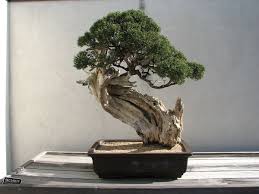
During the controlling phase of my life; when I felt things worked better by imposing order and good government, I had a small bonsai tree. Its roots were constricted like the feet of Chinese girls of ages past. Its limbs were shaped by twists of wire. Its growth was restricted by judicious use of fertilizer. I wasn’t a good pet keeper and this plant did not flourish. In the film Trees, And Other Entanglements, director Irene Taylor tells us of a famous Bonsai artist and others who attempt to represent their views of how plants should be shaped to serve our needs. It left me feeling a bit creepy.

Let’s face it, as a species we didn’t think through the whole industrial revolution period. Our machines have laid waste to the eden from whence we came. Now we find we must manage other species before the tipping point of their extinction. In university I studied for a degree in Fish and Wildlife Biology. Many of the courses described methods of farming multiple species so that these living resources could be effectively used to feed, clothe and house the ever growing and expanding human population. We were being trained to be efficient dominators of the environment’s flora and fauna. We studied how deer ate, so they could be fed better and then be hunted. We studied the salmon’s cycles so they would grow prosperous before they were netted. We studied forest growth so that we could improve tree yield before it could be harvested. We were given the licence to dominate every creature, animal or vegetable, to serve our own needs. We still fell short. We failed to be taught how to live with, rather than lord over, the Earth Garden.

Our colonizers, The British aristocracy, once ruled this land calling it The Dominion of Canada. The Crown still holds power in our affairs. The label has fallen out of favour but citizens may still proclaim allegiance during formal community events. I hope the age of possession is over. I don’t want us to be the master of all that we survey.

Re: Play

A friend of mine asked the other day, “What do you do for fun?” I had to think, and I’m still thinking. In days gone by I might have made a list which included; playing street hockey, snow castle building, pick-up baseball, fishing or splashing around in a creek. Now, at age 71, my definition of fun is very different. I wonder if my ability to even have fun is still in play.

In the video playback in my brain, my first thoughts around playing are of the sandbox. My dad built my sister and me one of those playthings when we were toddlers. We were sad to leave it behind but we found one came with the courtyard of the apartment when we moved to Scarborough. This one had triangular corner wooden seats where mothers sat to watch over their children playing with strangers. Much later I built a deluxe rectangular sandbox so that my three sons could play safely in the backyard of our duplex in Timmins. I crafted a cover to prevent other animals from peeing and pooping in it, since awareness of intestinal worms brought fear to the hearts of parents at that time in history.

Playgrounds come in many configurations. I had a summer job one year creating modular climbing stuff for kids to enable them to build muscle and expand their imaginations. It’s amazing how designs of wood, metal, plastic and rope can foster team building, giggles galore, the sharing of secrets and playful expressions of friendship. Whenever I pass one in my neighbourhood I feel triggered by childhood memories. I love the happy sounds of children playing freely yet I don’t linger by the fencing since I’m sensitive about my maleness. We can’t play innocent when it comes to ignorance of society’s current insecurities.

The world of imagination is not limited to youth. The push and pull of good and evil is often played out in the theatre. Truth be told, the play’s the thing I’m most attracted to when it comes to thoughts of fun at my stage of life. I’ve never been involved in a theatrical production but I sure have felt my emotional response as an audience member watching the plot unfold on the stage. I’m envious of Playwrights for being able to use their way with words, and then on completion, creating an opportunity for so many other artists to interpret and extend their work. 

I can delight in watching others have fun. I feel lucky to be a grandfather so I can get a chance to relive some of my infancy vicariously. Sometimes, the toddler I’m being silly with might look at me like I’m an alien from another planet: I’m handed a bit of Play-Doh and I start to mold a goofy face and I’m told, ‘Not THAT way!’ Or I’m given a balloon and I start to punch it crazily and my granddaughter runs crying to her mommy.

Silly is something I do for fun. It may not play well with others.

Re: Book

Publishing is going through massive change. Books, magazines and newspapers used to be the norm since Johannes Gutenberg invented the press machine. In my lifetime there has been a decline in print sources delivering news and information. Text and picture can arrive by digital means but for most people my age that mode of delivery comes up short. Words on paper (I miss handwritten letters delivered by postal carriers) have a tactile benefit that cannot be understated. Words are meant to make us feel.

The old Hawaii Five-O television series had an oft quoted catchy line, “Book ‘em Danno” when referring to crooks being arrested. Books on the other hand must never be judged harshly, by their cover or otherwise. My special mom, who can’t even see the covers of her audio books, would agree. She reports that a good book is like comfort food. Her CD player is provided by CNIB (bless them) and when her discs arrive in the mail box she exclaims with delight. It’s a treat to see her smile when she is immersed in her world of words. She shows similar interest when my wife reads to her from my published work on this site.

I’m in the process of gathering columns I once wrote for a daily newspaper into a book. It’s a self publishing effort and I don’t intend to make any money from it. I had made photocopies of the individual columns which I kept in a three ring binder. First the pages had to be recopied and the data stored on a digital file. Then I had to bring it to experts to have it paginated. I next had to book an appointment at my local printing house. Other writers can relate to a similar process as everyone has a story to tell it seems. Every person is literally a walking book. Those who write are usually ravenous readers. I am unreservedly pro books, never want them to be banned, never want them to be burned (ironically the books in the story Fahrenheit 451 ARE burned). Both banning and burning still occur around the world which to me is a shocking example of misdirected anger.

If those who love food are ‘Foodies’, then I guess you could call fans of reading, ‘Bookies’. Too bad that label is attached to shady old-school gambling agents of the underworld sort. As an aside, I wish all gambling ‘pushers’ were arrested and booked for damage to society, but that’s for another blog page. In other WordPress postings, I’ve written about my love of libraries where words and other forms of artistic expression and information can be shared. I love the continuing impression that a source of books is central to any healthy community.

When I book my final passage to the great cosmic beyond, I’ll mix my life essence with countless others in the ether. I can imagine that blend of quantum particulate matter lodging in the head of some future writer who might wonder where that idea came from for another story.

Re: Self

I can’t believe this is the 300th word that I’ve examined as it pertains to me, quite selfishly. I think all art is a selfish pursuit. A friend, who has commented on my work, has called it cheap therapy. He’s right in a way, since I get a chance to talk to myself and review my thoughts before sharing them with the world. I have no illusions about being the major benefactor of these essays. When I reread my words the feelings of self reflection can sometimes be powerful enough that I laugh or cry at my own expense.

I’m telling my mom, at this moment (even though she is long dead) that my head is not swelling from false pride. I’m still trying to convince her that I can be self interested and still be caring toward others. A person can be humble and still delight in the things they have created. In my understanding, being selfish is not in the same vein as being self-centred or perpetually self-involved. I try to view myself with the same level of enjoyment as I would the person next to me. In fact I love moments of one to one creative sharing since in that moment of context or conversation we have a mutual connection. Our souls have no borders.

Of course there is a line that some people may cross as they search to exclude others rather than embrace the human community. Making others irrelevant makes you a narcissist. There are many examples of narcissists in the current political landscape. Choosing a candidate to represent your interests in government is tricky enough without someone purposefully trying to manipulate you. Check carefully before you make a Trumpian Bargain: Your self-preservation as a trade for the charlatan’s self-aggrandizement.

Self help books have been a section in most book stores for quite a while. The Do-it-Yourself type can find these guides useful when the way to fix a problem becomes elusive. Many stores are currently promoting self-help options seemingly to speed your shopping experience. The resulting lack of need for cashiers and staff in general pads the corporations bottom line and speaks to the shareholders’ self interest. Yet all that glitters is not gold eh?

One of the responsibilities of a parent is to help their children develop a positive sense of self. It’s a delightful and complicated task to guide a child to see themselves as worthy individuals. I tried to help my boys understand that they had the power to decide the kind of person they wanted to be without becoming self possessed. Equally important to me was that the goal was not to be so selfless that actions became like a cross to bear. We all have needs. Our journey is to become self actualized. To reach for our best selves, we must aspire. Our goal can be accomplished through skill development, thoughtful reflection, watching others, reading, and conversation. Being self absorbed, as an act of personal creation, can awaken vistas of understanding and healing light. We are mighty!