Re: Drawer

This word must be hard for ESL students. I taught elementary school kids and they would have more trouble with words if they were hard to pronounce. Drawer has a sound like shore when it’s used in sentences about places to put things. But an artist can be a draw-er, which makes me think of someone involved with practising law, which puzzles me even more because that person is a lawyer, which is consistent with someone who works with wood who might be a called a sawyer. Poor students! Imagine the questions if I assigned The Adventures of Huckleberry Finn and his friend Tom who explored the Mississippi River while dressed in muddy cotton drawers!

My dad was a drawer. He would draw on his life experiences to tell fabulous tales. In that sense he was a collector of curiosities & thoughts, in another sense of the word he actually drew stuff. He used a pencil to sketch or a brush to add colour to his surroundings. His drawings were his perception of the world, put on paper. He was sometimes commissioned to replicate a favourite dwelling. One house-proud person was so delighted by his pastel reproduction she exclaimed, “That’s exactly how I see it when I’m turning into the driveway.” When he told me this story and showed me the photo he had taken, I noticed he had left out a telephone pole, and a hydrant, from his final sketched landscape. I understood he was a drawer in that instant. He allowed that the homeowner would draw her own conclusions, all the while anticipating her human need for fantasy.

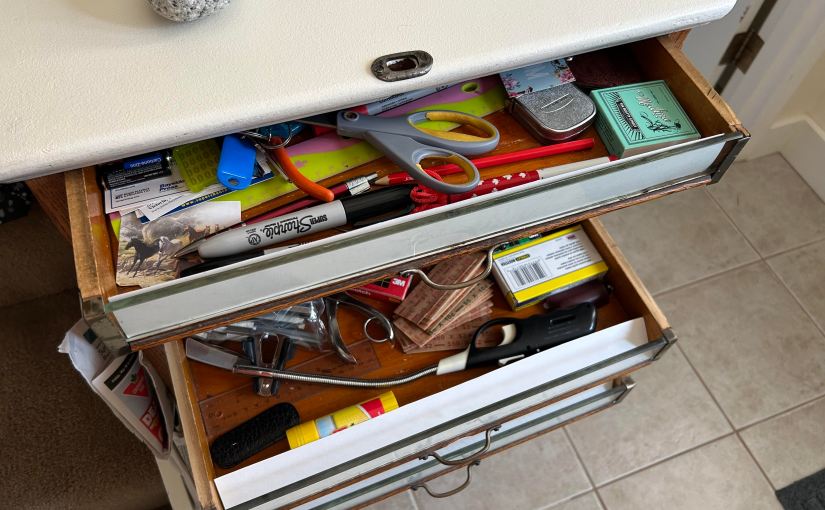
Everyone has a junk drawer, sometimes in the kitchen, sometimes in the bedroom. Like a magpie we collect stuff and toss them here for when we think we might need them. Even things that have no use. If you can’t afford a place with an attic or basement crawlspace, a drawer will do to hide those old love letters, secret things, or stuff not worthy of the knickknack shelf. My mom had a glassed-in corner curio-cabinet with shelves that could be pulled out for closer examination. She kept her thimble and teaspoon collections in these suede-lined drawers. I can picture her in my childhood memory excitedly drawing on a cigarette as she talked about the origins of these treasures. She let the ash fall where it may.

Thanks to my dad’s influence, story telling later became a big part of my teaching curriculum. I often read fairytales to instigate study of other subjects. I remember one student designing an efficient water well, for a science fair project, after hearing Diamonds & Toads by Charles Perrault being read in class. Together, other students did their research and discovered there were many fables based on the drawing of water from wells. My essay is about to draw to a close. Let your imagination wander.
Re: Fishes

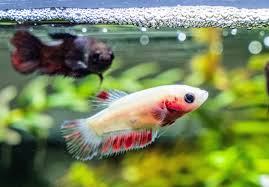
I kept an aquarium when I was in my early teen years. In several tanks in my bedroom I cared for neon tetras, gouramis, siamese fighting fish, angelfish, varieties of suckerfish and zebrafish. Those were the sorts of tropical fish available in the late sixties for someone on a limited budget like me. One of my friends had a saltwater aquarium which I envied for its exotic assortment. I made a deal with the local pet shop owner to provide him with the products of my fish breeding program in return for supplies. Most lucrative to sell were the Betta’s fry. I was able to coax this combative species to mate and produce eggs which were beautifully kept safe in bubble nets, not unlike the jelly masses of tadpole creatures, until they matured enough for market.

If something smells fishy, it probably is. The whole trade of popular aquarium species has a shady history. The practise of capturing and shipping constituted appalling loss to the local populations of fishes as well as contribute to habitat degradation in many parts of the world. I feel guilty to have been part of that capitalist agenda and yet through my exchange of home-grown fish I suppose I limited some of the need to get specimens from the wild.

During those years my hobbies revolved around fish. I spent endless hours during adolescence peering at my aquarium, cleaning the glass, separating the sick or pregnant fish to a hospital tank. I dedicated one tank to hold a collection of pond-life species that I captured from a nearby creek. I took notes, feeling like a young scientist, and later presented my findings to my high school biology teacher. This work and the resulting A+ grade was an encouragement to apply for university studies in Marine Biology. I also spent memorable leisure time sport fishing in rivers, streams, and lakes. I always had my rod and reel handy when the opportunity arose to hop in a boat or hunker on the shore. I felt a bit like Tom Sawyer on those occasions.

The natural resource industry is a big part of Canadian history. The early years of this country contain stories of greedy resource extraction of all kinds. For the famous fishers of Newfoundland this poorly managed industry would ultimately result in the great cod moratorium of 1992. This was a change of biblical proportions to a culture dependent on fish. Similar tales can also be told of other countries where the fishery was once never expected to be depleted. In the west coast current realities of salmon stock reductions due to over-fishing and poor habitat conditions make my heart ache for what bit of nature might still be left for my grandchildren.

I don’t earn money from working with fish like I used to, but I still go fishing when I need to change my lifestyle. Not fishing in the literal sense but as a metaphor for searching for possibilities. I’ll ask questions with baited subtext to see if the response brings a rewarding strike on my lure. Opportunities abound! It’s all how I cast my line.

Re: Itch

What is an itch and why do we have it? I could google my lead question but it isn’t really a question and I rarely do any research other than a quick Siri type throw away inquiry because I have to satisfy an itch of the curiosity sort. Suffice to say that I’ve been itching to write about itches because they are among the few basic things that humans have in common with other animals.

Let’s agree that the origins of itching are elusive. I suspect a link to the Missing Link can be made whereby living together in caves created an environment for pests. Once bitten or bored into, Neanderthals would scratch to remove the parasite, otherwise they might fall prey to infection, disease, even death. Maybe these ancient humans didn’t die out from war with Homo Sapiens but because they couldn’t invent an efficient scratching protocol. This must be the source of our ancestral behavioural DNA as though some distant memory compels us to attend to our itches: That’s my theory anyway so I’ll pick away at it for now.

If you refuse to acknowledge an itch I don’t think it ever goes away. Itchiness can be a symptom of physical disease, yet psychologically an itch is an urge: To find out. To start a fight. To get going. To get started. Or, to leave your spouse, as in The Seven Year Itch.

https://www.youtube.com/watch?v=fJgC549mpRk

An Itch can be a form of curiosity and while you are scratching you just might come up with an amazing idea. Kids love to scratch. As with passing gas, it is a continuous source of amusement. Surely the title of The Itchy & Scratchy Show from The Simpsons was inspired by this fascination with moving fingernails across our skin. One of my children’s favourite camping songs was ‘Flea, Fly, Mosquito’ nicely rendered with all its silliness in this youtube video by Arlo & Alro’s dad of Tiny Mule Songs.

https://www.youtube.com/watch?v=BC6Ey_QyGQw

Dogs and cats have very satisfying lives, I can imagine, because they are always licking, scratching or rooting around looking to please themselves. No one tells them to go moisturize! I can relate when I watch films of chimpanzees, grooming each other with scratches and nibbles. It looks naturally healthy to be itchy from time to time. At the Imax a few months ago I watched as scientists recorded, ‘for the first time in the wild’, a grizzly bear stopping to satisfy an itch in the middle of its back by rubbing against a spruce tree. I’m no different. I love a good scratch. I’m quite dependent on my wife for getting at those hard to reach places. I have gone all consumer-ish and invested in some ‘money back guaranteed’ quality backscratchers ‘as seen on TV’. I’ve been told that attending to an itch (especially in public) is the epitome of bad manners. Yet we can feel collectively encouraged when someone says, “You scratch my back I’ll scratch yours.”