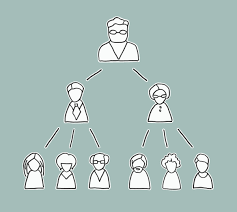
I don’t put much stake in status. I believe a system of hierarchy in a culture creates more harm than good. Perhaps it’s my lack of ambition that propels me to say this. Maybe it’s because I’m older (but not necessarily wiser). I never wanted to be the top dog in any setting, even though I appreciate recognition when it has come to me. When I have received accolades, I don’t view those who have patted me on the back as being lesser than. I like a level playing field.
A state of hierarchy is present in our systems. There is a chain of command in more than just the military. Business operations are defined by their top down approach, with chiefs being tasked with providing direction for the underlings. Well advertised economic principles are expected to trickle down benefits to the masses. Religion expects followers instead of adherents; sheep who will not stray and never confront the status quo. I once had a brother-in-law who used a patriarchal methodology with his family because the bible told him so: Father knows best. Hierarchy is a ranking of people based on a particular management team’s view of the environment at hand. To benefit the ruler, someone is to be judged smarter than, cuter than, stronger than, whiter than, younger than, or more obedient than and then given a certificate, badge, job, or corner office to occupy. Control usually comes from a pyramid design for administration. Rarely do we have an example of co-leadership where all stakeholders are given an equal share in ownership or decision making.
Children learn early to express their authority. My middle son was quick to point out that his brothers were not the boss of him. I remember him once standing rigid at the top of a flight of stairs, fists clenched, while shrieking, “I know another way!” because his elder brother wanted him to follow his lead. Bosses are critical in a hierarchal society, or so the bosses tell us. It becomes accepted that decisions are made by those in charge. Some are offended by this when it is stated as fact; “You can’t make me!” is something I’ve heard often from my children and from my students.
One of the aspects of a second U.S. presidential term of Trump that frightens me is the way he uses his authority. I believe he feels exulted that he is head honcho. And 80 million people (far from the majority mind you) have given him permission to be The Boss over a vast and diverse collection of people. Most of those people, I suspect, just want to go about their business exercising their freedom to be autonomous within their particular setting. Some will argue that there must be some form of supremacy within a culture: A desk somewhere, perhaps, where the buck stops. I think again of people like Trump, democratically elected but part of a flawed system, who is destined to have the final say. We, the people, each of us alone, are sovereign.

 Catch My Drift?