Re: Kill

In exploring my world through individual words, I’m often surprised when I come across a word that I haven’t examined in this blog. Kill is part of everyone’s vocabulary yet it’s one of those basement words that we might leave boxed up, unattended.

Maybe our fascination with killing comes packaged in our minds with the broader mystery of death. In the art world, we can love murder mysteries, film noir is fascinating and slasher movies are popular for date nights amongst teenagers. We are repulsed but intrigued by serial killers; we want to know details, the reasons behind the murder. When I hear an ambulance I’m curious if the siren stops close to our neighbourhood. If there is an accident on the highway, we rubber neck to see if there’s been some road kill. The dark side of our imagination isn’t pleasant. Yet it is present. Stephen King is a popular author for reasons beyond his skill with words.

I’ve known one person in my life who has gone to prison because he killed someone in a bar fight. This fellow was a run-of-the-mill boyhood friend. It’s curious to me why authority figures want to convince us that murderers are all insane. That’s usually the approach taken to try to dismiss the incessant gun play and resulting carnage that goes on in the United States. Some cases just don’t fit the madman stereotype. I’ve read of mercy killings for example, and have considered the more frequent accidental deaths involving highway collisions. I don’t believe that the Alberta truck driver who missed a stop sign causing the death of many members of the Humboldt Broncos can be called a crazed killer.

When we want to avoid the word Kill we invent a substitute like Slay, Slaughter, Smoke, Terminate, Disappear, Blow Away, Liquidate, Crush, Bump Off or Hit. Wordlessly, a mafia gangster might signal a death sentence with a kiss. Likewise, someone who wants you gone might make a slashing movement across his throat to show evil intent, even if he is ‘only joking’. Professionally, a director could yell “Cut!” while making a fierce chopping motion to signal her desire to kill the action in a scene.

We can’t fool ourselves by thinking normal God Fearing Folk don’t kill when it says in the Bible that there is a time for it. Our spoken word endorses the emotion behind the thought: “I’m going to kill you!” (we might cry out in rage). “We killed them!” (we might declare after a sporting victory). “I’m going to kill it!” (we boast after cramming for an exam). “He’s killing me softly…” (we might sigh/sing while bringing news of a lover to a friend). We feel proud when we kill two birds efficiently using only one stone. Hunters still find it necessary to pose while smiling beside their dead prey.

I try to avoid using the K word but I don’t want to be a killjoy when it comes to encouraging reflection. Words colour our perception of the world; it’s ignorance that kills.
Re: Get

“You can’t always get what you want…” A Rolling Stones song can be a philosophical code for living a life of satisfaction. I once had a great conversation with a friend about getting it: The it being life’s meaning. We both agreed that what you got, when you thought about life, was directly proportional to how much you thought about your existence. Most days I get why I’m here, existentially speaking.

The word Get has a lot of use for its size. This small word is used without much thought because it makes the sentence flow. Consider that you might be told to get stuffed, get it together, get cracking, get a room, get a life, get going, get real, get over it, get lost or ‘just try to get along already!’ Get suggests a direction as well as a directive. Sometimes we get anxious about getting there. Other times we long to get back to where we once belonged. We save money for a get-a-way so that we can get together or because we must get off the hamster wheel. I often wonder if we get what we deserve.

When I was a kid we were encouraged to recite what we got for our birthdays. After Christmas the question, “What did you get?” rang through the classrooms. As we emptied our halloween containers we would spread our fingers through the loot hoping to find those candies that we wanted most to get. Thinking back now, I wonder if this desire to acquire was a step towards indoctrinating us kids into the consumer world. After all, a capitalist society is predicated on getting stuff.

As 2020 dawned the exclamation, “You’ll never guess what I got!” gained a morbid new meaning: I was among the many who got Covid19. As advised, I had gotten all the shots to try and prevent it but the virus found me anyway proving I was not as immune as I thought I was, and that vaccinations probably kept me from dying like the seven million global souls.

One of my pet peeves surfaces while I’m in a fast food restaurant. A customer will look at the menu board and state more than ask, ‘Can I get…?’ which sounds rude to me. The annoying part of me wants to turn around and ask if their mother taught them the ‘Please may I have…’ sentence starter. What I’m getting at is the same kind of feeling when someone non-accepts a thank you by saying, ‘Not a Problem.’ Oh well, we are what we are. At this part of the blog I’m thinking of Judy Blue Eyes: It’s getting to the point where I’m no fun anymore. I am sorry. https://www.youtube.com/watch?v=QZGeU83K6Do

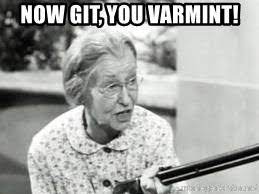
Harmonies by Crosby, Stills and Nash are at the blissful end of the vocal spectrum whereas a hillbilly yelling “Git”might be at the opposite pole. Language is forever fluid. I love it when I can capture the right word at the right time. It’s a Gotcha moment.

Re: Set

Ready-Set-Go.

The set up for this page begins with an innocent looking three letter word. I start my blog postings with no set agenda (my work has been compared to an episode of The Simpsons). A single word is always the theme: In this case the word Set can stand alone or be incorporated into another word fragment. Read on and see how many references you can find. Report your findings to set the record straight. All set?

We all have a set of something: like golf clubs, luggage, cutlery, earrings, barbells, thimbles, or beer coasters. Sometimes the things we collect into sets are purposeful. Some folk can boast of having complete sets of things. I like to prune and harvest my own set of ideas about life. I choose to edit regularly so I don’t get set in my ways. As we age we collect a robust set of memories. And most old folks, including me, can set their mind to something and never let go of it, which can be upsetting to the younger generation.

As a kid, I liked watching cowboys shoot people on a TV set, while building a model battleship. As the glue set I would plan how I would re-enact a war scene. Back then every boy had a train set and every girl had a tea set. I see no sign that my grandkids are conforming to rigid cultural patterning like their grandfather. They wear pink if they want or dress as unicorns, dinosaurs or super heroes. As far as I can see there is no set idea regarding who they are or who they can become. Mindsets have changed.

I can’t believe the word Set is so ubiquitous! How many variations so far? Imagine you are an ESL student trying to sort through all these examples? Ok. Now visualize a stage set, which has pieces arranged in a setting to stimulate the minds of the audience. This set design is integral to the plot and to the actors who inhabit this temporary theatrical settlement. The play may be about an innocent man who has been set up or maybe the play’s about a dinner with friends and a grand table has been set with fancy china and a centrepiece.

My favourite activity in general is to set out on a journey. No matter whether it is a voyage of the mind or a geographical adventure. I usually set a goal for my escapade but I’ve been known to be spontaneous. I might set my watch to keep track. Or better still, setting an alarm will help if I get lost in my thoughts.

I’m feeling like I need a reset. Being silly helps me settle my nerves after a distressing news story. It’s a good thing I enjoy playing around with words. I’ve read that reading & writing is a way to prevent early onset dementia. Tennis may appeal to some, but going for sunset walks with my sweetheart keeps me feeling like a winner.

Game. Set. Match.

Re: X

But X is not a word, I hear you thinking. And you are right and I know I’m cheating in my journey of looking at my life through the magic of words. I’ve used one letter before however: The letter I, which is truly a word in a letter, through which I could describe me. When it comes down to it, language is really a bunch of symbols that stand for something. In this case the single letter X conjures up an extraordinary assortment of things for me.

When I was a kid pirates held an oversized fascination. I used to love going on treasure hunts that my dad would design out of obscure clues. Sometimes he would hand me a map with a prominent X marking where my surprise would be hiding. The quest was never easy and most times I sought extra hints which would encourage my father to pretend to be Blackbeard or the dreaded pirate Bartholomew Roberts. My sons have memories of playing with their granddad using the couch as a ship sailing to uncharted islands searching for buried treasure. I can still hear them all giggling excitedly in faux fear as they fell overboard into shark infested waters. We all shared a love for the film Captain Blood, starring Errol Flynn as the swashbuckler. Much later, after my father had died, I thought of him as I watched the exceptionally good movie, The Princess Bride. I hope to share this film with my grandkids.

I have fond memories of some Xrated films I snuck into as a teen. My friend, who looked older than I did, would get the tickets while I hung back down the street. Knowing I would be quizzed by my mom when I got home I had to gather a few facts about another movie playing in the same area. Digital parental locks on computers and other media make it easier for adults to exclude their children from this type of content but I think if there is a will, there is a way. I wonder if the internet makes it easier to lie imaginatively.

Normally I wear a large sized shirt, but recently I’ve noticed that my wardrobe has been shrinking. I could put it down to a laundry excuse; the dryer was too hot for example. That would work if it was only one item. I think I’ve resolved that my Covid girth is to blame so my next trip to the store will find me looking through the XLarge rack. I will not be able to explain my behaviour if I have to purchase an XXLarge. My shriek will echo throughout the halls of the mall, “Nooooo!”

Size is not the only change that comes with aging. Forgetting where you put things, scabs appearing without remembering you banged into something, missing activities because you are just too pooped to carry on. Life is sometimes learning to say goodbye. I know my time is coming. Maybe there will be a marker somewhere: X marks the spot.

Re: Covid

Covid is a word that was not part of my vocabulary way back in December 2019. My blog postings are all about words that matter to me; words that create a thousand and one visuals in my brain; words that conjure up emotions and memories; words that have become as much a part of me as the bologna sandwiches I love to eat.

The word Covid has quickly found its way into dictionaries. Some may stick a number 19 onto it when they are speaking but I think the single C-word will persist throughout history. English language speakers regularly use about 20,000 words. Since December 2019, I suspect I’ve said Covid out loud every other day. Somedays I can’t stop talking about it. Here I’m writing  about my thoughts using Covid as a subject heading. Some English words come and go depending on relevance I guess. My wife sometimes teases me when I use a word like Trousers. She’ll say, with her eyebrows raised up to her hair line, “What century are you from?” I’m not anywhere near fluent in other languages, so I’ll try to do justice to my birth tongue, I’ll tell her. I can also baffle my bride with future words like Levidrome. I’m part of a growing group who is promoting its inclusion in the dictionary. It has been a fun pastime during Covid to share puzzles online as a way to maintain a semblance of social contact. I wrote a whole blog page on Levidrome. https://catchmydrift.blog/2020/06/22/re-levidrome/

Language changes with the times. Those born with a cell phone in their hands may shake their heads in disbelief when reading about someone using a phone booth. My grandfather used to love to entertain my children with tales of when his farmhouse got a wall phone that had to be cranked by hand in order to get the switchboard operator. Covid life has quickly become a before/after experience for many people in a similar way that people talk of life before/after computers or other profound moments in history.

Due to Covid, I’m beginning to forget how it felt to be in a crowd, in a restaurant, on a plane. I’m imagining my sons trying to explain the differences between then/now to my wee grandchildren. Questions of what it was like ‘before’ are no doubt becoming something that teachers must anticipate. Lesson plans involving how to keep Covid exposure to a minimum will be padded with discussions of the way it used to be when we crammed into a classroom. As a career teacher many of my happiest moments were when I planned a school wide assembly with guest actors, speakers or for awards ceremonies where three hundred or more squirmy bodies experienced each other in the gym for an hour of collective fun. The thought of that now makes me gasp at the risk for viral exposure. We didn’t think twice about it then.

Five years from now how will we talk about Covid?

Re: Hope

Hope is one of those words we hear all the time and never get tired of hearing. Hope is like the word Love: It’s easy to insert it into a conversation but difficult to explain. Hope is everywhere, except when it’s not. Hope, it’s been said, is the only thing that can’t be taken away from you. 

I’ve felt hopeless. I have hoped someone would die even though I never wished them dead. I try to live hopefully, especially when cynicism comes a calling. Living in a temporary, wait and see environment is difficult for me. It’s not about remaining positive; I can do sunshine and lollipops. Currently, Hope has become the catchword of my days. It is something I hang onto when I’m down and something I use as a planning tool when my mood shifts to building a better day. According to suggestions from environmental activist Greta Thunberg, hope must be equated with action. We can’t just hope that things will turn out all right, we must all be involved in the journey to find solutions.

It’s a good thing that Pandora, of Greek myth, closed the box before Hope escaped. Alexander Pope suggested that, “Hope springs eternal in the human breast.” Elton John contended that, “When all hope is gone/Sad songs say so much.” Paul the Apostle summarized a letter to the Corinthians, “And now these three remain: faith, hope and love.” There are many references to hope in art and culture. This song has always been an ‘in the shower solo’ favourite of mine.

Hope, Honor, Grace, Charity and Prudence are five human qualities that are sometimes used as names for girls. My mother’s name was Joy. If my mom was any example, I suspect it is very hard to perform in life if a virtue is your name. To hear Mom tell it she was always hoping to please her father. Her dad expressed disappointment that she wasn’t a boy. Joy never brought her own mom any happiness either because of her willfulness. Perhaps Wilhelmina would have been a better moniker for this feisty, self absorbed lady. 

We try to define hope by matching it with something we can see, even though it is something we only feel. Hope and light are often referred to in the same sentence. Rainbows signify hope as they come after the darkness of a storm. Hope can be the light at the end of the tunnel. Conversely, hopelessness feels like darkness or a void, a pit where despair and bitterness can grow. We can wallow, but not for long. We must hope that the sun will come out tomorrow. 

My niece thoughtfully created a symbol of hopefulness which is hanging in our apartment. It is a painting of a lighthouse, casting a beam into the unknown. It reminds me to be patient as my wife assists her parents over hurdles of declining health. Hope will see us through.

Re: I

I is a word and a single letter that carries a lot of punch. I is declarative: I was! I am! I will be! Translated to Latin: Ego eram, ego sum, I erit. Whenever bullying teachers asked rhetorically, “Just who do you think you are?” I always wanted, but lacked the courage, to respond with a preteen snarl, “Me, myself and I!”

There is a certain trinity to who we are. Christians are taught that Jesus was the father, son and holy ghost all rolled into one being. Sigmund Freud contended that all individuals are psychologically composed of an Id, an Ego and a Superego. I especially like the last term because it sounds and looks like a comic book hero. When I think of my responses to people and events I often consider whether it’s my inner child, my parent voice or my authentic adult self that is creating my thoughts.

In the context of the power of the word I, its homonyms are cool to think about too. Aye is something you shout with positivity when you are casting an oral vote or voicing agreement with your pirate captain.  Eye is the centre of things, as in a storm, calming, focussed. An eye is a body’s tool to gather information. William Shakespeare wrote that the eye is the window to the soul.

A single letter as a word with meaning is startling to ESL students. Only one other letter in our 26 word alphabet is a word unto itself. The letter A is what I used to call a helper when I taught early readers. Officially referred to as an indefinite article, the word A is important when distinguishing the difference between say, A baby and THE baby. Watching an episode of the British television series Call The Midwife, I was amused to hear the nurses refer to the newborns with the single word ‘Baby’. What a lovely declaration to start a wee one’s life!

During classes that I took to prepare myself for working as a Guidance Counsellor, I learned a lot about using the word I and I encouraged the students I worked with to use it when they started a sentence: ‘I don’t like what Johnny’s doing at recess.” “I feel bad when Jenny says that to me.” During these dialogues it became chaotic if most of the sentences began with the word You: “Ah, you said!” “You took my things!”

In previous generations talking about yourself was discouraged, even frowned upon. It was thought that if you proclaimed that you were good at something then your head might swell. Whenever my mom thought I was getting too big for my britches she used the Biblical quote, ‘Pride goeth before destruction and a haughty spirit before a fall.’  She didn’t think a person could be an I, without being selfish.

Sir Paul McCartney, here in an interview with Stephen Colbert, speaks well about the reality of his fame while being aware of his kid self and the lazy adult persona, Paul. Let it be.

https://www.youtube.com/watch?v=vdGlGwlgxTk

Re: Morning

Today I announced to my wife that every morning I wake, I feel joy at having another day with her in it. This will be too sickly sweet for some readers yet I’m in earnest. For as long as I can remember, morning has been the best part of my day, I sing in the morning! I Zip-a-dee-doo-dah to the glory of another beautiful day.  https://www.youtube.com/watch?v=6bWyhj7siEY. On this particular morning, I proclaimed how my partner continues to be an essential part of my happiness.

I know others who embrace the sunrise with enthusiasm, perhaps pulling on runners and jogging off into the sweaty distance. I’m not one of those energized ‘Morning Larks’ any more than I am a ‘Night Owl’. My mornings have no imperatives and are not as manic as I might be presenting. I greet them calmly, with coffee in hand, as an appreciative witness, with expansive wonder and abundant gratitude. https://www.youtube.com/watch?v=e0TInLOJuUM 

I have written poems on mornings. Some poets write about mournful experiences and revel in the mire of despair. I can be sad but I fail to see what can ever be sad about dawn: It is the beginning of a new day! Nothing bad has happened yet. Possibilities are out there to be grasped. Carpe Diem! 

Several years of my teaching career were not sunny on awakening. My walk to school was filled with dread since the principal at my school would notoriously sit up all night preparing ‘changes’ that would be translated into operational edicts. Many were terrorized by this man’s obsessions. Those horrible mornings began a depressive spiral that sent me into medical sick leave. My optimistic outlook was shattered. My hopeful view of morning had been broken. But those were rainy days of despair. https://www.youtube.com/watch?v=dPmbT5XC-q0

I’m better now, even though I live in a temperate rainforest. Rainy mornings bring a smile to my lips as I linger (post retirement) in the warm folds of my bedsheets. I’ve run for the morning cup of coffee, some cookies and the newspaper. Now with the rain drops patterning on the window I surrender to the morning and hope it lasts past noon. 

There is inevitability to mornings. Sometimes I feel resigned to the pattern of my place on the planet as it speeds in its orbit around the light source. Sometimes I have celebrated the new day by pondering possibilities of action: “Will this be the day I ask her out?” “I’m not letting another day go by without demanding that raise.” “I shan’t spend another day cooped up inside!” “Today is the day I tackle those tax forms.” So many choices await at daybreak. Whether we realize it or not, get excited or not, embrace it or not, a new day will begin, every 24 hours. This joyful scene clip from Peter Rabbit is beautifully imitated by Olivia, in the spirit of the morning. https://www.youtube.com/watch?v=WQBTyVYmG8U

Re: Adamant

I went down a rabbit hole of ideas recently after working on a Jumble Word puzzle: ‘a mad ant’ translated to a surprisingly apt anagram for adamant. Ad-a-mant is a catchy word for a repetitive melody. For days I hummed a one word song using a made up tune. From there, my word search journey took me from early punk rock through to memories of a difficult work colleague.

This word reminded me of Stuart Leslie Goddard, aka Adam Ant! I have no idea if Mr. Goddard created his band Adam and the Ants (and later his solo name) because he was adamant about his musical role in the world. His videos https://www.youtube.com/watch?v=o41A91X5pns seem to scream adamancy, so he must have considered that Adam Ant might be an appropriate label. I thought his chosen name sounded a bit like a Marvel superhero, so I did more research and found Mr. Ant was indeed written up as a comic book character.

Adamancy sounds like something that must be in Latin as part of a heraldic crest. It suggests to my ear, a level of religious zeal. I hear someone say, “This is where I draw a line in the proverbial sand.” Indeed to be adamant is to express serious concern about a topic, principle  or behaviour. I asked my partner to describe some things she was adamant about; cleanliness came to her mind first. I wondered what I felt adamant about. I do have a stubborn nature: You can’t tell me what to do! Yet I don’t want to come across as being unbending. I remember a story in my youth that had something to do with how it is better to be a reed in a storm rather than a mighty oak. The latter plant will often crack, be uprooted or break under the relentless force of the wind. 

When I am in a heated discussion I will fight for those principles I feel adamantly about. Some of my beliefs are sacrosanct: Autonomy, Optimism, Preparation, Husbandry, Honesty, Forgiveness, Redemption. Hopefully I can make my point without making the other person or group feel threatened. It is a balancing act to be authentic whilst maintaining an open mind to suggestion or persuasion. Listening to a different point of view doesn’t have to make you feel manipulated. Changing my mind doesn’t mean I’ve lost my way.

I once had a conversation with a principal where I worked as a teacher. He was adamant that all his staff pursue a consistent approach in their professional practise. He was a ‘My way or the highway’ kind of guy. I suggested that individually we could reach for consistency in our methodology but what he was really expecting was uniformity. Many people, like this school principal, want others see the world as they do in order to maintain control. This can lead to intolerance, prejudice, bigotry and racism. In any relationship the worst thing you can do is try to change the other.

Re: Chips

I’m always on the lookout for great fried potatoes. At least once a week my mom used to cook up a dangerous mess of chips in a stove top pot. She used lard which she kept in a container in the fridge. This fat was never thrown out to my knowledge; she clarified it regularly through a strainer, then cheesecloth. The hand cut potato slices were chilled in the fridge overnight then put in a wire basket which could be clipped to the side of the hot fatpot to drain. The chips were slippery with the oil and ever so tasty with salt, vinegar or ketchup.

When someone refers to fried potatoes as ‘fries’ I immediately think of the McDonald’s variety. However, they are not the ‘chips’ I remember from my childhood. Fast food fries are usually pasty, dry and unappetizing to me. They are probably a long way from the Belgian pommes de terre frites that WWI American soldiers were reported to love. I’ve ordered steak and frites in a fancy restaurant and was underwhelmed with that fried potato version. I’m particular about my chips.

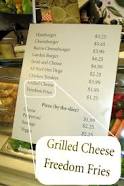
In 2003 there was an amusing international kerfuffle involving the term French fries. A politician in the United States named Bob Ney got himself in a knot over France not agreeing to the Iraq War and took exception to French fries being offered in his cafeteria so he had the item relabelled on the menu as ’Freedom fries’ to make a childish point. Mr. Ney is clearly an example of someone who might walk around with a chip on his shoulder. Here is Lera Boroditsky showing how language and this coined term was used to politicize the event. https://www.youtube.com/watch?v=YL8cZ6nmWPg .

What I love about the English language is the variety of ways I can use the same word. Wood chips don’t elicit a watery mouth (except perhaps if you are a beaver) yet those kind of chips conjure a smell of resin and the damp basement where my father would create carvings out of pine logs. I’d like to say I’m a chip off the old block but I don’t carve or make potato chips. I content myself with ordering the popular side dish when I’m checking out a dining spot. It’s hard to not think about chips, and get a craving, because the word is used in so many ways. Children of my generation laughed at the adventures of Chip&Dale. https://www.youtube.com/watch?v=wlmdWP0Y8e4 . Go to a casino and you need a supply of chips. Better keep a chipper attitude because your friends might accuse you of being too ‘chippy’. I try not to let what others think of me to get me down so I just let the chips fall where they may. I even had a childhood friend whose nickname was Chip.

The frequent use of the word chip, in many contexts, makes me hungry. Lately I’ve found the best chips from food trucks, but they’ll never match the batch from me mum’s fryer.