Re: Poetry

I believe that Art (the essential practise, not the person) saves the world. From what, you might ask. Well, some may deny it, but the world would be a darker place without Art in its many forms. And I’m not talking about the art only accessed through galleries, theatres, or museums. I’m referring to the art that comes from within us; that creative process that can drive our imaginations. Art is found in nature, is replicated by human, and is a particle of the soul. By definition, Art was present at the moment of creation, and will remain to be witnessed long after humans have become extinct.

Poetry is an art form; an item on a page to be read, an expressive line to be spoken, an incantation to soothe, or a melody to be sung. Poetry is a practise, a methodology, and a natural response to our environment. A poem is often the first piece of writing read aloud to young children. When a mother sings a lullaby to her child, she is evoking a rhythmic talisman of love that was born centuries before and will light up lives for centuries to come. Blessed are the children who are encouraged to find the Art within.

Having said all this grand stuff I don’t wish to be imagined as this poetry-reading exclusionist. I don’t believe that a poem a day will keep the boogey-man away. However, I have been calmed by coming across a poem in a magazine, written on a subway wall, or copied onto a social media posting. I have written, mailed, or sung poetry for my lovers, relatives, friends, and once for an enemy. The latter poem –– scribbled in a rage of hateful words on a scrap of paper, spat on, torn into tiny pieces, buried in a muddy stream bank and stomped on –– was never delivered. Poems can relief stress. Poems can heal. Practising poetry can be a form of meditation. Poetry helps us to become our best selves.

I could list poets who have inspired me to recognize that I contain multitudes. Poets, who suggest that we have value because we are unique, need to be heard. Shel Silverstein comes to mind: My skin is sort of brownish/Pinkish yellowish white/My eyes are greyish blueish green/But I’m told they look orange in the night/My hair is reddish blondish brown/But it’s silver when it’s wet/And all the colours I am inside/Have not been invented yet.

During my teaching career, I scheduled poetry time as part of each day. Regardless of the age of my students, joy was found during these periods of word fun. No poem was judged better or worse. Nothin had to rhyme. We all laughed or sighed at the combinations of noun, verb, adjective, adverb, or nonsensical words. Playing with words using pen on paper can be like scribbling on a sketch pad. The outcome is not as important as the process. All you need is your imagination, a few moments, and the encouragement to begin.
Re: Garden

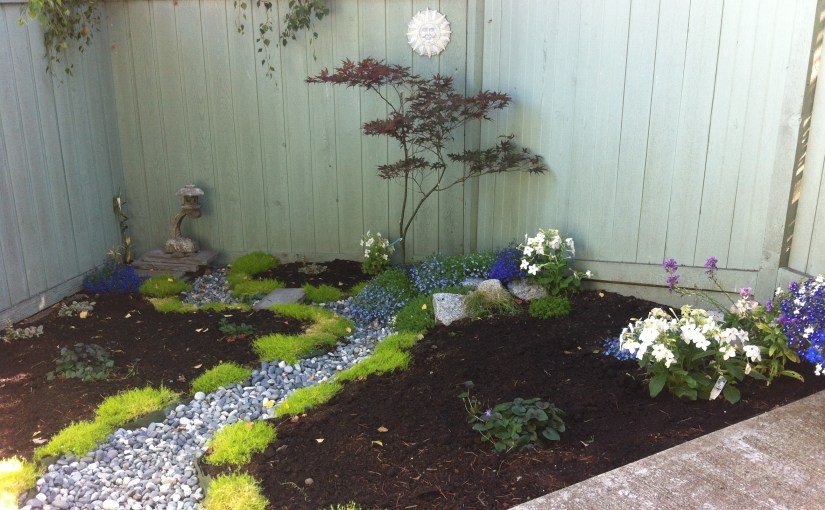
There was a side garden at the home I named Spindrift in Timmins, Ontario. It started out as a strip of lawn I hated to mow, running down the east side of the building. When we first moved there, my wife Claudia suggested it might make a pretty garden path. Over the ensuing years I built a fence & a gate to define its borders. I tore up the sod, then added fresh loam and mulch to the topsoil. My sons helped collect some slate-like stepping stones from an old mine-site nearby. Their mother found bleeding heart, forget-me-not, clover and creeping thyme to plant along the pathway. My father found this secret garden enchanting and sketched it before he died while holidaying in Portugal. His sketch was framed and hung in the front room of Spindrift, where palliative care was provided for my ailing wife. My teacher colleagues volunteered to weed & tend this special garden as Claudia’s death neared. I wonder now, having moved so far away, if this sanctuary garden still provides the delights of spring blossoms.

Currently my special mom is receiving eldercare from her only child and me in a small townhouse in Victoria. My wife Susan likes to call this narrow, three story home Treehouse Towers. A large Douglas Fir, at the west side of our house drops needles onto our small north-facing backyard garden. Black-hooded warblers love to peck and toss these needles looking for tiny forage. Inside the sliding doors leading out on this scene my 96 year old mother-in-law may eat lunch while listening to her audio books. John Steinbeck is one of her favourite authors. When she finished East of Eden she concluded that the story alluded to that first biblical garden, “Only now,” she said, “Eden is surrounded by dark clouds from an easterly wind.” 

I believe life is a garden of earthly delights even though I have never been much of a gardener, of things floral or vegetable. As a former teacher I like to think I helped nourish children in the manner of the original idea behind the Kinder-Garten. My birth mother told stories of how she and her teen girlfriends would create Victory Gardens, which were being promoted as a way of providing much needed food during WWII in England. Amidst the bombing raids she said that working on the land with shovel and hoe provided a sense of hope. Not having a green thumb doesn’t stop me from planting seeds of other sorts to keep my feelings optimistic.

The original story, The Secret Garden by Frances Hodgson Burnett has been visioned in many art forms. In all versions, The Garden is depicted as a transformative place where fears can be overcome and confidence restored. The needs of the plants become metaphor for human basic needs: warmth, sustenance, order, health, and community. There is loss along with new growth found in any garden. Life is discovered here, even amongst tangled weeds. A garden may have a wall, or fence, yet a gate can be found through which joyous secrets can be explored.

Re: Outcome

I don’t remember when I first learned about compound words. Every word has a certain power when used effectively. A hyphenated word brings an idea together quite nicely while two or more words that are smashed together can be particularly enlightening. For a planner like me there is something very satisfying when all my organizing, mapmaking, list-making and future gazing creates an outcome that fits the contents of my imagination.

Our personal stories are often crafted to have outcomes that put us centerstage. In our vision of life, past or future, we tell our tales of adventure, defeat, disappointment, shame, honour etc. within the context of how we wish To Be in the world. I went on a much needed four-day holiday with my partner to an island retreat. I hadn’t anticipated getting lost in this fairly remote place, but I did, get lost. But it was temporary. A stranger appeared, literally driving out of the nowhere woods. I leapt from my car, waving my arms to stop him from going further along the dirt track. He smiled, led us to our destination only five minutes away, then vanished in a shower of small stones. The outcome, besides my embarrassment, was a good story of my fallibility.

At the Pearly Gates of Heaven, so it is said, you will discover the outcome of your existence. Someone will have kept a notebook of your transgressions and accomplishments. You will be judged. Of course you will likely disagree with the assessment. You will have kept your own ledger of regrets, misdemeanours, sacrifices, and awards of distinction. This island paradise I visited was Eden-esque; it certainly felt like heaven. While there, I talked with a young fellow about the importance of family. He was determined to tell me about how his life changed after becoming a father. He said he couldn’t have anticipated such a marvellous outcome as his crying fragile baby, turning into the boy that he so dearly loved.

For business types, the outcome is only read as the bottom line. The great Hudson’s Bay Company, established as a cornerstone for Canadian commerce back in 1670, recently died. From my point of view it was a case of neglect by rich folks less interested in history and more in profit. The outcome: Bankruptcy. I pushed my mother-in-law around our local HBC in a wheelchair. She commented on the bare aisles and naked mannequins. We both thought that the space felt like a garage sale. Our outcome: A feeling of loss.

On this temporary island of welcomed respite, my wife and I watched the tides filling and emptying a lagoon twice daily. We could gaze out our shorefront window and intentionally develop a new rhythm; one defined by more natural needs and intentions. Time felt less important here, we tended to ignore our digital handcuffs. The inbox and outbox of our manufactured world lost meaning. Our existence in this curious world felt familiar. The outcome of this experience has yet to be fully determined, but there can be no limit to our imagination.

Re: Quaint

I used this word in a recent game of Scrabble. I got a score of 66 because I had the Q tile on a triple letter score where an I tile was exposed at a corner intersection, so I could get two words for a single play! I felt that Qi circulating as a life force of victory. My wife later captured a coveted seven letter word besting me and raising the ceremonial cup. Scrabble is a quaint game.

Quaint is the kind of word that, if used more often, has the potential to change the mood of a nation. I’m not talking MAGA, move back in time, dump progress, that sort of thing. No! Quaint is a beautiful old English word, rich with various meanings and applications. Quaint could be used in the context of a cleverly devised construction such as: “What a quaint looking chair!” Most people might use the Q word as a reflection on cuteness, which is OK but limiting. I wouldn’t put quaintness in the realm of a picture of a puppy, for example.

Currently my wife and I are providing eldercare to her 96 year old mother. This aged lady lives in our home and provides many moments of enjoyable exchanges. She says she loves a good conversation but will rarely start one; that’s quaint to me. Once I bring up a topic however, she will contribute some fascinatingly obscure points of view. When she uses words like Tarvia, or trousers, I feel a connection to another time while still being grounded in her present moment.

The other day a sales clerk in a store I was visiting gave me helpful feedback on where to find what I was looking for. We had a friendly dialogue which seemed to amuse her enough to say that she thought me charming. This remark made me suggest she had an old-fashioned way of speaking, to which she giggled, “People say I have an old soul.” The conversation that day, on reflection, could have been held in an old-timey London milliners shop, a scene in a play, or part of a serial book written by Charles Dickens. I would consider that master of the English language to be a Quaint-essential author.

Some words evoke a feeling rather than a fact. Quaint feels cozy, like a country cottage with a wood burning fireplace. Quaint exudes hearth and home. It is a timeless word, yet of-a-time. I wonder if a person could quaintly go about their business. I picture the character Geppetto doing just that as he pieces together the wooden parts that will become his Pinocchio, a puppet desiring to be a real boy. When I think of any sort of home-made craft my head spins with all the quaint aspects of bringing art to life.

My aging mother-in-law enjoys listening to her house mates play Scrabble. Even in her blindness she seems to gather warmth from the kitchen as my wife prepares a meal. She probably doesn’t realize that she is adding to the quaintness of our existence.

Re: Bond

Bond is a four letter word like Love. Of course when I say this word out loud I want to continue: “Bond, James Bond.” Being a film lover, I have much respect for the longevity of the Bond franchise (25 movies all told, unless you count the 2 rebel outliers). I read recently that the Broccoli caretakers are on the search for the newest iteration of this iconic spy character. Good luck to the producers as they navigate the sticky issues of misogyny, political correctness, sexual diversity, and national identities.

Love of any sort starts with attraction, then association, and eventually an adhesion of sorts. When we make a vow or sign a contract we have joined ourselves to another. Those ties are binding until we find the original circumstances have changed in some way or another. We all have certain attractions to things, both natural and unnatural. We feel bonded to our pets, our family, our friends, and our possessions. Those bonds can often be hard to explain, difficult to maintain and tricky to break. Emotion, history and convenience are involved.

My dad used a paper glue that brushed on and had light adhesive properties for his artwork. I think it was called rubber cement and it was designed for artists who needed something to tack gently to another surface, then after the material was removed the glue could be rolled off by your fingertips. He also used a fixative in a spray can to set his pastel drawings. I learned that, metaphorically speaking, some things are meant to stay fastened while other things may be better thought of as a hasty-note.

In high school I remember saying to a prospective girlfriend, “I’m stuck on you.” I think that’s a lyric in a song by Lionel Richie. Anyway that relationship didn’t stick around, so to speak. Much later I concluded my best emotional bonds were cohesive rather than adhesive. The former is a fixation on someone of similar disposition; like minds as it were. The latter is more about the phenomenon of opposites that attract (another great song by Paula Abdul). My longest lasting bonds have been with people, women in particular, who share similar philosophies of life with me. Birds of a feather, if you catch my drift.

There is a contrariness here when thinking of magnetic attraction. North and South poles on two magnets are going to snap together when brought close to each other. I’ve been with others where sparks fly causing fusion of ideas in spite of lack of commonality. This is not a case of like-attracting-like. It’s a question of Game On! And I know some successful human bondings that are the result of a connection between two people who many would consider to be polar opposites. In those cases there is mystery at work. Maybe it’s a hidden bond that holds them up along with the friction, like a bracket-less shelf.

I am bound to freak out when the next James Bond is announced. Don’t ask me to explain it.

Re: Most

“You’re the most!” Is a declaration that someone once said to me after I delivered on a promise. This cliched phrase (a relative of ‘you’re too much’) was delivered as a thank you when I held up my end of a bargain. It was one of those humbling moments because I didn’t think I had done all that much. Apparently I went beyond much, into the superlative Most!

The word Most is related to the word Best and can be used to describe all the things you really like. Extreme yet simple words like these appeal to the novice wordsmith and to aged writers who can still relate to the wonders of life. My grandson recently learned this word and wants to use it in his daily speech. He wants to know all the Most things; like who had the most fun, the most dessert, who got the most candies. I tell him I love him the most.

If I were to list the times in my life when I did my utmost, those events would be few. I tend to be a lazy guy, lacking what some might call ambition. The time I had to travel across the Atlantic Ocean to my very ill father comes to mind quickly as an example of superior effort. When I had to respond to a leaking hot water tank required a lot of quick thinking. Sometimes I find large gatherings rather taxing, but I wouldn’t describe my efforts to show patience on those occasions as herculean. In other words, it is probably true that my life is mostly moderate instead of extreme. While I try to get the most out of any circumstance I wouldn’t say that I go overboard to create drama or intrigue. That doesn’t mean I lack enthusiasm. For example, if I say “That’s the most fun I ever had!” someone is bound to point out that I said the very same thing last week. I sometimes, usually, regularly, and predictably live as a character in the film Groundhog Day.

My 95 year old special mom just filled out her MOST form. Medical Orders for Scope of Treatment is a document that directs others to respect her wishes in the event of a life threatening medical situation. Some jurisdictions use DNR (Do Not Resuscitate) paperwork. MOST sounds more positive somehow. The majority of us would like our last moments to be peaceful, I suspect. Most of all my mom wanted to make her medical wishes clear to anyone who might wonder how to proceed on her behalf. She tells her daughter that she has had a satisfactory life and doesn’t want to be anyone’s bother when it comes right down to it.

When Ella Fitzgerald sang the great Cole porter song ’You’re the top!’ she’s giving the highest accolade while feeling joy in the moment. and to my ears she is the mostest. I hope the best I can say, when I reach my special mom’s age, is that I did the most with what I had been given.

Re: Break

Break and its homonym Brake can give me trouble when I am writing. I can imagine ESL teachers using this pair of words as examples in a humorous writing assignment. And sometimes the meaning within the sentence can give me pause to wonder why a third word hasn’t been invented to provide a better illustration.

Take Breakneck Speed for example. These two words clearly describe a perilous situation requiring brakes to be applied before physical damage occurs. “Gimme a break!” Is something shouted in exasperation, but is the person asking for time out or for someone to halt the forward momentum of the monologue as in “Shut up!” A work stoppage is not a break from routine but an effective strike action to put brakes on unfair labour practises. If someone  breaks a dish while cleaning up there is no R&R involved, just more work. Why does destroying something and taking a vacation get described by using the same word, same spelling: Break!

When you have broken a promise damage has been done and emotional repairs are needed. Perhaps your lifestyle, when it comes to your relationships, has been too fast and loose and you need to apply the brakes before more trouble comes your way. When it comes to romantic friendships we all know that breaking up is hard to do. In that case, maybe taking a break from normal routine is the best course of action before it’s forced upon you.

I’ve shared this conundrum of two spellings, too many meanings with others and they think I’m rather overreacting. When I was working on the details of this blog page I asked my 95 year old special mom what she thought. She is a whiz at spelling so wasn’t challenged by my ideas, just a bit exasperated by the reason behind my niggling point. She chewed on it, literally working through the rest of her breakfast, put down her utensils and calmly said, “That’s just the way it is.”

In Thunder Bay, Ontario the residents celebrate Spring Break, not by travelling to Florida or Mexico but by gathering in around Port Arthur to watch the winter ice break. The floes come apart making a noisy, metallic, crackling sound: Like a cross between pinewood in a fire and a waste metal recycling plant crushing cars. It’s big news every year since many container ships have had to put the brakes on their movement up the St.Lawrence River.

“Hold your horses!” I suddenly imitated a grumpy Abe Simpson bellowing to his son Homer. In my imagination I’m saying this to myself to put the brakes on this hamster wheel of thought. I then see a donkey, stubbornly taking a break and braying about his plight carrying loads so heavy he might suffer a broken bone. I picture this cartoon mule with his scrawny neck extended, and a speech bubble above his head, not saying HeeHaw but “Braaayyk!”

‘Brayk’, a new all-purpose word, meaning; ‘I’m tired please stop’. Take that, Spell Check!

ALDO

Daily writing prompt
Tell us about your favorite pair of shoes, and where they’ve taken you.

That’s the brand name of an awesome pair of sandals; open toed, foam formed, slip-on and go beauties that took me all around New Zealand for three months of Freedom Camping back in 2007.

Re: Know

Once upon a time a friend came to visit. She was known to be a bit flakey in a good way; prone to creative spurts and mystical pronouncements. She had met my wife several years before and now she wanted to meet me. I think she wanted to affirm that my bride was headed in the right direction before she decided to tie the knot, so to speak. I remember feeling I was being mildly tested. On departing she gave presents of poems to her old friend and a stone to me. I looked at what she had printed on the rock: Know.

To know, is very central to my personality and behaviour. My wife’s friend provided that affirmation having barely experienced me. I seek knowledge, knowing I will never know all that I wish to know. I’m not after omniscience, merely a competent level of understanding. My quest can be funny, pathetic and infuriating at times. For example when I am trying to sort something out I will check for multiple confirmations that I have got the message. This applies to sales receipts as well as important contracts. I wish to know that everyone involved in a decision is on the same page.

We need assurances that we have been heard, felt, or seen. No one deserves to fall through the cracks. Seeking information is the beginning of all knowledge acquisition. I used to sing in a church choir. One of my favourite hymns began like this: ‘Ask and it shall be given you/Seek and ye shall find/ Knock and it shall be opened/Be opened unto you’. Knowledge is empowering, enabling, ennobling and encouraging. Having the know-how allows me the confidence to stride forth and accomplish things.

I go about all this as quietly and unobtrusively as possible so as not to freak my people out. Say I’ve been told that I am on a wait list for a doctor, which happened to me recently when my previous physician retired. I wasn’t willing to leave things to chance so I checked with an online registry in my province. When they could confirm I was on a list I next called the local clinic to see if I was on their duplicate list. Time passed so I set out to affirm that the wheels were still in motion: I wanted to confirm the confirmation. The squeaky wheel theory very much applies in my philosophy of life. However, I like to think that my approach is more dogged, than annoying. I try to appeal to people’s innate desire to be of help to their fellow humans. I never want to get ahead in the line: Just knowing I am IN the line is satisfaction enough.

Know-it-all TV host Johnny Carson used to admit that he did not know things. Likewise I’m fine with ignorance because it allows me to get excited when I’m late to discover that Marni Nixon sung big songs in movie musicals while others lip synced her gorgeous voice. Let’s call that a ‘getting to know you’ experience.

Re: Sex

I never had a birds and the bees discussion with my father, perhaps consequently I was averse to having ‘the talk’ with my three sons. To even write about sex makes my typing fingers go all jittery. Thank goodness for auto correct while I try to navigate the politically incorrect. I may be timid about the topic of sex but I champion its inclusion in classrooms.

Currently North Americans are getting all hot and bothered about how sexuality, sexual orientation, sexual preference, and sexual identity can be taught in schools. Children’s rights are being trampled as we claw at each other over who is the responsible distributor of sex information. When it comes to sex curricula we all share the book, even though there is no single definitive volume on the subject. Parents, teachers, administrators, politicians are all probably a bit shy when it comes right down to how to approach sex.

We rarely open up about our sexual body parts. In the art world, some dare to showcase those things that are obvious whenever we step from the shower. The penis rarely gets talked about or even seen unless it’s associated with a crime scene. It is taboo in film to show a penis unless it’s a rubber one. I remember seeing an ad for a bunch of male performers who would play with their organs like a puppet (originated in Australia called Puppetry of the Penis, I never went, too embarrassed, but very curious in an innocent way). I’ve been to a performance of Vagina Monologues and remember being stunned by the bravery of the cast to talk about such intimate things. As a lover of language, I am amused by the variety of descriptions for our sex bits: A hot dog bun, a mussel, an acorn, a mushroom, a zucchini, a kiwi. Funny how we use items in the grocery store to help define what lies unexposed in our underwear. The pseudonyms for penis and vagina, even breasts, can fill a book or at least the length of a comic’s stand-up routine. Over sexualizing our body parts is part of the communication problem. An abundance of puritanical privacy and secrecy makes any issue of sexuality ripe for problematic intercourse or discourse.

Sex is an activity, an orientation, an identity or a bad word depending who is doing the talking

Much of what I thought I learned as a child about sexiness came from Playboy magazines that my friend and I would find in our apartment building’s basement storage lockers. We’d show each other pictures, giggling nervously while wondering if we’d get caught. When I taught students of that same age in sexual health classes, I was professional enough to engage them seriously. Many parents sat in on my tutorials, telling me how discussion continued with their children after going home. The recent British television drama Sex Education does an excellent job breaking down stereotypes and common misconceptions.

Conquering our bashfulness will be a first step toward talking to each other about who we are meant to be.