Re: Crisis

What one considers a crisis is subjective. I write this knowing that the troubles in my life can’t be ranked on the scale of dilemmas others in the world have now, or will experience. For example, on tonight’s news, I just watched horrified as hundreds gathered at the Kandahar airstrip clambering onto the fuselage of a taxiing aircraft. That was a scene of crisis on an unforgiving and unforgivable scale.

One could say that our thoughts on crises are all relative. Yet that is so dismissive. I’ve known people who would not admit their troubles just because they thought others suffered more. That would be like not talking about love because you feel outclassed by romantic stories you have heard others share. Shakespeare, Byron or Browning would advise you to proclaim your love in words relatable. Every person’s feeling has value, from woe to whimsy. Judgements on the quality or quantity of your experience will only send you into a crisis of confidence.

I’ve had momentary crises; like locking my keys inside my car, forgetting important papers for a meeting, or getting stuck in traffic. I’ve had prolonged crises that have required persistence and courage. Recently my hot water tank burst moments before I came downstairs to make my morning coffee. I stepped into a puddle of water and immediately panicked but then sprang into action, took off my terry towel bathrobe with a Sir Frances Drake flourish, dropping it on the water so I wouldn’t slip. I turned off main valve and clicked the power switch to the unit. I called the plumber to arrange repair, mopped and prepped the area. Within 30 hours from start to finish it was all sorted. I felt gratitude that I had been there to catch the situation before it became the crisis that it wasn’t.

We can’t always be so lucky. And yet our imaginations can lead us into crisis mode so quickly. A problem that is hard to solve at first glance may be deemed a crisis, that’s when you need help and you need to work toward a solution. I’m learning to be more critical while in the throes of a crisis. Even a moment, for prayer or meditation, can give me the time gap needed to act more efficiently, prudently, safely. I worked with a school principal who told me he handled a crisis by giving it to someone else. Others I’ve known have been able to just let things be. https://www.youtube.com/watch?v=-TGg7cGQRlg

As far as the climate crisis goes we can’t just let it be. Neither can we turn it over to someone else to fix. Regular maintenance of our selves, our institutions or our systems will minimize problems. The evidence of our neglect of the planet has been around for many years and yet we continue to fail to act. We ignore all warning signs of a crisis at our peril. Now we find ourselves in a perilous planetary situation. Our Earth is calling for a common collective critical response.

We must answer.
Re: Bank

Where I spent my formative years there was a small river that wound its way to Lake Ontario. Its banks were muddy, with tangled roots grasping for water. I hid plastic toy soldiers amongst these fibrous tendrils, lit small red firecrackers to imitate war. It felt safe here, with my back against the wall of cool earth, watching the creek water smoothly trickle past my feet.

I have Scottish ancestry so I feel a yearning kinship while humming the lilt from ’On the Bonnie, Banks of Loch Lomond’. https://www.youtube.com/watch?v=gb8AGuD2uOI

One of my favourite television shows from that time was the hypnotic black and white classic, ’Tales of the River Bank’. The creators seemed to imagine exactly what was on my mind as I used small toys to create a miniature world. https://www.youtube.com/watch?v=-VTn6VlUXNA

I took to television with an eye for more than entertainment, like many in a previous generation had immersed themselves in books. While I did find comfort and escape in reading my mind quickly awoke to world issues. I chose stories that spoke of adventuring to different lands on the open sea. I could bank on authors like Farley Mowat to set a pleasing compass course by spinning tales of non or near fiction. His stories of man and nature contrived to inspire and are so relevant to today’s angst over the decline of Earth’s natural resources. In early adulthood, I wept through parts of ‘A Whale for a Killing’ and later gasped at the abundance that once was found off The Grand Banks off Newfoundland in ‘Sea of Slaughter’. In high school my Student Aptitude Test results indicated I was destined to be either a Banker or a Lighthouse Keeper. Hardly occupations for my adventurous spirit! When my mom found out I clearly remember her show of disappointment while my father made a joke of it by saying, “I wouldn’t bank on it son.”

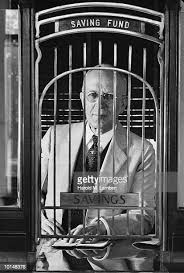
In the northern Ontario town where I spent my career my neighbourhood bank had a history dating back to Gold Rush days. When I first strode in to open an account I was awed by how much it reminded me of the banks depicted in the film Butch Cassidy and the Sundance Kid: Lots of wood, brass and a mammoth safe standing sentinel in a corner. It’s hard to believe that this was in the late nineteen seventies! Two tellers sat behind antique looking arched frames with vertical bars. There was a small safety deposit box room at the very back but the only other room was one accessed by a heavy oak door on which was carved the manager’s name.

I enjoyed having my bank book stamped and updated while chatting with the tellers. When a new bank branch of chrome and glass was built into a modern mall nearby, some new fangled ATMs were installed. My sons taught me how to use them. It took time for me to feel safe along the walls of this bank.

Re: Make

I think making things is the highest calling. Humans were created to create. When I talk to my grandchildren I ask them what they made today. I want to know what they’ve been up to, what they might have done or thought about doing, before I comment on their cuteness. When I was a teacher of elementary school students, making something was an important part of our day. During guidance talks we would discuss ways we could make things, rather than take things. And sometimes at the end of a day, the best thing we’ve made is someone smile.

My dad would often read me something he had just read from his newspaper, then he’d start a conversation by asking, “What do you make of that my son?” Making sense of the world was of paramount importance to my father. He practised several art forms, admitting that the act of making things from scratch helped him sort out his troubles. My first wife was a determined craftsperson whose skills in homemaking helped our family of five make ends meet.

When I start writing a think piece like this one I make it up as I go along, because it’s a work in progress. And sometimes the process of making things can be reason enough. There is an element of ‘fake it til ya make it’ like jello cooling in the fridge. A bit of writing can look like it’s complete but still not quite set. When I make dinner I rarely follow a recipe, trusting that when I get everything plated that it will be as tasty as I had imagined. Sometimes what we make is never as perfect as we would like it to be.

We say the word Make many times throughout our conversations: Make the most of it, make a mess of it, make sense of it, make a mountain out of a molehill, make hay while the sun shines, make war, make peace, make love, make out, make money, make do, make sure, make your mark, make the best of a bad situation, Make.Some.Noise!, make amends, make it happen, make your way in the world, make a promise, make light of a situation.

Globally we are in a climate crisis partly due to our productivity. We are making things that have  changed the health of our environment. Many modern day prophets have been warning us that we need to make up for our mistakes before it is too late. I continue to hope that humans have the capacity and creativity to remake the agenda of prosperity; to fashion it for all not the few, to take from nature only that which can be replaced, to think of needs more often than wants.

“What do you want to make of yourself?” Might be a question I pose as I’m gazing into the mirror of my thoughts. The answer changes with age and circumstance. Many things make us who we are in this present moment, yet life is truly what we make of it.