Re: Poetry

I believe that Art (the essential practise, not the person) saves the world. From what, you might ask. Well, some may deny it, but the world would be a darker place without Art in its many forms. And I’m not talking about the art only accessed through galleries, theatres, or museums. I’m referring to the art that comes from within us; that creative process that can drive our imaginations. Art is found in nature, is replicated by human, and is a particle of the soul. By definition, Art was present at the moment of creation, and will remain to be witnessed long after humans have become extinct.

Poetry is an art form; an item on a page to be read, an expressive line to be spoken, an incantation to soothe, or a melody to be sung. Poetry is a practise, a methodology, and a natural response to our environment. A poem is often the first piece of writing read aloud to young children. When a mother sings a lullaby to her child, she is evoking a rhythmic talisman of love that was born centuries before and will light up lives for centuries to come. Blessed are the children who are encouraged to find the Art within.

Having said all this grand stuff I don’t wish to be imagined as this poetry-reading exclusionist. I don’t believe that a poem a day will keep the boogey-man away. However, I have been calmed by coming across a poem in a magazine, written on a subway wall, or copied onto a social media posting. I have written, mailed, or sung poetry for my lovers, relatives, friends, and once for an enemy. The latter poem –– scribbled in a rage of hateful words on a scrap of paper, spat on, torn into tiny pieces, buried in a muddy stream bank and stomped on –– was never delivered. Poems can relief stress. Poems can heal. Practising poetry can be a form of meditation. Poetry helps us to become our best selves.

I could list poets who have inspired me to recognize that I contain multitudes. Poets, who suggest that we have value because we are unique, need to be heard. Shel Silverstein comes to mind: My skin is sort of brownish/Pinkish yellowish white/My eyes are greyish blueish green/But I’m told they look orange in the night/My hair is reddish blondish brown/But it’s silver when it’s wet/And all the colours I am inside/Have not been invented yet.

During my teaching career, I scheduled poetry time as part of each day. Regardless of the age of my students, joy was found during these periods of word fun. No poem was judged better or worse. Nothin had to rhyme. We all laughed or sighed at the combinations of noun, verb, adjective, adverb, or nonsensical words. Playing with words using pen on paper can be like scribbling on a sketch pad. The outcome is not as important as the process. All you need is your imagination, a few moments, and the encouragement to begin.

Re: Drawer

This word must be hard for ESL students. I taught elementary school kids and they would have more trouble with words if they were hard to pronounce. Drawer has a sound like shore when it’s used in sentences about places to put things. But an artist can be a draw-er, which makes me think of someone involved with practising law, which puzzles me even more because that person is a lawyer, which is consistent with someone who works with wood who might be a called a sawyer. Poor students! Imagine the questions if I assigned The Adventures of Huckleberry Finn and his friend Tom who explored the Mississippi River while dressed in muddy cotton drawers!

My dad was a drawer. He would draw on his life experiences to tell fabulous tales. In that sense he was a collector of curiosities & thoughts, in another sense of the word he actually drew stuff. He used a pencil to sketch or a brush to add colour to his surroundings. His drawings were his perception of the world, put on paper. He was sometimes commissioned to replicate a favourite dwelling. One house-proud person was so delighted by his pastel reproduction she exclaimed, “That’s exactly how I see it when I’m turning into the driveway.” When he told me this story and showed me the photo he had taken, I noticed he had left out a telephone pole, and a hydrant, from his final sketched landscape. I understood he was a drawer in that instant. He allowed that the homeowner would draw her own conclusions, all the while anticipating her human need for fantasy.

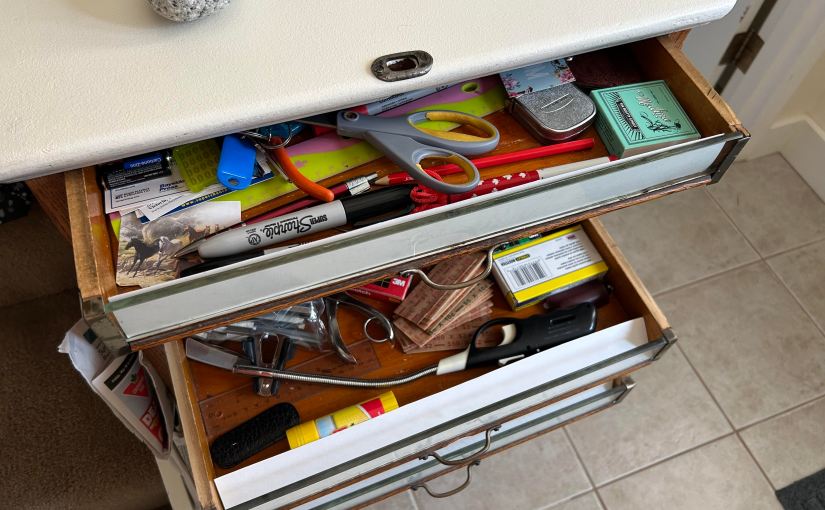
Everyone has a junk drawer, sometimes in the kitchen, sometimes in the bedroom. Like a magpie we collect stuff and toss them here for when we think we might need them. Even things that have no use. If you can’t afford a place with an attic or basement crawlspace, a drawer will do to hide those old love letters, secret things, or stuff not worthy of the knickknack shelf. My mom had a glassed-in corner curio-cabinet with shelves that could be pulled out for closer examination. She kept her thimble and teaspoon collections in these suede-lined drawers. I can picture her in my childhood memory excitedly drawing on a cigarette as she talked about the origins of these treasures. She let the ash fall where it may.

Thanks to my dad’s influence, story telling later became a big part of my teaching curriculum. I often read fairytales to instigate study of other subjects. I remember one student designing an efficient water well, for a science fair project, after hearing Diamonds & Toads by Charles Perrault being read in class. Together, other students did their research and discovered there were many fables based on the drawing of water from wells. My essay is about to draw to a close. Let your imagination wander.

Re: Blame

A young woman surprised me while sharing a story, saying she solved problems by finding someone to blame. There have been times when I’ve played the Blame Game so I wasn’t judging. However, I was shocked that pointing-the-finger would be her first choice for getting out of a difficult spot.

I believe it’s true that a finger, when pointed, will eventually turn back in your direction. Finding fault only stalls the effort to find a solution. In British Columbia we have no-fault auto insurance for that reason. When a traffic accident occurs, let’s conclude that what is needed is a resolve: fix the bumper, comfort the injured, and otherwise repair the damage. In all but the most unusual cases, if we drag each other to court then more problems will arise. I like that policy. Wouldn’t it be great if we went about resolving all our human woes by recognizing that we all play a part in the great dynamic of human existence.

It’s not always easy to concede though. Reconciliation takes time and cooperation. Sometimes we have to show humility even when we are bursting with self righteous indignation. I’ve been practicing putting myself to one side when I feel the upwelling of emotion. It’s not fence-sitting; more like going to a safe corner during a boxing match. In my mental time-out position, while I calm down, I can watch my imaginary, alternative self give some unnecessary blows. At the ring of the bell, ending this imaginary sparring, I can take stock, knowing I haven’t done any real damage by wanting my Point (jab, uppercut) to come first. Going for a knock-out punch is rarely necessary.

Victim impact statements are a bit like blaming, at least on the surface. Stating how another’s actions have altered your sense of security have value for the victim in getting feelings aired. The perpetrator of the offence may even learn something, or change their life-path. In a justice sense, finding fault is only really helpful if it changes the way we operate society’s systems. In other words, if we can truly find out the why of things, then maybe the answer will point the way to eliminating the origin of the problem.

While watching the film ‘Longing’ I was struck by the number of intersections we arrive at in life. These fictional characters discover some extremely challenging facts requiring them to choose: Do I go forward, back, or a multitude of sideways paths? Hopping on a Blame Train might have made their ride easier in the short run, but I liked the way restitution was found when apologies were given and allowances made, even in the face of trauma. This was the road less travelled. This was how to find truth and reconciliation.

In real life, we are all responsible for the wider picture. Most times the best thing to do is consult yourself first, without guilt. Blaming yourself is as bad as blaming others! Seeing the ultimate goal as being a learning experience will calm your urge to say, “Why me?”

Re: Music

I like movies that contain music, subtle or overt. I once rented a VHS tape called Evita starring Madonna and the desk clerk asked me if I was aware that the film was a musical. My look of surprise made her ask, “Do you still want it?” Apparently the tape had been returned many times because folks were put off by the fact that all the actors sang something. Apparently taste can be found in ears as well as on the tongue.

I get hijacked by music. I don’t choose to have music playing while I work or fuss around the house. Music finds me when I’m going about my business though. In a store it will follow me as I look for blue jeans. I’ll chew my food in rhythm to a restaurant’s playlist. I get the music in me despite having no musical training. My musician friends are amazed when I answer their skill testing questions. Instrumentalists are artists I admire enough to pay money to watch them perform. I’ll sometimes linger by a street performer because the air itself seems somewhat different as it blends with the melody. It sparkles!

Imagine the first gasps of wonder as ancestors in caves created vocalizations or tapping sounds on bones and stuff! My perfect world has people singing or humming all the time. Paul Simon was once asked his greatest thrill at being famous. He said he is always delighted when he passes someone on the street murmuring one of his songs. Music has been described as a soundtrack to our lives and that’s probably why I get earworms of melodies that imbed themselves in my head and just won’t shake loose until I hear another tune. Who doesn’t find themselves joining in when they hear a familiar lyric from a car radio: Home where my thought’s escapin’. Home where my music’s playin’. Home, where my love lies waitin’. Silently for me.

Music is said to soothe a savage beast or breast. Speaking of which, our inner child remembers a mother’s lullaby while being fed and cradled, so we naturally associate sound with comfort and joy. But sometimes music incites when it’s linked to parades and protest. I’ll never forget marching behind a bagpipe with my teacher colleagues during strike action against our government. Anarchy can have a soundtrack too.

I may not have a cultured musicality or practised musicianship. My only music lesson was a month of violin. I’ve winced when hearing snobbish comments at a concert venue: Being a wine connoisseur is one thing but music is for everyone. Ranking of a musical piece is not a requirement for me, appreciation is key. I have trouble with some genres like Rap and my easy listening preference tends towards Folk but I love being surprised by sound. The long retired television series ‘Glee’ enthralled me. Opera may be tedious at times but it gets my respect for being the origin of the staged musical. Music in any form is to be lived.

I got rhythm. I got music. I got my gal. Who could ask for anything more!

Re: Reflect

Reflection requires a certain amount of stillness which is challenging my body’s circulatory system. I’ve got a case of chilblains in my toes as a result of too much idle thinking which is freaking me out. I’m of an age where parts go missing or malfunction. I have a personality that is suited to pondering and puzzling so I think that should ward off dementia but it seems my body is being sacrificed while I attend to intellectual matters. 

My current three common activities are like the classic educational three R’s adapted as: Reflect, Read, wRite (the last one is a cheat but makes for the alliteration, so what). Truth is I prefer to reflect, rather than deflect. Issues are important for me. I probably dwell on general news items too much for my own good. I’m a good muller. I like to share my reflections when anyone cares to listen. My 95 year old special mom likes my cerebral wanderings and we often have great dialogues. Reflecting on stuff has helped with her memory and gives me insight into my own aging process.

We both read a lot during the day. She likes to listen to her audio books while my wife and I catch a film on television. Since she has a headphone set, it’s a fine arrangement so that we can keep track of each other all in the same room. It provides an Upscale Nursing Home atmosphere: Complete with kitchen privileges. When I ruminate on the way my life has changed with the advent of Elder Care, I’m glad I can see the humour at most times because when I glance at myself in the mirror I notice the telltale signs of stress and fatigue. I figure getting these observations down on this website will help me laugh when I have time to review these seemingly endless days of routine.

In years gone by I used to see myself reflected in my kids. My eldest I thought carried my enquiring mind, my middle son knew how to look on the bright side of life, and my youngest exhibited my peace loving soul. I pictured them growing up happy and, by and large, they have. To gain a perspective one must reflect. Narcissus of Greek myth fell into a pool because of a singular point of view so his story tells us to include others, resisting the vain notion that only our reflections count. 

Truth be told I rarely spend time examining my mirror image. My wife will straighten my mussed hair with gentle fingered caresses and that suits me just fine. She and I have developed a way of mirroring each other’s feelings so that conversation becomes more revealing. Our own individual thoughts can often lack clarity. Two people ruminating offers surprising revelations and outcomes. Like two songbirds playing off of each other’s melodies perhaps. In my retelling of Echo and Narcissus I see the two lovers being blessed for respecting each other’s uniqueness. That way they look into the pool in unison, loving what they behold. It’s a selfie!

Re: Know

Once upon a time a friend came to visit. She was known to be a bit flakey in a good way; prone to creative spurts and mystical pronouncements. She had met my wife several years before and now she wanted to meet me. I think she wanted to affirm that my bride was headed in the right direction before she decided to tie the knot, so to speak. I remember feeling I was being mildly tested. On departing she gave presents of poems to her old friend and a stone to me. I looked at what she had printed on the rock: Know.

To know, is very central to my personality and behaviour. My wife’s friend provided that affirmation having barely experienced me. I seek knowledge, knowing I will never know all that I wish to know. I’m not after omniscience, merely a competent level of understanding. My quest can be funny, pathetic and infuriating at times. For example when I am trying to sort something out I will check for multiple confirmations that I have got the message. This applies to sales receipts as well as important contracts. I wish to know that everyone involved in a decision is on the same page.

We need assurances that we have been heard, felt, or seen. No one deserves to fall through the cracks. Seeking information is the beginning of all knowledge acquisition. I used to sing in a church choir. One of my favourite hymns began like this: ‘Ask and it shall be given you/Seek and ye shall find/ Knock and it shall be opened/Be opened unto you’. Knowledge is empowering, enabling, ennobling and encouraging. Having the know-how allows me the confidence to stride forth and accomplish things.

I go about all this as quietly and unobtrusively as possible so as not to freak my people out. Say I’ve been told that I am on a wait list for a doctor, which happened to me recently when my previous physician retired. I wasn’t willing to leave things to chance so I checked with an online registry in my province. When they could confirm I was on a list I next called the local clinic to see if I was on their duplicate list. Time passed so I set out to affirm that the wheels were still in motion: I wanted to confirm the confirmation. The squeaky wheel theory very much applies in my philosophy of life. However, I like to think that my approach is more dogged, than annoying. I try to appeal to people’s innate desire to be of help to their fellow humans. I never want to get ahead in the line: Just knowing I am IN the line is satisfaction enough.

Know-it-all TV host Johnny Carson used to admit that he did not know things. Likewise I’m fine with ignorance because it allows me to get excited when I’m late to discover that Marni Nixon sung big songs in movie musicals while others lip synced her gorgeous voice. Let’s call that a ‘getting to know you’ experience.

Re: Education

Why education is not free for all I do not know: For knowledge, like love, is as central to our existence as the air we breathe. Acquiring an education can come by differing methods; Formal education must be part of the social contract and paid for through our tax system. We must be culturally encouraged to self educate through many different delivery modes. And of course the school of hard knocks can be enlisted, edited, analyzed by each individual in a life long learning manner.

I’ve spent a lot of time in school buildings. If you count my childhood years and my teaching career, I’ve spent half a century within hallowed halls. I respect the institutions of education enough that walking near such places of study today gives me emotional sensations of hope and positivity. I can readily recall my grade school teachers: Mr. Stroud, Mr.Green, Mrs. Fourfar. Their names don’t matter so much as the information and encouragement they imparted. My parents instilled in me the value of education too. By example the gave me the prerequisite for all thought: Curiosity.

I believe that learning is a quest, an imperative to a fuller life. I ache to acknowledge that some in this world do not have the opportunity to have an education. Some religions still forbid entrance to schools of learning. Girls are still denied an equal footing in many places of study.

I believe much of the dissatisfaction found in the world today is due to the corralling of knowledge and information by those who wish power. Equal access to education for women and men diffuses the centralized vision of control, bringing balance and a shared imperative to community. Reading is at the heart of self education. Text brings intellect to life. Insight is gained from words used in different contexts. Imagine a universal book club. We begin by sharing the latest of what we’ve read. I delight in hearing my blind mother-in-law describe her latest discovery from her audio selections. Her reporting of information makes me recall listening to old radio shows when I was an infant.

To know is to be. Central to the entrapment explored in the film Women Talking is girls not being allowed to go to school. “No more pencils/no more books/ no more teachers/ dirty looks” is not something to promote in a policy document. “We don’t need no education/ We don’t need no thought control.” Is an anthem about revolution over a centralized authority. The subjugation of indigenous children to the atrocity of residential schooling brings a sadistic meaning to the school of hard knocks. We learn through our experiences and I believe our most relevant lessons are best delivered with love, not fear. We can only become our best selves when we are nurtured in the practises of daily life. We each have a role to play in educating each other; providing information as we would a gift, not withholding knowledge as though it were a secret.

We left Eden a long time ago. The whole wide world awaits.

Re: Sex

I never had a birds and the bees discussion with my father, perhaps consequently I was averse to having ‘the talk’ with my three sons. To even write about sex makes my typing fingers go all jittery. Thank goodness for auto correct while I try to navigate the politically incorrect. I may be timid about the topic of sex but I champion its inclusion in classrooms.

Currently North Americans are getting all hot and bothered about how sexuality, sexual orientation, sexual preference, and sexual identity can be taught in schools. Children’s rights are being trampled as we claw at each other over who is the responsible distributor of sex information. When it comes to sex curricula we all share the book, even though there is no single definitive volume on the subject. Parents, teachers, administrators, politicians are all probably a bit shy when it comes right down to how to approach sex.

We rarely open up about our sexual body parts. In the art world, some dare to showcase those things that are obvious whenever we step from the shower. The penis rarely gets talked about or even seen unless it’s associated with a crime scene. It is taboo in film to show a penis unless it’s a rubber one. I remember seeing an ad for a bunch of male performers who would play with their organs like a puppet (originated in Australia called Puppetry of the Penis, I never went, too embarrassed, but very curious in an innocent way). I’ve been to a performance of Vagina Monologues and remember being stunned by the bravery of the cast to talk about such intimate things. As a lover of language, I am amused by the variety of descriptions for our sex bits: A hot dog bun, a mussel, an acorn, a mushroom, a zucchini, a kiwi. Funny how we use items in the grocery store to help define what lies unexposed in our underwear. The pseudonyms for penis and vagina, even breasts, can fill a book or at least the length of a comic’s stand-up routine. Over sexualizing our body parts is part of the communication problem. An abundance of puritanical privacy and secrecy makes any issue of sexuality ripe for problematic intercourse or discourse.

Sex is an activity, an orientation, an identity or a bad word depending who is doing the talking

Much of what I thought I learned as a child about sexiness came from Playboy magazines that my friend and I would find in our apartment building’s basement storage lockers. We’d show each other pictures, giggling nervously while wondering if we’d get caught. When I taught students of that same age in sexual health classes, I was professional enough to engage them seriously. Many parents sat in on my tutorials, telling me how discussion continued with their children after going home. The recent British television drama Sex Education does an excellent job breaking down stereotypes and common misconceptions.

Conquering our bashfulness will be a first step toward talking to each other about who we are meant to be.

Re: Retire

I’ve been retired from a career in teaching for seventeen years. I’m not tired of it. Back in 2006 I had reached the magic formula that gave me a full pension so I embraced the moment to call it quits. I told my friends, family, students, whoever would listen. During one of my last recess duties a six year old came up to me with her friends in tow. “You’re not going to be a teacher anymore?” asked one kid. I nodded. “I told you he’s retarded.” stated another little scamp. I reminded them all that the R word wasn’t polite and that I would be retired after Christmas. “See!” one student shouted as they scattered through the playground. I still miss the children, but not the job.

I wonder what the word retire really means. After a working life in education, I took a job with my wife in joint resident management of a condominium. During those five years in a new community I also did a lot of volunteering. I wasn’t as idle as the designation of Retired might suggest. I wasn’t even technically a senior citizen yet. I had relocated, reconnected, reestablished, renewed, reconsidered and revamped my life. Those labels don’t appear on drop down menus from online surveys of employment status. My life didn’t end when I halted my career. Some of my most active years were still ahead.

Workers are being slammed/shamed by some employers these days for being selective about how they see work after Covid19. There is a workers’ revolution underway and it’s about a quality labour environment. Union membership is on the rise again as a reflection of employees wanting a greater stake in their workplace choices. Consideration of preservation and equality of retirement benefits is part of the negotiation demands. We are currently living in an age of record profits for companies and share holders and yet workers, who create the wealth, are being scorned for wanting better employment conditions. Labour must be honoured.

Life long learning is a banner slogan and a quest that I take seriously. It used to be that some folk might be called ‘retiring’ in attitude or behaviour. I’m not someone who is reticent about revealing my feelings. I consider myself to be an introvert in general, yet I will never retire from standing up for a just cause. Education is key to my continuing to feel that I have a place in my community and my society. Right now I am doing lots of reading; a great activity during one’s retirement years!

There were times during my full time working days when I wanted to sing out and declare to my boss ‘Take this Job and Shove it!’. When I was on the countdown to my last day of teaching I cut out a large ad from a local furniture store; Don’t Pay Until 2006. I pinned the reminder to my cork board behind my desk. Children in my classroom may have had trouble with the concept of being retired, but I sure didn’t.

Re: Sign

We have tried to find significance throughout history for the meaning of stuff. Shaman’s and soothsayers, seers, witches and warlocks would take mystical readings of signs revealed only through their extra sensory powers. From an eye of newt or an eagle’s claw the fortune teller could predict the future and our place in it.

Some signs we must obey. Some signs can tempt us to misbehave. Other signs we ignore at our peril. Quite a few signs seem so absurd they seem meant to make us laugh. The Five Man Electrical Band had a groovy song about being pissed off with so many signs. Here’s a version of that song with some far out signage someone posted on YouTube.

https://www.youtube.com/watch?v=qLm3HMG8IhM

When I was in my late teens I got interested in calligraphy. I was fascinated with stories of how some criminal cases could be solved by examining the handwriting found at the scene of a crime. I practiced my signature and settled on a swirling capital T that apparently showed I had an artistic sensibility. Nowadays the signing of a document can be digitally formatted. Codes and passwords have become the way we determine the validity of an individual. We have vestiges of these olden times with the language we use. I can’t remember the last time I used my ‘John Hancock’. A signature is still required on a business contract. When you get married does one still sign the register? I signed a cheque months ago for a deposit on a rental. I recall enticements to get things on credit: All I had to do was ‘Sign on the dotted line!’

My grandson’s first fascination was with signs on posts. On toddling walks he would point out the little squares and rectangles and I would tell him what they said. The circle that said STOP was important. He puzzled over the triangle yield sign but his little feet scampered and got all tangled as he approached all the instructional messages posted near garbage cans.

A barefoot life is freeing but I have to check my feet regularly to look for calluses or other signs of road wear. The other day I noticed itchy, red and roughened toes, a hot sensation even though my feet felt cold. I typed the symptoms into a web doctor on my laptop and gosh a picture of my feet came up on the computer screen. ‘Chilblains’ declared the caption. I was aghast that somehow I had contracted something with a nineteenth century sound to it.  Vicks VapoRub came to the rescue.

Being a Boy Scout taught me some cool tricks about survival. I learned how to spot trail markers that serve me now as a metaphor for finding my way. It’s a sign of our times that we have become distracted by inconsequential stuff. I fear we’ve lost our ability as a society to pay attention to signals. Climate change is telling us something and because of light pollution we can no longer determine what might be written in the stars.