Re: Guilt

“I don’t do guilt.” John, a teacher colleague of mine, said long ago. I can still picture his face as we discussed heaven knows what. I remember wishing that I could be so cavalier. The way the word ‘guilt’ came out of his mouth made me want to shed the strong feelings of responsibility that weighed on me at the time. I wondered how someone could honour their responsibilities to others and not feel guilty when they inevitably let another down. While I envied John for his stance I also felt such a position could only be held by someone selfish. After all, guilt came easily and could not be ignored by a stalwart individual such as myself. I still wish that I might find an easy way to let myself off the hook.

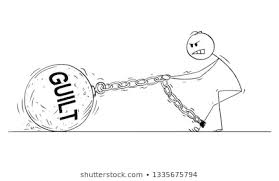
Feeling guilty is not a disease but unless it’s resolved it can make you feel sick. I have had periods where I have been rendered guilt-ridden. At the other end of this spectrum we have a label for people who don’t express remorse: Sociopath. Perhaps these individuals never resolved early feelings of guilt and so chose to tuck them away in the recesses of their mind.

These days, others named John may use a different word or phrase to easily absolve themselves of remorse: They might stand straight and utter, “Guilty as charged.” They may choose to feign humour, “Ooops! My bad.” Some may intellectualize their dilemma with the words, “Mea Culpa.” Saying sorry is difficult. Courts provide an opportunity to get things off your chest. An admission of guilt is often a precursor to a more lenient sentence after a verdict is passed. Witness impact statements can move those involved in a criminal act to feel remorse. In a perfect world, offenders and those offended can find ways of reconciliation beyond guilty/not-guilty definitions in order to create justice that lingers.

I always thought going to a Catholic confessional was an easy way out of dealing with the reality of guilty feelings. A few Hail Marys strikes me as not getting to the heart of why bad thoughts remain after committing an offence. Guilt thrives in the absence of forgiveness yet telling ourselves that it’s all right can be a hard thing to do. When my children made a mistake they were encouraged to apologize with an explanation of why they were sorry. The resulting dialogue helped everyone feel better because the act itself was acknowledged, feelings shared and understood, forgiveness provided. An emotional drive-thru experience: A happy meal.

I feel guilt just like I feel regret. There are times I say things that are unwarranted or do things I don’t really feel comfortable doing. I can’t blithely state that guilt doesn’t affect me. I’ve known some people who have responded to guilty feelings by seeking revenge on the very person who made them feel remorse. Deep feelings can be frightening. When I hurt someone else I feel the hurt too. Stopping the cycle of hurt is not easy, like most things in life, it starts with patient understanding.

Re: Legacy

I’ve had some amazing students in my classrooms. Some children have burned so brightly I’ve wondered at the time if this moment in their lives would eclipse all other accomplishments. Collectively, what they have left to me, is an affective legacy. Just as I have been part of my students’ lives they have shared themselves in ways that have influenced who I am today. 

Lately the term ‘Legacy’ has come up in news reports to describe what a particular politician might leave behind as they vacate their office. Lessons may have been learned from their tenure in government. If the leader was of great stature they may have created change that will live on in national policies and the consciousness of the citizenry. Hopefully these achievements will be referred to before the death of the individual. Contributions are worthy of repeating long before funeral speeches are written. 

While some wealthy people have used philanthropy to improve their social legacy, only history will say whether their overall impact as human beings will be revered or frowned upon. Gaining inheritance money or being a child of a celebrity can often be viewed as riding on someone else’s coat tails. Children of parents who have gone to prestigious universities in the United States are able to get Legacy Status for admission and thereby skipping the line. Recently people of privilege went a step further using bribery to receive bogus scholarships for their children.

Every Canadian knows of the legacy of Terry Fox, a one legged runner who attempted to cross our giant country to raise money for cancer research. His achievement and humility are factors that make his name appear on lists of top ten important Canadians, something he hadn’t envisioned or desired when he began the straightforward act of running. His legacy inspired Steve Fonyo to continue his run of a lifetime. Each year many run in Terry’s honour and hundreds of thousands contribute to boost this financial legacy. Individuals are often praised for what they leave behind. Groups of individuals can also be recognized for making a lasting contribution. Banners in stadiums attest to past achievements in sport. Plaques, stars in pavements or statues we erect can’t tell the whole story behind the individual honoured for their legacy.

Like the over used word ‘Hero’ we may be in a time when we hunger for an example of greatness so much that we might use ‘Legacy’ too easily. And yet no other word can be relevant to describe Captain Tom Moore as an example of a person’s actions leaving behind an imprint for the ages. https://www.youtube.com/watch?v=TPxOjHgqFrY . Capt. Tom’s example inspired others, such as John Hillman of Oak Bay, to add to his own personal legacy by raising money for a cause by the simple act of walking. https://www.youtube.com/watch?v=T7s4JshbjUA .

Sir Isaac Newton once wrote, “If I have seen further it is by standing on the shoulders of Giants”. Ultimately we increase the value of any legacy by continuing the work that has been started. 

Re: Spy

When is a spy different from a whistle blower? Or an investigative journalist for that matter. When we think of spies we think of deviousness, subterfuge, plotting and secrets to be discovered. There’s irony here: A spy is asked to uncover things whilst doing undercover work. A spy has to keep a secret in order to unearth one. The side that has the spy network is happy when results are obtained, the other side shows disgust that their privacy has been invaded. Spying rarely produces the win-win scenario much sought after in modern international politics.

The Cold War, begun in 1947 and not really over until the dissolution of the U.S.S.R., was originally about maintaining a balance of power between potentially warring nations. In order to achieve that, everyone had to be on an equal footing so espionage was an accepted practise. Some spies were imprisoned, if caught. Some disappeared. Many, like Sir Anthony Blunt, despite being considered a traitor by his countrymen, was not prosecuted due to the sensitivity of his proximity to the British Royal Family. https://www.youtube.com/watch?v=HFl7NdzOOZg&list=PLkmRedTjok3Sfpkq9AhhCXHr675gI9RJd&index=52

As a young fellow I loved reading the short graphic tales in MAD Magazine called Spy vs Spy. https://www.youtube.com/watch?v=onR7PD3Grc0. The cute characters, one white and one black, would basically chase after each other, laying traps, throwing cherry bombs while neither came out the clear winner. When I was older, my dad introduced me to Ian Fleming’s pulp fiction tales of James Bond. When the film franchise began I knew from the start I would be a life long fan. My mother relished being a sort of spy. She enjoyed ferreting out weaknesses in people and then holding the information, ‘over their heads’. She was once a personal assistant to a private investigator and went on stake-outs that my father frowned upon, until he was needed to pose as an ‘Englishman’; a role he played during a tense weekend in Hell’s Kitchen, a sketchy part of New York City.

We live in a time where security cameras are common. Privacy is hard to find, yet we expect transparency in government and business. Corporations might lose their new product’s edge if a design secret or release date becomes common knowledge. A brave few who work in industry, the military or in politics feel it is socially responsible to reveal insider information. Jeffrey Wigand may have singlehandedly changed the way North Americans thought of cigarettes. Journalists Woodward & Bernstein told Mark Felt’s Watergate story, which brought down a U.S. President. Daniel Ellsberg, Karen Silkwood, Juliann Assuage, Bradley(Chelsea)Manning, Edward Snowden are familiar names of people who have revealed truth to the public.

Whistleblowers, like spies, are frequently vilified yet they report they are acting according to their conscience. Even though the ‘top secrets’ exposed are shocking/dangerous/controversial, the informers feel they are acting in the public interest and fulfilling a personal directive that supersedes conventional authority. History may reveal the rightness of their tales, but at the very least we can be grateful for their courage.

Re: Privilege

COVID continues and I’m binge watching the television series The Crown. Talk about privilege eh? I feel lucky to have something to occupy my thoughts amidst the luxury of NOT having coronavirus. The portrayal of the British Royal Family shows characters who are the epitome of privilege. Setting aside their vast wealth for a moment (and I don’t do that lightly), I ranted privately on how someone could be given the right to rule simply because of the circumstance of their birth. The reign of Queen Elizabeth II parallels my time in history since she ascended to the throne the year I was born. My British parents were working class and yet still had an affection for the “goings-on” at Buckingham Palace. My mom thought that Edward VIII did the right thing by abdicating and “leaving all that nonsense behind.” As the episodes of The Crown unfolded I often shook my head in a socially egalitarian way, yet before I got too judgemental about the Windsors I couldn’t help but take stock of the ways I have been privileged.

Firstly, I’m born a white skinned male. Enough said? I’ve had the privilege of a solid education. I held a career with public status and enjoyed an income healthy enough to support a family of five. I can’t help but wonder how others may see what I’ve done with my privileges. I do believe with privilege comes responsibility yet I recognize I have been selfish at times with my talents, my resources and my energy. Someone once told me that I “present well.” I’m sometimes embarrassed by the privileges I have not earned, however it’s been a privilege to help maintain the society within which I have been able to thrive. I try not to abuse the gifts that have been bestowed on me. I sincerely feel that privilege never gives me licence to be rude or disrespectful.

Birthright does not always enter into the success of an individual’s life, hard work and talent can place you in a privileged, enviable position. It’s true, those who work hard deserve something special for their efforts. However I also judge the way the wealthy few exercise their privilege. When I think of today’s 0.1%: Jeff Bezos, Elon Musk, Bill Gates, Mark Zuckerberg, for example, it’s clear they represent the new royalty. Their individual wealth gives them privileges far beyond anyone currently entitled to a crown.

When dog walker Amy Cooper famously ranted in Central Park she abused her privilege. When Ted Yoho swore at Alexandria Ocasio-Cortez he assumed his privilege would protect him. Ms. Cortez later stood in Congress on a ‘point of personal privilege’, and gave a moving speech related to human rights.

Sometimes it is clear where the line between privilege and right is drawn. The United Nation Declaration of Human Rights includes 30 rights felt to be essential to human life. They are often disregarded, usurped or dismissed by those who claim privilege, however these rights are inclusive, irremovable and do not depend on where, how or to whom you were entrusted at birth.

Re: Character

Actors who play supportive roles in movies or plays are sometimes referred to as character actors. Even though Robin Williams has played the lead in films, I like the way he brings out the personality of the characters he plays. Mr. Williams is also adept at caricature. His imitation of cultural icons by vocal and physical impersonations is hilariously accurate. People who mime others surely must have great skill in observing a person’s characteristics, beyond the obvious ticks, accents and mannerisms.

I often wonder how we get our particular character traits. Some must come to us genetically, while others are likely crafted over time from our connection and responses to mentors, neighbours, coaches, teachers or friends. I have a quiet character. I am quite patient, faithful, persistent and optimistic. Those are some self-perceived personality traits of a positive nature that I hope others recognize in me. I don’t know if I’d be brave enough to ask someone how they might characterize me. I might not like an honest answer.

As an elementary school teacher, I have asked my students to choose an animal that has characteristics that might best match their personalities. I have also asked them to tell me their favourite comic book superhero. One autistic fellow refused to play this game of self identification unless he could choose a dinosaur that best represented him. This matchmaking with a safe non human character lead to some great lists of characteristics and of important values like courage, fairness, cooperation, kindness, honesty and determination.

Sometimes we recognize our character in another and rejoice in the knowing. I remember a conversation I had with a complete stranger that entered into this realm of soul connection. It struck both of us as profound and later he brought me a book called The Aquarian Conspiracy saying mystically, “You are one of us.” Much later I watched the film Avatar and relived this moment from my past when one of the animated characters said, “I see you.”

Sometimes I’ve wished that another person’s character would change so that I would find them more agreeable. With maturity I realized that I would have to change my ways or find a path of acceptance when it comes to individual differences. I still love stories where the central character sees the light and vows to behave in a more positive manner. I wish that this would happen with President Trump most days, but I’ve had to conclude that some characters are immutable.

The content of one’s character is an important matter in any historical age. Men and women of virtue, from all walks of life, have provided us examples of how to live productive and compassionate lives. Who hasn’t heard Martin Luther King Jr. speak these words on the significance of character. https://www.youtube.com/watch?v=Wxc6iqRC-n8

We look to influencers who can show us the way to our best selves. Hopefully each of us can then model an example of exemplary character that ripples ever outward.

Re: Best

Those of us who are competitive or ambitious want to be more than better; we want to be Best. The urge to ‘Be Best’ would get the attention of the current First Lady of the United States of America. Ms. Trump is determined that her program, despite the poor grammar, will be valuable for child development. Comedian Randy Rainbow suggests a different conclusion.

I’ve never had the honour of being the best man at a wedding. Somedays I feel better than others. I’ve been told I am a good neighbour. I believe in the presumption that the best is yet to come yet I also realize that Good is often good enough. When I’m not feeling my best it’s usually best for me to meditate or take a nap rather than transfer my mood to someone else. I try to be better everyday but I know I’ll never be perfect ‘cause that would make me Best and who am I to say I’m better than you anyway.

Grammatically speaking I see the value of superlative and comparative adjectives. They aid the writer who’s into description. Philosophically however, I resist thinking in these terms. I don’t like the feeling of dominance that Super brings to Superlative. And without a clear criteria for comparative points of view how can you have a satisfying conversation? For example is it the Best Poutine Ever because of the crispness of the fries, the squeak of the cheese curds or the savouriness of the gravy? Just what are we arguing about here!

Discussing the qualities of film is always a lively debate in my family, especially when it comes to the Oscar pick for Best Picture in any given year. Here’s the top pick from 1946: The Best Years of Our Lives. https://www.youtube.com/watch?v=1yc5PugV4mk . It’s not your average overacted late forties melodrama! When I revisit this film I’m stunned by these performances. Others may be stunned in another way by the slower story-telling pace of the film. Before an argument begins it’s probably best to say that choosing best of anything is subjective, at best.

Speaking of controversy, I had this jingle in my head as I shaved yesterday. “Gillette! The best a man can get.” The catchy tune came from this 1989 advertisement which seemed harmless for its time. https://www.youtube.com/watch?v=ThDBf14qPsc
Recently the same company got into hot water for attempting to send a message in this post #metoo age about how men could be better behaved.

The 45th President of the United States has been called many things. This sophomaniac continues to convince voters with his braggadocio attitude that he is the best choice for your vote in this election year. He has called himself the “Greatest president God ever created.” New red ball caps may need to be embroidered ‘God Knows Best’. My anxiety levels need lowering so I’m hoping that beastly Trump gets bested in November.

Re: Shame

Shouting “Shame” at a protest rally on the steps of the Provincial Legislature building felt shameful. Yet I was drawn in by the pulse of those assembled as the speakers called out the injustices of previous governments. We were attempting to make ourselves heard and to hold those currently in power to account. Yet as I walked away from the demonstration, I felt slightly ashamed by my vocal use of that word. I felt embarrassed that I had lost some control over myself for the sake of joining in this act of public shaming.

I spoke with a friend about the meaning of shame and guilt within our personal narratives. She asked if I had experienced any shaming as a child. I told her one of my first memories, sitting with my parents at our dinner table, wanting to join in on the adult conversation. My mother loudly admonished me for barging in. “Shut your face!” she shamelessly shouted. I had been excited but now I was ashamed. I remember the blush of embarrassment, resisting tears yet fully shocked. What did I do? I was too young to analyze all the meaningful particulars, but now as an adult I can say to myself, I am not a bad person for interrupting my mother.

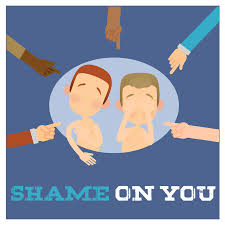
I can even say I bare no feelings of guilt, yet by telling this story I still feel the flush of shame coming to my cheeks. I was brought up in an age where parents and teachers might regularly say things like, “How dare you?” or “Shame on you!” to drive home their point of knowing one’s place in the world. Some old school teachers might send kids to the corner, or even get them to wear a dunce cap. My mom would give me the silent treatment when I had misbehaved. I wonder if shunning is a form of shaming.

The novel ‘The Scarlet Letter’ was one of several books I read in high school English class that had a lasting impact on me. In this moving story of shame, Religious zealots (Puritans) force the character, Hester Prynne, to wear a red letter A to atone for her sins. What astonished me was her grace in protecting those who had brought her this embarrassment. I learned that guilt is put onto us by others while shame is generated from within. She refused to be ashamed of herself. We too, can refuse to be ashamed of ourselves.

I don’t believe it was right then, anymore than it is now, to belittle someone. There are other ways to register disapproval of our elected officials or anyone who might offend our view of things. Questions can be posed, opinions shared, without pushing guilt on to the other. We don’t have to make others feel unworthy to satisfy our own sense of righteousness.

By the same token we have every right to shamelessly go about the business of our lives, looking for ways to express ourselves and be fully human without owning the knitted brows of disapproval that sometimes are directed at us.

Re: Sort

Carl Linnaeus, considered the Father of Taxonomy, developed a system of sorting plants and animals in the mid-eighteenth century. In university, I enjoyed an Entomology course where 50% of the final mark was to sort hundreds of varieties of insect specimens found mounted and stored in dozens of drawers in the lab. Many features on each specimen needed examining before it could be assigned its proper Order, Family, Genus then Species names. I got my highest mark in this course, where order took precedence over randomness.

Not without coincidence perhaps, my favourite candy as a boy was Liquorice All Sorts. When we first came to Canada they were hard to find in stores. Sometimes my grandmother would send a package from England at Christmas. My sister and I had different favourites which luckily avoided conflict; she liked the black tubes filled with white sugar paste and I loved the coconut wheels with the liquorice centre. I still enjoy them as a treat, my wife loving the colourful beaded ones that look like buttons. No arguments here: Harmony reigns.

An English phrase I recall my parents using was, “Let’s get you sorted.” I’d have a problem with my bike, or something troubling happened at school or sibling rivalry reared its head and Mom or Dad would sit us down to get to the bottom of it. We were encouraged to sort through our problems in a structured way by examining ourselves first.

What sort are I? Like my fellow human, I am a person wanting to be able to express free will. The more you put me in a box with a singular definition the less I will feel free to be me. In the documentary film, ‘Ask Dr Ruth’, Ms. Westheimer rejected being classified by her daughter and granddaughter as a feminist. https://www.youtube.com/watch?v=qkZ8Kn3xVO8
I thought about this scene in the movie for days afterward since it seemed obvious to me that she represented in word and deed what a feminist would stand for. She later accepted the label saying she wasn’t ‘radical’. I wondered if her reluctance had anything to do with being sorted, as so many of her generation had been, in the methodical terrorist manner that was the Nazi Germany of her youth. Under Adolf Hitler, people were identified and classified. Once labelled, a person could be discriminated against, legislated against and potentially exterminated.

None of us want to be put in boxes. We are much more than one aspect of ourselves. We are many facetted. We are all a unique combination of our skin colour, our beliefs, our upbringing, our occupation, our thoughts, our daily activities. We are complicated. We are right to reject being classified. We must shout loudly if necessary, that we are a member of the human race. We can say this with certainty, objectivity and truthfulness in our hearts and minds. History tells us that this fact needs to be declared repeatedly so that we remember our common natural classification as Homo sapiens. No further discussion needed. What else needs sorting?

Re: Mission

“Your mission, should you choose to accept it.” Says the self-destructing audio tape given to agent Jim Phelps at the beginning of the television show, Mission Impossible. https://www.youtube.com/watch?v=0TiqXFssKMY. It was one of my favourite shows as a kid. I loved all things relating to adventure. I loved drawing detailed maps in elementary school of early explorers: Magellan, Vasco de Gama, Shackleton, Cook. I remember being fascinated by the twin tales of Stanley and Livingston: Reporter Henry Stanley was sent on a mission by his newspaper, The New York Herald in 1871, to find the presumed missing missionary David Livingston.

In the Kama Sutra of sexual positions, ‘missionary style’ (male dominant facing female) is reported to have been promoted by white African missionaries as the acceptable way for natives to procreate. This sexual act offers the promise of creation; a mission by two people to provide an individual to further the continuation of humanity. A lofty mission that has had many motives and several potential outcomes.

Most corporations, of the business sort, have well defined mission statements. The intention of the mission mantra is to focus investor imagination and provide a set of achievable goals. I worked with school principals in the eighties when societal managers were hungry to adopt a business model of operations. We were advised to see an educated student as our product so therefore could create a mission document focussed on that outcome. I fear our children’s education will become even more like an assembly line process as we move ever closer to the merging of biology with AI technology

During my career, I met many colleagues who considered education as their mission in life. For me, however, my job was not the singularity of my life. I would never have referred to my work in schools as a calling. Some people do seem born to do what they do. Recent films about Fred Rogers suggest that his teaching about love and acceptance rose to the level of a mission. In the final scene of A Beautiful Day in the Neighbourhood, Mr. Rogers is shown at a piano while other crew members of his children’s show are packing up to go home, their job finished.

Missionaries bring a message to the world. Their prophet-like work needs support and accommodation from the rest of us. Many individuals throughout history have been heralded as innovators; their missions lauded yet doomed to fail when public opinion has swung the other way. I don’t believe that any individual with a creative vision can succeed alone. I’ve been supported when I’ve had an idea. I suspect those who support great leaders feel their role is to enable the mission: They become Sanchos to their Don Quixottes.

A timeless film, The Mission, tells the story of several characters on personal, political, military, corporate and religious quests in eighteenth century South America. Their chosen missions come into serious conflict. They discover for themselves how missions are huge burdens that come at great cost. https://www.youtube.com/watch?v=Ui91q7Y9xPk

Re: Cast

The toys I remember having the most fun with as a child were die cast. I had trucks, cars, army guys, planes. I have kept one: A wheelbarrow. Go figure. When I was eight I broke some bones in my foot. Back then the affected parts were encased in a plaster cast to immobilize the area. Suddenly I was famous! My schoolmates had heroic sympathy for me. I was cast in a whole new light. Children who I thought hadn’t even noticed me before, were happy to write funny sayings or well wishes on my cast.

In my adolescence there was nothing I liked better to do than to go fishing. With little allowance, I considered the purchase of my equipment carefully. I had a Mitchell 300 spinning reel, not a baitcast nor a spincast variety. My friend and I would spend many a lazy summer on a river or creek casting into small pools and eddies, hoping for a strike. During those blissful moments of singular concentration all other thoughts of teenaged angst were cast aside.

My parents cast my sister’s baby shoes in bronze. This was my mom’s idea as she was trying, I’m casting about for a reason here, to shed her lower class English roots. WWII had cast a long dark shadow over her adolescent experience. She refused to believe her die was cast so , while my sister was yet to be born, she persuaded my dad to immigrate to Canada. People of the Downton Abbey set will appreciate how the British Empire spread this idea of your place in society. Consider the Caste system which still exists in India. It is as if Shakespeare’s pronouncement ‘All the world’s a stage…’ was taken so seriously by government that each citizen was given a clearly defined role to play. Peace, Order and Good Government eh what?

I’ve often wondered what it would be like to go to a casting call to audition for a part in a play or film. My favourite stage or television productions are always ones with a varied cast of characters. Due to the technological advance of green screen computer enhancement, you don’t get too many movies these days advertising a ‘cast of thousands’, but for my Sunday matinee viewing pleasure as a kid, there was nothing to compare to Ben Hur or Around the World in Eighty Days. https://www.youtube.com/watch?v=vjiCO8k6Jhg

During Shakespeare’s time, ruling British monarchs waffled over rules regarding the casting of female roles. The underrated film ‘Stage Beauty’ examines this political dilemma. One of the best lines in the film is, “Who are you now?”
https://www.youtube.com/watch?v=lLlKmqH_5ak. This film alludes to the challenges of defining oneself. A current phrase used in self exploration is, “I identify as…”. Part of becoming mature is being able to be comfortable with your individual nature. Looking into that metaphorical mirror we must be able to see ourselves as the one who will play the most important role within that play of a lifetime.