Re: Protest

I live in a community where people come out to protest on a regular basis. I join in because I naively see it as a sign of democratic action. Based on the signs people carry to support their outrage/concern, there may be other motivations for their presence in the crowd. For example, at a recent climate change rally, I saw one overweight man sporting a T-shirt that read ‘I love CO2’ while waving another ‘I love fossil fuels’. Was he after sales or just being contrary?

Being somewhat afraid of large crowds and a functional introvert to boot, you can often find me at rallies like this leaning against a tree where I can appreciate the shade or gain some shelter from the drizzle. An activist I’m not. Rather a cheerleader/witness. My sign would probably read; ‘I see what you mean’ or ‘I’m here for you.’ Some protest signs written by a more anarchistic sort can seem like manifestos: small print on corrugated cardboard, begging to be read, to acknowledge the effort that it took to pour out such passionate thoughts. Short form declaration: ‘Pay attention! I mean it!’

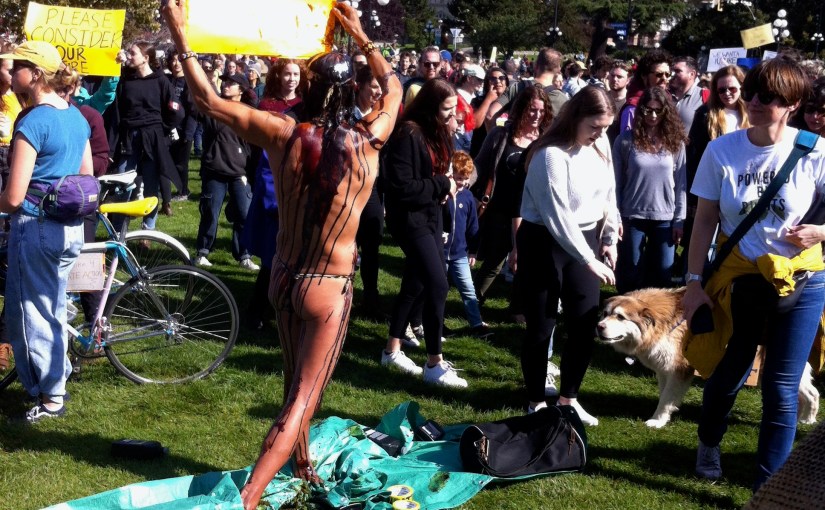
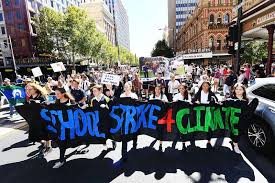
Protests I’ve attended clearly allow folk to vent. Quiet self expression is as evident as a collective shout of alarm. At a recent Fridays For Future congregation I was impressed how Greta Thunberg’s leadership had encouraged a diversity of ages, backgrounds and emotions to come together in a harmonious demonstration of concern over the climate crisis. Amidst the speeches, music and cheering a small hole opened in a part of the crowd as a lone middle-aged male removed his clothes and poured a bottle of motor oil over his body, miming his anguish over pipeline leaks. He wasn’t arrested. People gave him space.

In our city protests tend to be peaceful. Marches and rallies offer up chants, poems, speeches and slogans. Some who line the streets join in if they find a friend or are moved by the cause. Sometimes it seems counterproductive to see smiles on the protesters’ faces while they’re shouting to end war. It makes me wonder about the line between protest and carnival. But in Canada it’s true we are polite and, for better or worse, we work hard at trying not to offend others, even those with whom we disagree.

Art lives and thrives in protest settings. Feelings pour out in creative ways. I always feel grateful for the civility expressed at protest gatherings I’ve been to in Canada. I’ve heard bystanders thank the calm looking police officers for just being there. My sons, in contrast, have been witness to protests that have started out civil but have turned violent, often as a result of police being instructed to clamp down on demonstrators.

There is much injustice in our current world. Perhaps there always has been, yet now it’s easier to see. It’s easier to name the wrongs. It’s easier to find something or someone specific to blame. At the same time it seems harder to find someone who will listen. https://www.youtube.com/watch?v=4r3KlDamA3U

Re: Circumstance

“Circumstances don’t make the man, they only reveal him to himself.” so sayeth Epictetus. He was a famous Stoic, among those Romans of the stiff upper lip. Much of Stoicism I can agree with, yet I think we are all to some degree a victim of our circumstances.

Yes, we have choice. We can go high when others go low. We can keep our wits about us while others are losing theirs. I’d like to be easy with it all, as Keith Carradine sang it in Nashville.

However, it ain’t easy to be noble when the leaders of our world do things that create uncomfortable or dangerous circumstances. Currently, in the U.S. of A., it is a wonder to me that there is not chaos. Some days I feel like freaking out with the lack of kindness and civility that streams at me from the White House. It wasn’t always this way. Circumstances have changed.

Sometimes it’s only circumstantial evidence that leads to a conviction in a courtroom. Circumstances can point a finger and if one doesn’t have an air tight alibi, then one can find themselves in a whole new set of circumstances. Being free to be is certainly the objective but some circumstances can lead you away from positive choice. Poverty, despite what the one percenters say, is not a choice. It’s a circumstance that is difficult to find relief from, let alone propose a cure for. My sister once found herself having to register at a food bank. The company where she had worked for almost two decades folded and she struggled to find herself after that shock. She died trying. In my opinion poverty prevention must be discussed at every election event until not a single person finds themselves in such unforgiving circumstances.

Fate, fortune and randomness all have a part to play yet sometimes you have to assert, “Under no circumstance will I permit this!” I hear a struggle for a path through difficult circumstances in the voice of Billy Joel. https://www.youtube.com/watch?v=h3JFEfdK_Ls

We can be victims of circumstance. We like to think that we are in charge of our happiness. The truth is others impact our lives. Undoubtedly we have a role to play in making things better, but so do members of society have a responsibility to build a better village. Viktor Frankl, a psychologist and survivor of the Holocaust, reflects on our personal agency under trying circumstances when he states, “Everything can be taken from a man but one thing; The last of the human freedoms-to choose one’s attitude in any given set of circumstances.” I don’t want to believe that a circumstance like being taken to a death camp would be regarded as something within someone’s personal control.

I enjoy love stories where a couple has to be separated by circumstance yet they make a vow to find each other when things change. Sometimes we must trust in Time: It may be the only agent that can bring the change we long for.

Re: Strike

One hundred years ago, in a Canadian city once referred to as ‘the Chicago of the North’, the working class had had enough. A general strike was called in Winnipeg with switchboard operators, called ‘Hello Girls’, being the first to refuse their labour. This work stoppage was the biggest and longest of similar strikes throughout North America. While the original intention was to seek redress for poor working conditions through collective bargaining, this strike soon included non-unionized workers, returning WWI soldiers and thousands of other people who felt disenfranchised. Much like today, those living in 1919 experienced a disgusting disparity between rich and poor: The few had much. The many had very little.

Strike is a word that conjures up decisive action. One of the first movie musicals I enjoyed as a child was ‘Strike Up the Band’ starring Judy Garland and Mickey Rooney cast as two young folks with enough energy to change the world, perhaps even take it over with their enthusiasm.

Striking can be subtle but still forceful. When someone in the fashion industry strikes a pose they are trying to capture a moment of body posture to maximize drama. In one of Madonna’s masterful music videos, ‘Vogue’ she works her image to maximum effect. https://www.youtube.com/watch?v=GuJQSAiODqI

Strikes can be lucky if they connote finding gold, or unfortunate if they come in threes. My mom and dad were two pack a day cigarette smokers (to my knowledge they never indulged in Lucky Strikes). One summer afternoon, my father took me to a baseball game (this was a rare treat for me as my parents were part of the lower class). What I remember most was the abundance of cigarette butts that piled up around his feet. We stood and sang ‘Take me out to the ball game’ at the seventh inning stretch, yelling this line amidst Dad’s coughs, ‘and it’s ONE, TWO, THREE Strikes you’re OUT!’

I grew strong in spirit during my brief time as a Boy Scout. My favourite activity was camping. It was where I first learned to build my own fire. We were taught how to keep our matches dry so we could get the kindling going on the first strike. What I learned in my scout troop I applied with happiness to camping trips with my parents, and later as a young father of three boys. When it came time to strike camp there was always a sadness. Packing up the shelter that was our tent seemed too sudden a thing after we had spent such quality time under its protective embrace.

In the nineteen fifties, I learned about the hazards of a nuclear strike. In the event that missiles were launched in our direction we were taught to hunker under our school desks. What naivety! My nine year old self wanted to trust that my teacher knew how that bit of metal and wood would protect her students. My almost seventy year old self shakes his head when thinking how ignorant people can be.

Re: Resistance

Tales of the resistance movement during WWII continue to fascinate me. Such bravery from those Partisans I can only imagine. They chose to move in the space between compliance and defiance. They were examples of people devoted to helping themselves and others overcome tyranny. Throughout the world in modern times there continue to be regimes/policies/governments/corporations that challenge us to choose between acceptance or rejection.

Resistance may be underground, subtle or go unnoticed, yet it is not a form of giving up. To resist is to take purposeful action. In human behaviour I see a Resister as someone who chooses to actively refuse something that doesn’t hold true to their value system. In electrical circuitry, a Resistor is a device that controls the flow. I find it curious how those two words, for only the difference of a vowel, can be similar in concept.

Consider for a moment that a Resistor’s unit of measure is an Ohm. Another Om is considered by Buddhists to be the first sound. I have often used that sound to control my anxiety. When I chant using that word I feel grounded and my thoughts cease to speed in whirlwinds about my head. In that moment of meditation I am a Resister and a Resistor, holding thoughts at arm’s length so that I can interpret them more clearly.

I met a Resister the other day at the grocery store where I shop. We were both in a line to have our purchases scanned by a clerk. We chatted about voluntarily waiting when we could have checked out faster by stepping one aisle over to scan our items via a robot cashier. We agreed that AI was taking over the world and we were determined to resist.

Cliches are worthy of resistance. I appreciate that a commonly used term may be easier to say while engaging in small talk, however a serious discussion deserves a more careful choice of words. For example, a well known celebrity recently announced his terminal cancer and was quoted as saying, “I’ll fight this.” Cancer talk is often filled with warlike terms. I find it upsetting that if the patient doesn’t want to fight the disease they are somehow deemed to be giving up on life. My late wife chose to resist the pull of death after her diagnosis by filling each day with amusements. June Callwood, a noted Canadian author, who died of cancer in 2007, resisted the common call to ‘fight on’ by refusing treatment for her disease. Her wonderfully watchable interview on CBC television aired mere weeks before her death is a testament to the term ‘dying with dignity’. https://www.youtube.com/watch?v=Duif0tGZ4pc

When it comes to death, to quote from The Borg in the Star Trek universe, “Resistance is futile” https://www.youtube.com/watch?v=rtEaR1JU-ps . The irony, perhaps, is that resistance can sometimes empower us to be an active participant of change. To rebel or to acquiesce may not be options. Resistance may be the middle ground where we can assert our unique individuality.

Re: Resilience

If I am resilient I can survive change. I may not completely bounce back from the trauma nor will I necessarily become stronger simply by dodging a proverbial bullet. My experiences may make me better able to cope the next time a challenge arises. Trouble is, there may be enough difference in the new situation as to make my response difficult. I must rely on my belief that, given time and adequate support, things will get better.

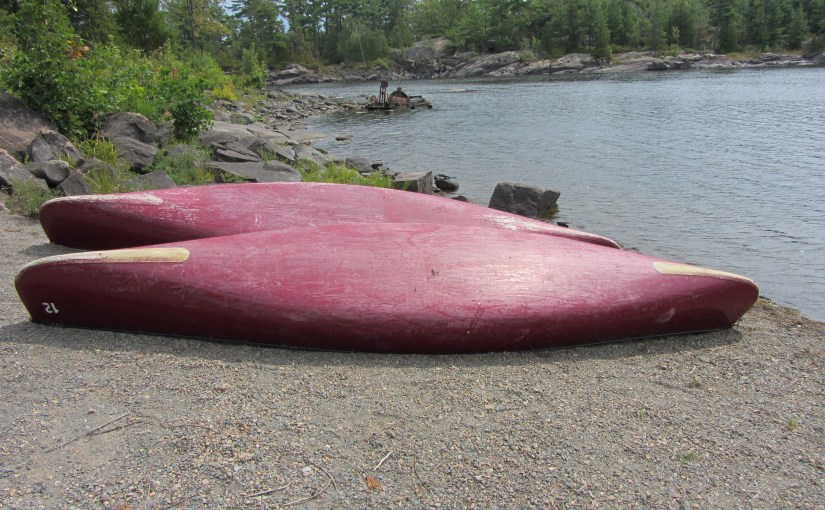
One of the best things teachers, parents and coaches help us discover is our personal resilience. I can credit my years as a Boy Scout with teaching me a lot about resilience. I was instructed to hope for the best and prepare for the worst, to seek shelter when confronted with a storm, and to try one more time. I remember one portage in particular during a canoe trip through Algonquin Provincial Park. I had felt a head cold starting the morning of the third day into the trip. The paddling part was a blessing as the breeze cooled the fever my body was developing. Once out on the land and weighed down by packsack and canoe the going got tough. Biting insects could not be swatted and our path was through boot sucking mud. Each step was agony. I was young and wanted to cry. I faltered briefly and looked up as my Akela now stood near me. Quietly he asked, “Can you go to the next tree?” I repositioned my load and said yes I could. He walked beside me until the tree and said, “Can you make it to the next hill?” Somehow I could and just past the hill was the location of our camp for the night.

I recall having my meal that night in one metal bowl; a ground beef mixture, cookies and chocolate pudding. I tagged out of the next activity to get some rest in my tent, quickly falling asleep. Much to my surprise, my Sixer came to wake me for Mug-Up. My body still aching, I was persuaded by this familiar before-bedtime tradition of a warming tin mug of hot chocolate, so I rallied myself. The next morning I felt like I could canoe forever, no matter what might lay ahead on the trail. I was a modern day voyageur. I was invincible!

A resilient attitude is elastic. It bends like the marsh reed to the wind’s insistence. Rigidity can cause us to snap under pressure. Sometimes we can only respond to the change that blows our way. Other times we can make a change that will bring us closer to who we want to be. We can build resilience in mind, body and spirit by being watchful for opportunities that test us to be better.

What Akela had taught me that day was that I had more resilience than I ever imagined. By shrinking my goal I could continue. By sometimes taking baby steps I wasn’t diminishing myself. By trying one-more-time I found I could discover something new about the person I was becoming.

Re: Protocol

I’ve self declared that I’m a formal type fellow so I will also admit that I easily sense the importance of protocol. I need to have a system before I can proceed. I can adopt a protocol that is already there and I enjoy developing my own set of rules to fit the occasion. In politics I prefer a party or candidate with a platform that articulates a clear path. I like to volunteer for an organization that can fill me with confidence with their policies.

I had a woodworking phase in my life. I assembled hand-made picture frames and built original furniture items. Towards the end of this pastime I manufactured bookends. To weight the bookends I used various found objects, sometimes according to a buyer’s particular specifications, thereby creating unique pieces. This artistic ‘bookend period’ was back in the day when everyone I knew had a bookshelf in their home. My dream home still has one room (Library? Den? Study? Conservatory?)that has a full wall of books on display. My most requested bookends were made of mining drill cores. It was a mass-produced gift for family and friends one Christmas. I arranged one side to have a neatly stacked grouping, on the other I glued broken cores arranged all higgledy-piggledy. My statement was that between life’s bookends there is Order and Chaos.

Protocol is designed to maintain order and reduce risk. Protocol suggests consistency through proven success. I can’t imagine enjoying an air flight without the confidence of knowing that the crew follows an exacting procedure. There are protocols in medicine that must be followed for good health; the simplest being, “Wash your hands”. Adjustments have to be made in any system and are certainly required if something within the system breaks down. Normally if protocols are tried and true, their value lies in efficiency. Along with that, a good protocol provides a feeling of security. However, all protocols must be used with underlying compassion. Without kindness in the mix, rules can crush. https://www.youtube.com/watch?v=CLUZ0Nv7UH4

If protocols break down, confidence flags, confusion and chaos follows. When we no longer count on the protocols we have become used to, then the doors open to pirates, snake-oil pedlars, and other multitudinous conmen. Today we use the word Disrupter in place of my grandmother’s word; Conman. This person, usually male, or corporation, comes into your life for one purpose: To persuade you to buy something. I’m convinced that Trump’s legacy is to be the character in the warning fairytale for our future generation’s bedtime story. Trump is the shyster of our age and he may be used as the very definition of Chaos.

This is not to say that randomness is not important, even welcomed! The great Charles Darwin recognized it was critical for the survival of the species, any species. Yet a measure of consistency is critical for short or longterm protocols. We can accept randomness, even plan for it, as long as the benefits we’ve learned and earned aren’t disregarded.

The basic meal of life comes first, then variety adds the spice.

Re: Identity

Each of us have had a Big Bang moment in our lives. Probably several: There is that seminal moment of our birth as we are pushed out into the world gasping, reaching, spreading ourselves outward into the unknown. That explosive moment when we discover that our actions get a reaction, when we make a gesture that gets a smile, or our first words bring delight and feedback. That first urge that helps us define our sexuality leading us to tentatively explore with others. As the universe within us expands we get a chance to define ourselves.

Some moments are pivotal. External factors sometimes lay out the timeline of development yet it’s your internal response to these life suggestions that will craft the person you will always be. These are the foundations of your central character.

Discovering our personal identity is the most important and exciting thing that we do as we grow. We define ourselves by our experiences. We can overcome harsh beginnings. We sometimes shoulder these realities as a cross we’ve had to bare. Actors must enjoy the temporary thrill of inhabiting another identity. They can choose a role that helps them display a weaker persona or they may get to play the part of an evil manipulator. The spectrum of human behaviours is limited only by their imagination.

I enjoy taking stock of the parts of me which make me whole. I like shuffling this deck of characteristics when I look in my metaphorical mirror. I wonder when I let one aspect of me dominate the other; does that make me more, or less? After suffering through a bout of depression in my forties I had to restore my identity step by step. I consciously rebuilt myself based on the memory of what I thought I had lost in my journey into adulthood. I recovered my birth name and created the story that was Robert. This identity wasn’t so totally new that others didn’t recognize me, but as I broadcast my newest self I felt a confidence that my message was being accepted and appreciated.

Canada’s Residential School system has left a huge scar on our collective identity. The policy was specifically intended to erase the identity of a whole race of people. Reconciliation will take time. Hopefully all of us, as individuals, will find new parts of ourselves. We have a daily opportunity to reshape our identities in grace and harmony.

Groups work hard at creating a communal identity. This is easy to spot in the sporting world as teams encourage support by inviting you to belong. Consider attempts made in communities to build identity: We are Marshall, We are Boston. We are Humboldt. Some feel they belong to a national ethos. I am Canadian! https://www.youtube.com/watch?v=pASE_TgeVg8

Clearly in the present U.S. political climate many may feel, “I don’t recognize my country anymore.” Part of a search for a collective identity has to include the varieties of the membership otherwise it will be hard on those who have felt left out.

Re: Tear

In the inner city elementary school where I was hired to provide Guidance programming there were many children with mental health issues. In one case, a grade two classroom teacher asked me if I would help reduce the amount of bullying that she had observed. I began by building awareness amongst the students by asking them to wear a tag, during recess, fastened to a chord around their necks. Every time they felt they were being bullied they were to tear a little piece off of their tag. When we met at the end of the first day we talked about the damage that had been done to their tags. Some students hadn’t torn any pieces off their tag. Others had a few pieces missing, while a few had most of the tag gone.

The focus throughout this exercise was not on the bully but on the response to a feeling of being torn.I recorded these results, using the data to design an appropriate program. By the end of the month the majority of the students were talking freely about their feelings and were sharing with their teacher how they were standing up for themselves.

Every teacher will tell you that they learn from their students. In this particular case I was shocked to learn how many people (young or old) can feel that pieces of themselves are lost by the end of each and every day. As we tear around trying; to get what we need, to satisfy our wants, to please others whom we love, it’s no wonder we can feel shredded.

The youngsters in my school setting would often tear up as they told me their stories of being pushed around. At that age emotions rule. Everything HAS to be fair. Crying helped to a degree but then the tears would dry and a more constructive solution had to be found. I was pleased to see that, over time, many students understood that there were things they could do as individuals to protect their ‘tag’. If they didn’t reduce the tears, at least they could find ways to repair themselves to face another day.

Much later in my life, a friend of my wife introduced me to this wonderfully poignant song by Peter Mayer called Japanese Bowls. https://www.youtube.com/watch?v=qOAzobTIGr8
The imagery is outstanding and relevant to the notion of our amazing ability to be resilient to the soul tears each life can experience. As I have come to feel the full understanding of this song I often cry. The tears that fall are from the joy of my personal healing.

Whether in early stages of personality development, in relationships that fall apart or in end of life considerations, assessing our tears helps us to decide what to do next. The data we have collected on ourselves is not always pretty. Our experiences may have left scars.

But I believe we can always come around again to the beauty of life.

Re: Assurance

There is great satisfaction in figuring something out and then taking the time and energy to make it all work. Artists rehearse and rehearse. Editing has a purpose: to try to remove doubt, to seek assurance that the work will be the best it can be.

I think of the word assurance in a forward way. By planning ahead I feel I can cover whatever eventualities might occur and then “come hell or high water” I have some assurance that my plan will reach a preferred outcome. I’m not one for leaving things to chance. I don’t want to gamble my life with a ‘wait and see’ attitude.

Assurance is different from insurance in my mind. Insurance is a bet you make that something is going to go wrong and then you will be compensated. I don’t want compensation. I want confirmation that I have taken steps to reduce the inevitable risks of life. Shit will happen. Assurance is what I provide for myself by checking. I look to see if I am on the right track. I refer to my self designed map to assuage doubt.

I can be slothful, but only after my plans have been made. My plans often come in the form of forecast. I like to see the future as I would like it to be, then take the steps to arrive there. It’s logical to me. Sometimes I will plan down to the smallest detail, laying out various scenarios in my head. The downside of this is that I will often be disappointed.

Being a planner has its benefits and its baggage. When you wish to be in control you must commit time to planning. Truth is, I am not a ‘random’ person. That philosophy appeals to me on a Zen level; live for today and all that. But randomness is too close to chaos for my liking. My planning is my security blanket that I wrap around me when chaos reigns. I feel I have developed a set of strategies for when I have to surrender control. I’m getting better at going with the flow when others are making the decisions yet my patience is still tested until I have some assurance of the outcome.

Some have said that plans are for fools because there is always the unknown eventuality. Robbie Burns in his Ode to a Mouse captured this in the oft repeated line; “the best laid schemes o’ mice and men”. By seeking assurance I am not so naive as to believe that I can eliminate all random acts. I know that you can’t plan for everything. There are some things that we just can’t imagine might happen, these are the unpredictables or the “unknown unknowns” as Dick Cheney once said. He also spoke of known unknowns, which I believe, with planning, you can ameliorate to some extent.

I want adventure in my life. I want to explore even the deepest forest. Assurance to me is about feeling confident that, even if I do get lost, I can find my way back home.

Re: Disruption

Most people can handle being interrupted. Perhaps you’re a shift worker trying to sleep and a neighbour starts mowing the lawn. You’re on the freeway and your progress is interrupted by some construction. Disruption, however, is another matter. It means your world is turned upside down and will never be the same. We have been faced with this disorientation for several decades as the world of politics, communication, finance, transportation and commerce appear to be working to a different beat, perhaps even a different standard.

Trump was voted in because he promised to “drain the swamp”. As a disruptive force he has few peers. In my lifetime I have no one to compare to his total disrespect for convention. His campaign slogan ‘Make America Great Again’ can be ironic in this context. Comfort can be found in old ways of doing things, even when it’s not healthy. I don’t think of myself as an old fogey, prone to complaining about the way things used to be. I can embrace change and enjoy looking towards the future with hope not trepidation. I think most people can handle change well, especially if they are invited to be part of the change process.

Change makers were once referred to as innovators. Existing technology or infrastructure was modified, not razed. A societal advancement or some new product became brighter, faster, stronger, longer lasting but not foreign to our senses. Now change can be so dramatic it startles. No human cashiers at the 24hr store, what are you talking about? A phone that can take a picture, are you nuts? A transport truck without a driver, are you kidding me? Paying to sleep in someone’s house, you’re joking right? I text for transport to the airport and my neighbour arrives, for a fee, it’s Uber easy! Yet, when the motivation behind disruption appears to be all about the money, cynicism grows while the potential enthusiasm for something new diminishes.

Disruption is like exponential change, like having a baby, like a forest fire that clears acreage making way for fresh growth. Disruption can be beneficial. It can be revolutionary! Yet too much fire can seem apocalyptic, immobilizing and devastating. With manufactured change, those born before this new millennium knew another way, so some of us may feel out of touch.

Power comes from feeling part of the revolution. Hope is knowing in our hearts and minds that things will work out eventually. Humour allows us to all catch a breath from the stress of it all. Poetry has always been a people’s choice and voice when times get messy. I like to be silly with my poems so I’m going to be disruptive and suggest a whole new literary genre: Non-Fiction Poetry. In our present push to challenge existing structures, we must not lose sight of facts. So my poems will be purely factual; not opinions, neither musings nor reflections. Joe Friday used to say: https://www.youtube.com/watch?v=v4LPkmGO5Cc

Here’s my first, titled, “100%”.

A slice of pie
Is 100%
Pie.