Re: Blame

A young woman surprised me while sharing a story, saying she solved problems by finding someone to blame. There have been times when I’ve played the Blame Game so I wasn’t judging. However, I was shocked that pointing-the-finger would be her first choice for getting out of a difficult spot.

I believe it’s true that a finger, when pointed, will eventually turn back in your direction. Finding fault only stalls the effort to find a solution. In British Columbia we have no-fault auto insurance for that reason. When a traffic accident occurs, let’s conclude that what is needed is a resolve: fix the bumper, comfort the injured, and otherwise repair the damage. In all but the most unusual cases, if we drag each other to court then more problems will arise. I like that policy. Wouldn’t it be great if we went about resolving all our human woes by recognizing that we all play a part in the great dynamic of human existence.

It’s not always easy to concede though. Reconciliation takes time and cooperation. Sometimes we have to show humility even when we are bursting with self righteous indignation. I’ve been practicing putting myself to one side when I feel the upwelling of emotion. It’s not fence-sitting; more like going to a safe corner during a boxing match. In my mental time-out position, while I calm down, I can watch my imaginary, alternative self give some unnecessary blows. At the ring of the bell, ending this imaginary sparring, I can take stock, knowing I haven’t done any real damage by wanting my Point (jab, uppercut) to come first. Going for a knock-out punch is rarely necessary.

Victim impact statements are a bit like blaming, at least on the surface. Stating how another’s actions have altered your sense of security have value for the victim in getting feelings aired. The perpetrator of the offence may even learn something, or change their life-path. In a justice sense, finding fault is only really helpful if it changes the way we operate society’s systems. In other words, if we can truly find out the why of things, then maybe the answer will point the way to eliminating the origin of the problem.

While watching the film ‘Longing’ I was struck by the number of intersections we arrive at in life. These fictional characters discover some extremely challenging facts requiring them to choose: Do I go forward, back, or a multitude of sideways paths? Hopping on a Blame Train might have made their ride easier in the short run, but I liked the way restitution was found when apologies were given and allowances made, even in the face of trauma. This was the road less travelled. This was how to find truth and reconciliation.

In real life, we are all responsible for the wider picture. Most times the best thing to do is consult yourself first, without guilt. Blaming yourself is as bad as blaming others! Seeing the ultimate goal as being a learning experience will calm your urge to say, “Why me?”

Re: Own

The times in my life that have worked out for the better have been those occasions when I have owned the narrative. Times when I have made the best out of a poor situation. Times when I could have felt ‘done to’ but instead I decided that I could find a place for myself amidst the lives of others. It’s best not to feel victimized or even put upon. In the best or the worst of times, having some control allows us to use our creativity to make an adventure out of any circumstance. Taking ownership is the first step towards making a plan.

I resist the phrase, ‘You’ve made your bed now go lie in it’. Yet, owning the problem can enhance your responsibility; moving you into a place where opportunities await. Change becomes less shocking. You alone are best positioned to decide the best choices to make within the reality. Currently I am sharing the daily task of elder care. My wife’s mother is living with us so that her unique needs can be met. I rarely feel as though I want to jump ship but assessing my role in this present picture is a challenge. I could say to my bride, “She not my mother, you deal with it.” Or, I can accept my situation better the more I feel involved: I can read newspaper stories to this special 95 year old (almost blind) woman. I can engage her in a stimulating conversation. I can invite her to help me solve the crossword. I can walk her to the seaside, sit with her, and describe the scene my eyes can still see. I owe it to myself to own every moment I have in concert with the people in my world. In this scenario I am working towards the goal of recognizing the value of thinking, “Well she’s my mother too.”

Owning the present in an affirmative way has helped me accept change. As a teen my parents separated (I discovered I felt better when I spent more time independently with each of them). My first wife was raised in a church going family and wanted that lifestyle for our children (I found a new side of myself by joining the choir and learning biblical teaching). My second wife was into healthy food choices (I found the world of cuisine expanded my curiosity and gave me a heightened awareness of other countries and cultures). I adapted rather than acquiesced.

During one talk with my elder roomie, I asked her what she thought about the word Own. She blurted out, “Well I don’t own any furniture anymore.” An obvious statement coming as the consequence of downsizing and a cross country relocation to a small townhouse with her daughter and me. Digging out of the confusion of a life no longer being normal takes a lot of patience, until you find what is normal again. Owning up to the part you can play and being unafraid to design your own script can help with the success of any of life’s productions.

Re: Menu

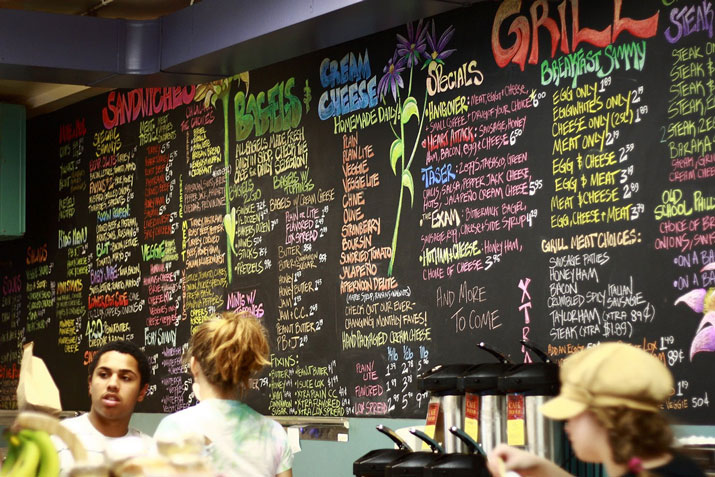
I have an aversion to menus. My feeling is not pathological, but some people might want to declare that I’m nuts after reading this blog page entry. In the book of phobias (there probably is one) fear of menus comes closest to Decidophobia: The irrational fear of making a decision. Anyway, I resent being called irrational.

I don’t like Drive-Thru restaurants but the other day I had a craving for KFC. My wife encouraged me to have the bucket handed to me through the car window. I nervously complied. But first I had to contend with an eight foot tall menu printed with more types of fried chicken than I thought existed. The voice on the speaker asked what I wanted. I froze. The voice asked again and I blurted out that I wanted a ten piece bucket, original recipe. I breathed while my bride coached me to be calm. The voice said, “It’ll be mostly dark meat.” I mumbled something about ‘I hope it’s not all drumsticks’ as I considered the logistics of aborting this mission. “Drive to the window,” commanded the tinny speaker voice. I meekly obeyed.

Confusion over, I merged with the highway stream of traffic. My wife cradled the warm container of ready-to-eat chicken in her lap as I concentrated on the job of driving home safely. I tried to laugh at myself about being rattled but it wasn’t the first time I’ve expressed a reluctance to deal with the ordinary task of ordering from a menu. I’m nervous enough, while on a date, to ask my partner to order for me. The big overhead boards at fast food restaurants are the worst, especially when I don’t have my glasses on. The food choices are arranged in weird categories too; like Breakfast, Lunch or Dinner and then you have Combo Meals or even Vegetarian. At a table service restaurant I get stressed by the multi-folded plasticized menu maps, like those offered at the diner in the award winning Canadian television series ‘Schitts Creek’.

https://www.youtube.com/watch?v=JvRACORcR_I

The origin of word Menu is French for ‘detailed list’ and the Latin for ‘very small’. I prefer simplicity when it comes to menu choices. If it is beef stew I don’t need to know the details of how the beef was raised/braised or that there were three kinds of potatoes hand peeled and marinated in organic vegetable stock. A dining out option is a time to treat my guests to the social aspect of breaking bread, not to go overboard about the type of flour that might have been used for the loaf.

A large amount of choice brings me stress. If someone asks me where I like to eat out, I say I don’t. My preference being to look in my own refrigerator and picking something with minimal preparation time. That way I can spend more of my leisure writing reflections like this one. My writing program has a drop down menu of only six headings; That’s not scary at all!

Re: Yes

The YES/NO binary fascinates me. When I went to university computers were a becoming thing. Beginning science students at my college had to take a basic programming course. We used punch cards, stacks of them. We talked Fortran to a whirligig machine the size of a classroom. The best thing I got out of the course was learning Flow Chart methodology. I still use this principle to make personal decisions.

Life is not always a matter of a yes or no decision. A yes answer to a question can mean you agree, and when it comes to a contractual understanding I believe it shows strong character to commit to the outcome. On the other hand, saying yes can also be a process to finding out. I always told my young sons when they were out with others that if things went south and they started to feel uncomfortable, they could always call me for a pick up. Deciding yes doesn’t mean there is no turning back, yes doesn’t mean you are stuck. There is always something else you can do; it’s quite fine to change your mind.

When we are in autopilot we probably don’t think too much about our Yes/No response rate. Most of our lives we just flow along. I’ve said a resounding Yes to marriage twice in my life. Choosing teaching as a career was a fateful Yes. I’ve chosen affirmative responses to life changing questions when folks have shown confidence in me even when I have doubted my own ability. I once chose to question the YES of life in the midst of some dark days.

Back when I was coding those punch cards, the computer could only determine between one and zero. Like an On/Off switch the pathway to an answer flowed like an electrical current until a solution was found. As we move closer to AI robotics I wonder if we’ll be able to program something like a shrug into a SimBot. A simple yes or no is restrictive to creativity. A Maybe thrown in, once in a while, can stimulate imagination.

I love saying Yes. But it’s not always a practical answer. My wife says I’m a very emphatic person. I joke with her sometimes that life would be more fun if there was a limit to the negatives; Don’t, Not now, Not really, Never! M’Eh is the worst: That response combines a dismissive attitude with an apathetic outlook. Nothing is ever accomplished with a M’Eh. Unfortunately my reflex response, whenever we are out shopping, is No! I hate being a spoilsport. I can make firm and relatively quick decisions because I know myself well but my mind is not suited for a black or white rigid existence either.

My mother-in-law showed me her wedding pictures yesterday. She’s been saying her final goodbyes to her husband of 68 years. It took him nine years before he agreed to the union. I watched her smile like Mona Lisa as these memories played about in her head. Her lifetime started with a Yes.

Re: Compromise

I can look at the word Compromise from a negative or a positive perspective. When I’m feeling personally compromised I can feel defensive. I’m backed into a corner. My values, principles, even my character is being tested. Someone, (maybe me) has drawn a line in the sand and won’t back down from their position. Chances are this will end badly, unless a middle ground can be found.

Compromise is sometimes making the best of a bad situation. But the work must continue: One must not be resigned to one’s fate. Plans can be made to rectify hurt feelings and reconcile past wrongs. This is true on a personal scale as well as in the public arena. Leanne B. Simpson writes in her book ‘As We Have Always Done’ that relationships (of any kind) are based on consent, reciprocity, respect, and empathy. To my way of thinking reciprocity contains opportunities for finding a non-compromising solution.

It seems quite clear that our planet has been dominated, harvested, polluted and abused to the point where compromising is futile. Leaders gather at multi country conferences like COP26, held in Glasgow, Scotland last year, to attempt a negotiated consensus. It is maddening that while the intent to address climate change seems honest, financial interests time and time  again trump the agenda. The health of all humanity seems beyond our collective will. There is no room for compromise if it means our planet will continue to die. There is no middle ground here, not when that very ground is drying up, flooding and burning. It is really a time for action, not words.

In my life I’ve had to let go of notions that no longer served a purpose. For example, when I was twenty I wanted to be a husband and father within a strong family dynamic. I also wanted to sail the seven seas with Jacques Cousteau. Surprisingly, that great ocean explorer managed both and had two separate, secret concurrent families. I can only imagine the concessions involved for Papa Jacques. My choice was a compromise in the best way possible; I had a successful career, teaching many elementary students the wonders of life, along with abundant time to fill my cup with warm, expansive family memories.

I’ve learned that sometimes it’s ok to let others lead, while I provide a response as a supporting partner. It’s also ok to test out newness, owning the change that comes, making it less about compromising your character and more about celebrating your evolution. My growth as an individual has not been perfect, yet I’ve tried to find something close to perfection in all that I have done. Even my mediocrity has had its moments of splendour. In short, I don’t believe you have to lower your standards to make the concessions that are necessary in life. Maybe you adjust your expectations a bit. Marvel at the way others have found success, rather than feeling gypped about your existence. It’s more about finding the best way forward, seeking the best possible answer to the present question.

Re: Circumstances

It is possible to be convicted by circumstantial evidence. Likewise, we are all victims of circumstance. Our unique set of circumstances, beginning with the accident of our birth, forms the template of our lives. Some of us will carry our fates like a cross to bear, some will struggle with the unfairness of our circumstances while others will journey forth to find the truth of their destiny.

It’s not pleasant to feel shackled by unfortunate circumstances. We can look at the hand we’ve been dealt and search vainly for something up our sleeve; some magic that will improve our circumstances. I’d hate to live as a Hindu under the caste system. How is that any different from the rule of apartheid as practised once in South Africa? One’s lot in life can be accepted but to have it institutionalized is a travesty of human rights. It’s a form of segregation that the Dalai Lama finds abhorrent. I can’t imagine being an Untouchable.

I refuse to be a victimized by my circumstances.  I have sometimes shouted the Billy Joel song, ‘My Life’ while in the shower. Feeling angry after being bullied, I wanted to be left alone with my own life. Under these circumstances the lyrics can be seen as an encouragement to stand tall, girded by the courage of your own convictions. https://www.youtube.com/watch?v=Tka4DQGx7zc

I think artists, and particularly poets, are the scientists of emotion. They use words to try to make observations and draw conclusions about feelings. If you get concerned about the hand you’ve been dealt in life, it might help to change your vocabulary. Coincidence is linked to circumstance. Fate is the annoying brother. Serendipity is the favourite aunt. Timing is your gym coach. These words can lead you out of the prejudice you find whenever you hear the word Circumstance. Yes, events happen to you, but you can decide what to do next. Circumstances may have brought you to the crossroad and then it is up to you to go left or right.

To be sure, there is unfairness in the world. It’s unfortunate that some people work harder to prove this truth than to correct it.  I find no satisfaction in saying, “I told you so.” And pointing the finger of blame doesn’t help either, even if you are pointing it at yourself by saying, “I can never catch a break.” I walked by a park near where I live and saw many tents occupied by homeless folk. “Get a job!” I’ve heard some shout as they drive by in their cars. One tent was set on fire under suspicious circumstances. I often wonder if under different circumstances, I might be one of these unfortunates hunkering in a flimsy structure, unfit for a cold dark winter.

I like the first four letters in the word coincidence. Our circumstances can provide us with the ‘coin’ we may use to get the most out of life. Don’t make yourself a slave to fate. Watch for the opportunity, then lay down your hand with optimism.