Re: Imagination

Imagine for a moment you are enthralled by a young mind telling you a story from their imagination. In this context facts are unimportant, only the drama and wonder of thinking how this idea could possibly have begun in the first place.

There I was one afternoon relating the story of the big bad wolf and the three little pigs to my three year old imaginative friend. He was rapt as I told him that some versions of this fairytale had the wolf EAT the pigs (my listener has a vegetarian mother). He stopped me several times to repeat sections. A couple of times I had to assure him that every character was doing what came naturally. At the end of my tale I asked what he thought of eating meat from pigs (we had had sausage for lunch) or chicken (he concluded that birds don’t count). He said he didn’t care about fish.

Any teacher will tell you it’s a perk of the job to listen to examples of imaginary thought from their students. I remember my mom always saying the phrase “out of the mouths of babes” whenever she concluded a story about my sister or me to her friends. Back then there was a television program Kid’s Say The Darndest Things hosted by Art Linkletter. Later the program was rebooted with Bill Cosby posing as the questioner of the kids. Imagine!

My young friend ruminated on my fairytale for a moment (bathroom break). The house continued to buzz with kitchen clean-up and quiet adult conversation when he came back and sat beside me on the couch. I thought he was going to ask for another fairy tale but no, he began to tell me something that sounded like a recipe for baked horse. Allow me to provide a condensed version of his culinary how-to: You have to put on gloves and get all the poop out. Next (he instructed) you cut off the tail and chop the horse into pieces that will fit into the oven. Keep everything clean (he emphasized). When it’s all very hot then you spread on some mayonnaise (at this point he smacked his lips!)

After the first narration my young friend was clearly impressed by the attention he was getting (by now his parents had joined in, listening with a measure of shock & awe). The show must go on! He raised his arms and asked if I would remember his horsey story (I assured him that I would never forget it). He then stepped onto the floor and performed an interpretive dance version of The Baked Horse Recipe. His hands got rid of all the poop, the snipped tail miraculously flew into the air on sprouted wings, the horse bits were pushed into the oven, and the spreading of the mayonnaise was the piece de resistance! He could have bowed because we all wanted to give him a standing ovation. I suggested to his parents that he must be enrolled in acting classes immediately, or at least chef school.

Re: Choose

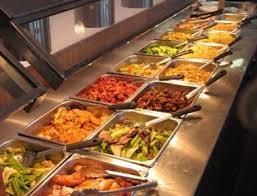
My niece as a young girl loved to have a choose meal: a buffet of food items laid out by her mother for grazing. That little girl could not be still in her chair when other members of the family gathered to dine. That come and go arrangement used to irk her grandad, whom she called Popop (coincidentally a name that unintentionally yet neatly labelled her behaviour of popping up and down).

For a while there was a popular series of children’s books styled as Choose Your Own Adventure. The construction of the pages allowed the reader to decide, at the bottom of the page or end of a chapter, which page to turn to, for the narrative to continue. Sometimes your choice would lead to a quick ending, or a multiple series of back and forth page flips before the action was resolved. Reminiscent of game shows on television that ask if you might choose between door number one etc.

I watched a riveting two person play recently, called Armstrong’s War. A young wheelchair-riding girl guide chooses to read to a youngish army veteran to gain her Service merit badge. In the narrative we learn that circumstances beyond both characters’ control required choices of life-changing proportions. Playwright Colleen Murphy’s script examines how complicated it can be to select a course of action. It’s an anti-war tale without cliché and a strong message about how our society could make better choices. With the current rise globally of authoritarian governments, I watched this play unfold amid a background thought of the meaning of democracy. I wondered how much choice we really have in this context.

We think we are choosing all the time; what to eat, who to partner with, how to fill our days, what to watch on TV, or when to walk in the park. Choosing feels like an active pursuit, we know in our minds that we always have a choice but choosing means we have to go from the abstract to the real. Sometimes choice feels like a burden, an obligation even. Other times we get riled if our choices are restricted because we equate choosing with freedom. We can choose from a menu board that’s presented (as in a slate of candidates) or the menu board that we have built in our minds to cope with everyday decision making (when to do the laundry). I confess that as my age increases I try to purposefully reduce the options in my brain so that the stress of choice is minimized. However, when outside pressures reduce my personal authority I can rise up tall in human right’s fashion. Currently I join the MAiD debate, proclaiming my right to choose a dignified death.

My niece has grown into a responsible adult, despite her Poppop’s concerns over her eating habits. She’s making great decisions on how to raise her almost three year old. He gets to choose but he minds his mom enough to consider a healthy path. I watch from the comfort of my elder chair and continue to learn.

Re: Wing

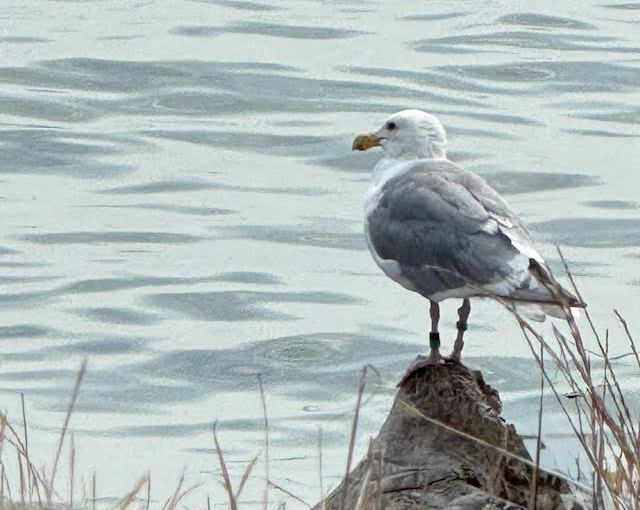
I’ve been watching a pair of seagulls raise a pair of puffy looking offspring this past breeding season. I have a vantage point that makes me feel like a voyeur some days and an anxious grandparent on other occasions. When the parents seem in a panic as they defend their own privacy, their nest, and then their nestlings, I can’t help but believe that I’m witnessing the reason for the phrase, ‘Living on a Wing and a Prayer.’

In my home I have a folk-art sculpture of a single herring gull I made to scale out of wire, plaster casting material, and paint. I call him Webster. He reminds me that I share this planet with other sentient beings; capable of being parents, babies, teens, and ultimately road kill. Webster reminds me of the circle of life for all living things. Some times we are required to go-with-our-gut by winging it and hoping for the best outcome.

For soaring birds like gulls, it appears that the sky is virtually the limit. As I watched the repetitive runs by my neighbour avian parents, returning from a hunt, regurgitating, and flying off again, I wondered about my past role as a parent looking after the needs of my growing boys. When the emotional weather was stable and resources were in good supply the job of preparing my kids for flight seemed routinely easy. But on stormy, unpredicted days it seemed all I could do was find shelter for my trio in the nest that I had painstakingly built with my wife.

Immature gulls must be trained. Reaching the size of their parents doesn’t guarantee successful flight. I can’t imagine what that risky leap from 3 stories up must feel like. Presently I watch as they bob on the waves near shore hoping for a handout from the latest military-like feeding style of the local harbour seals. Those marine mammals hunt in pairs, laying a bubble trap for minnows then exploding through the centre of the curtain to gobble a mouthful. Gulls, young and old, wade nearby looking for scraps.

A common human dream, next to appearing in our underwear, is being in flight, soaring above our problems and having the advantage of the sky as our higher ground. From there, while on-the-wing, we observe our possibilities and potential from a more commanding perspective. I wonder if that is an advantage that my gull friends are aware of as they take wing each morning. Looking for an updraft to lessen their need to flap they squawk like they know the meaning of freedom, even boasting of their superpower.

I can only imagine that first flight feeling by engineers like the Wright Brothers. Or of poet/pilot John Gillespie Magee Jr. as he “slipped the surly bonds of earth” on “laughter- silvered wings.” When I daydream of joining my fine feathered friends in fantastical flight I soar through clouds that comfort me as a blanket might when my mood is blue. Up there I’m away from the perils of a human Earth.

Re: Theatre

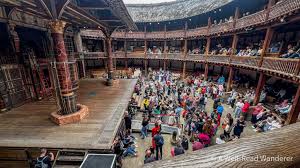
“Don’t go into theatrics.” my mom would say when I tried to explain why I did something she had thought was outrageous. Both my parents had local community experience on stage, so references to theatre popped up often during my childhood. My mom and dad met in a Social Club (which was a popular institution in pre-WWII England). These clubs were run by youthful members who planned dance-nights, sports events, card parties, and cultural festivals. Much later, in Canada and the USA, my parents organized successful amateur productions of traditional drama, musicals, and participatory community theatre.

My mom had plans for her son and daughter to go into showbiz. My sister and I performed on union hall stages and auditioned for television amateur shows. We didn’t like the spotlight. We didn’t dedicate ourselves to honing our talents. We were content with the theatre of our own lives. What we extended into our adulthood was our love of musical theatre, particularly as produced for the cinema. I knew many songs from these shows enough to sing heartily in the shower, or someplace private. My sister, once drunk, belted the lyrics out with enough gusto to convince me she knew them by heart too. Theatrically, our own paths diverged only slightly: She acted out on the karaoke stage while I joined voices with others in church choirs. My mother always referred to us as the devil and the angel. Pity us both.

That symbol of theatre; those masks of joy and sadness, are evident in personal lives as well as behind the curtain. There is an element of pretending in our behaviour. Some might refer to it as, “Fake it ‘till you make it.” I have to say I have tried to be genuine in my approach to life. Others have expressed that I am a man of even keel. I suppose I have tried to act that part whenever I can, being the guy everyone can count on. However there was one time in my early forties where I forgot my lines. In fact I totally went off-script and let others take the responsibility for life’s big play. Those days lacked the lift found in a musical production.

I relate closely to films that examine the complexity of the human condition. Recently I was transfixed by the television series Mare of Easttown. The titular character played by Kate Winslet, was disturbingly close to my memories of my sister. Within the gentle comedy of Ted Lasso I found that title character, played by Jason Sudeikis, to be as close to what I would like to be in my world. Self perception is often inaccurate and we may wish to deny the associations we deem fit to define us. Within the theatres of our mind we have had directors, script writers, costume designers, and singing coaches all trying to make our performance be spectacular.

A life’s work is finding the song we can sing, or the part we can play that will bring us to the red carpet knowing we’ve earned the recognition.

Re: Drawer

This word must be hard for ESL students. I taught elementary school kids and they would have more trouble with words if they were hard to pronounce. Drawer has a sound like shore when it’s used in sentences about places to put things. But an artist can be a draw-er, which makes me think of someone involved with practising law, which puzzles me even more because that person is a lawyer, which is consistent with someone who works with wood who might be a called a sawyer. Poor students! Imagine the questions if I assigned The Adventures of Huckleberry Finn and his friend Tom who explored the Mississippi River while dressed in muddy cotton drawers!

My dad was a drawer. He would draw on his life experiences to tell fabulous tales. In that sense he was a collector of curiosities & thoughts, in another sense of the word he actually drew stuff. He used a pencil to sketch or a brush to add colour to his surroundings. His drawings were his perception of the world, put on paper. He was sometimes commissioned to replicate a favourite dwelling. One house-proud person was so delighted by his pastel reproduction she exclaimed, “That’s exactly how I see it when I’m turning into the driveway.” When he told me this story and showed me the photo he had taken, I noticed he had left out a telephone pole, and a hydrant, from his final sketched landscape. I understood he was a drawer in that instant. He allowed that the homeowner would draw her own conclusions, all the while anticipating her human need for fantasy.

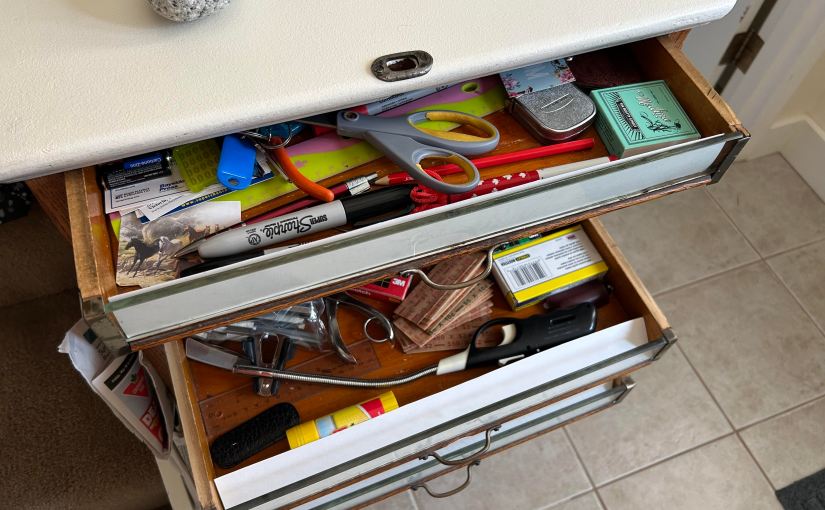
Everyone has a junk drawer, sometimes in the kitchen, sometimes in the bedroom. Like a magpie we collect stuff and toss them here for when we think we might need them. Even things that have no use. If you can’t afford a place with an attic or basement crawlspace, a drawer will do to hide those old love letters, secret things, or stuff not worthy of the knickknack shelf. My mom had a glassed-in corner curio-cabinet with shelves that could be pulled out for closer examination. She kept her thimble and teaspoon collections in these suede-lined drawers. I can picture her in my childhood memory excitedly drawing on a cigarette as she talked about the origins of these treasures. She let the ash fall where it may.

Thanks to my dad’s influence, story telling later became a big part of my teaching curriculum. I often read fairytales to instigate study of other subjects. I remember one student designing an efficient water well, for a science fair project, after hearing Diamonds & Toads by Charles Perrault being read in class. Together, other students did their research and discovered there were many fables based on the drawing of water from wells. My essay is about to draw to a close. Let your imagination wander.

Re: Shadow

My mom would sometimes answer my persistent childhood questions with, “Only the shadow knows.” She would say it in a spooky voice that gave me the creeps. It was much later that I learned it came from an old-timey radio program, The Shadow, about a vigilante and his female sidekick. I think my mom saw herself as a detective. She even worked part-time with a private eye on divorce cases involving suspicions of adultery. Dark serious stuff.

Shadowing someone sounds sinister. In the modern lexicon it might be described as stalking. But in business settings to shadow someone suggests a new employee watching and learning from someone more senior. As an experienced elementary school teacher I was asked to support newly graduated teachers in a mentorship role. One year I was assigned a policeman who gave up his career due to burnout (he had the grim job of taking crime photos). We had great conversations as he learned the ropes in the sometimes stressful arena of education. When he got a full-time position he honoured me with a poem describing how he had been “a shadow of his former self” before I helped him create a more satisfying work/life balance.

While in a playful mood with my young children I have used my fingers to create shadow puppets on a wall. One son helped me build a sun dial in our back garden to catch the movement of a shadow telling us the time of day. Another son loved how I read an abridged version of Peter Pan. We would playact the scene where Mary stitches a shadow onto Peter’s heels in an effort to ground the never/never boy to reality.

In the film Perfect Days there is a delightfully scene between two drunken middle-aged males playing a game of shadow tag. They exhaust themselves, trying to stamp on each other’s silhouette, then they get philosophical wondering if each other’s grey profile, when overlapping, would produce a darker shadow. It doesn’t get blacker as they hypothesized, which causes even more confusion. Directly and subtly, this intriguing film explores the shadows we cast as we move through our lives. We are led to build our own backstories of the characters in this film, from the brief shadowy references to their past. I love the way we are invited to consider time as fluid, moving gently from sunrise to sundown, until next time becomes now.

When I was a baby I giggled lots when my mom pushed my pram under the dapple of trees. The Japanese word for this speckled shadow from leaves is Komorebi. There is joy in this translation. For me this phoneme suggests the sound of a breeze through branches. It is hard to take a realistic picture of this mysterious play of lightness and shadow. A camera can distinguish light from dark and pick out the hues and tints of colour, yet our eyes measure more. The brain is reacting to what the eyes see as fact, yet life is about shading that perception with our constantly evolving selves. Perhaps answers can only be found amidst the shadows.

Re: Mistake

I don’t like the phrase, ‘We all make mistakes’. It has a let-me-off-the-hook sort of vibe to it. We see the underlying theme of this phrase often as in Brittany Spears singing ‘Oops I did it again.’ Yes, the reality is that we humans err, but there is no sense of accountability when someone shrugs. In politics there may even be examples of a cover-up rather than an admission of any responsibility. A Director in the recording industry, television, or movies can ask for another take, if the first performances have missed the mark. Yet a shout of “Take Two!” is not going to cut it in an argument with someone you care about. On the in-real-time stage of life scenarios, the miss-takes are unfixable, since the show must go on.

“My Bad” or the snotty version, “Mea Culpa” is not a replacement for an apology. I guess being a Canadian I am hard wired to be apologetic. But a sorry verbalization that comes naturally is still not an excuse if I have exhibited bad behaviour. I once kept my whole young family waiting at a campsite for me to return from an errand of my own obsession. I wanted a silly travel sticker to complete my collection for a Great Lake Superior Tour promotion. So I left everyone to pack up the travel trailer while I went into town early. In my excitement, at the tourist parking lot, I locked my keys in the truck. Long story short, I got my sticker and was rescued by an affable hydro worker who had just the right length of wire to pull my vehicle’s lock button. But, I had kept my loved ones waiting nervously, thinking I had been in an accident. That’s on me.

We don’t always try to learn from our mistakes though. In the film ‘Juror #2’ the role of mistakes in one’s life is examined through an extended courtroom scene. Slowly the errors of human behaviour and the systems created to provide a sense of justice are revealed. It’s a film that explores cynicism, righteousness, loyalty and community standards to resolve what began as an accident of deathly proportions. We can learn from art.

Misinformed, miscalculated, misrepresented, misspoken, misfortune, and misunderstandings are part of the vocabulary of the errant human. Sometimes we screw-up and sometimes it seems that the universe conspires to make our life difficult. Yes there are such things as innocent mistakes, even innocent bystanders. Even in those occasions when we feel blind-sided or personally hard-done-by, I feel we can learn something to try to prevent another mishap. Accidents are sometimes preventable with a little forethought. My elderly mom blamed herself when she fractured her hip. She went into a darkened room to fetch something and slipped on a bit of plastic on the floor. “If only I had slowed down and thought it through.” She said of her fall. She walks about very carefully now, so I guess you could say that was a lesson learned.

Would that each of us could learn something from the vastness of human experience!

Re: Empty

Emptiness can be both positive and negative. For example an empty calendar can be refreshing: There is no responsibility or must-do event waiting to corral your attention. Under those blank circumstances you can empty your thoughts if you wish or cram them with long denied pleasures. The negative part of emptiness suggests a void: A vast expanse of nothingness. I’ve had that feeling after a relationship break-up or a sudden loss. I felt so empty of ambition in those moments, my head seemed vacant of all ideas except a nagging question, “What am I going to do now?”

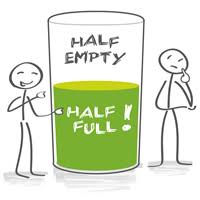
Generally speaking, I’ve been a ‘Glass half full’ sort of fellow, so if my vessel empties it’s because I need a rest, not because I’ve adopted a negative vibe. A soul can be depleted, that’s for sure, so it’s important to always check your levels to see if a top-up is required. I’m a guy who likes to keep the gas tank above the half-full line. I remember being highly anxious over a song that showed exultation over driving a car while ‘running on empty’. I imagine that scenario casting me into a void of no return. Not my kind of fun.

In my teens my mom admitted to being numb, emptied of emotion, because her relationship with my dad had been depleted. It was a sad time for all of us in the family that had once enjoyed relative abundance within the restrictions of a low-budget existence. Looking back on those depressing months before reconciliation, we all could have been described as walking wounded, barren of possibilities, grasping for mere survival. Board games had once been our favourite group activity. Now, in real life, we were playing a zero-sum game.

Most will run away from emptiness because we equate it to loneliness.  But an empty space or even a brief expanse of time can beckon. An empty container is often pictured on a still-life visual art canvas. It has beauty in form and structure all on its own. Being empty means the light can shine through and around in fascinating ways. A container can be full-some, in and of itself. Forms of yoga or meditation allow us to realize that an empty mind can be a starting point to new ideas. Going blank can lead to a refreshed way of thinking and understanding. There is a new car freshness to having a clean slate. An empty vessel can also suggest an expectation of forthcoming change or the approach of being filled with a hopeful breath of new life. Metaphors abound!

When I pass a hotel or apartment complex and see a No Vacancy sign I usually feel sad. I wonder why there is no more room to shelter someone in need. I feel badly for those missing out on a chance to stay, even for a little while, and experience what that place has to offer. But a flashing Vacancy is invitational. This place is Open for Business! Those in-between spaces, neither full nor empty, need our attention.

Re: Stories

While talking to my 95 year old special mom about a newspaper story of a neighbour who is lost, I became lost myself, in the flimsy gauze between truth and fiction. The report of the missing man has details that beg to be filled in with only my conjecture. My mom asks questions that I can’t objectively answer, yet a conclusion to the story had to be reached before we could move on with our day. Thus, the story in our community becomes wedded to our own story, even while the resolution to the story is pending. Even with her advanced age and experience, my mom found this hard to bear.

Bedtime stories are precious in the way they invite imagination. The child being read to goes on fantastical journeys with only a few words of script. Sometimes only a picture is enough to provoke multiple questions of why, how and where. The stories live on after the sleepy-head has been tucked in and the reader has left the room. Stories are meant to persist just as the witness to a life event takes in information and transforms the data into something relevant and understandable. In that way, life itself is a never ending story containing multitudes of chapters and possibilities.

A building starts with a foundation. Stories are added to this physical structure to accommodate people and things. Sometimes in poorer countries the extra floors take time to build. I remember asking a tour-guide, while on a bus trip in Peru, about some buildings having rebar sticking out at the top of rows of cinder block. She told me it was a sign of hope in her community that one day enough money would be available to add a second floor onto the house, to make space for expanding families. A case of another story creating room for more stories.

Recently Andrea Skinner, a daughter of Alice Munro, made public her story of abuse at the hands of her step-father. Readers of Munro’s work talked and wrote about the revelation as though it was their story. Some couldn’t see themselves ever reading this Nobel Prize winning author’s stories ever again because of this new, real life chapter insertion into the Munro bibliography. Ms.Skinner’s misfortune reminded me when I was a toddler and being admonished never to tell tales on the family. I took that to mean; Don’t lie. Yet when I saw my mom talking with others she would often start a conversation with another adult by asking for gossip. I still find the difference between privacy and secrets confusing.

Any bit of fact can be turned into a story. I believe conspiracy theories are an attempt to make our imaginations come to life. We want to understand things so desperately that we join in the story making with other like-minded folk to explain the unfathomable. Every culture is built on stories. Sometimes the truth is hidden to get on with other things we think are more important.

My story is not like yours but we have chapters in common, let’s build on that.

Re: Dad

Some words stand for a lot of stuff. To me, Dad is exclusive. Well, he was also a dad to my sister but they’re both dead now. In my memory he is the man who led the way. My dad was my elder: The one who made me ponder, made me proud, made me bashful, made me silly, made me ashamed. He patterned me in ways I’m still trying to figure out.

Like sons everywhere, I looked to my dad first as a protector. My first recollection of him is when he came looking for me because I was late for dinner. I believe I was still in diapers, at least I remember my pants were very wet from playing in a puddle, where he found me. He wasn’t angry. He took me by the hand and led me back to the house where my mom would surely give me a talking to. I don’t remember her lecture only that Dad changed my clothes and sat me down at the table in front of something hot to eat.

I rarely think of my dad as a father. There are many words in many languages for the patriarch of the family. Others may call out Pere, Papa, Papi, Apa, Vader, Tati, Baba or other words unrecognizable to my English speaking ears. My Polish born daughter-in-law sometimes calls me Tato. My own son is called Po by his son. My niece used to call my dad Popop when she was little. The word father is very generic sounding to me; as in everyone has a father. It is also religious sounding; as in ‘Our Father’. That father is always in heaven, far away and out of sight.

My father was a busy fellow during my growing up years. He was a shift worker at a factory so I rarely saw him until dinnertime. On weekends he often had another job which brought our family of four enough money to make ends meet. Those ends came together for me during our annual camping trip to the ocean. Dad became a different character altogether during these adventures: More playful. More thoughtful. With up to two weeks to play, my dad would not de-stress so much as re-create. Here at beach side I would learn more of his past life, his dreams, and his wonderings. He had a life before me? As I got older, I discovered I was only part of the timeline for this man I called Dad.

I’m still puzzling over the meaning of my dad in my life. Biologically, I believe there may be a genetic connection when it comes to my curiosity and creativity. I’ve been told I have a calm disposition and that comes from my father too. He demonstrated a love of nature, art and an optimism regarding his fellow humans. I can’t say he actually taught me much other than to be careful who I chose to be my wife.

My dad died alone, on a distant shore. I hope his final thoughts were happy ones.