Re: Shadow

My mom would sometimes answer my persistent childhood questions with, “Only the shadow knows.” She would say it in a spooky voice that gave me the creeps. It was much later that I learned it came from an old-timey radio program, The Shadow, about a vigilante and his female sidekick. I think my mom saw herself as a detective. She even worked part-time with a private eye on divorce cases involving suspicions of adultery. Dark serious stuff.

Shadowing someone sounds sinister. In the modern lexicon it might be described as stalking. But in business settings to shadow someone suggests a new employee watching and learning from someone more senior. As an experienced elementary school teacher I was asked to support newly graduated teachers in a mentorship role. One year I was assigned a policeman who gave up his career due to burnout (he had the grim job of taking crime photos). We had great conversations as he learned the ropes in the sometimes stressful arena of education. When he got a full-time position he honoured me with a poem describing how he had been “a shadow of his former self” before I helped him create a more satisfying work/life balance.

While in a playful mood with my young children I have used my fingers to create shadow puppets on a wall. One son helped me build a sun dial in our back garden to catch the movement of a shadow telling us the time of day. Another son loved how I read an abridged version of Peter Pan. We would playact the scene where Mary stitches a shadow onto Peter’s heels in an effort to ground the never/never boy to reality.

In the film Perfect Days there is a delightfully scene between two drunken middle-aged males playing a game of shadow tag. They exhaust themselves, trying to stamp on each other’s silhouette, then they get philosophical wondering if each other’s grey profile, when overlapping, would produce a darker shadow. It doesn’t get blacker as they hypothesized, which causes even more confusion. Directly and subtly, this intriguing film explores the shadows we cast as we move through our lives. We are led to build our own backstories of the characters in this film, from the brief shadowy references to their past. I love the way we are invited to consider time as fluid, moving gently from sunrise to sundown, until next time becomes now.

When I was a baby I giggled lots when my mom pushed my pram under the dapple of trees. The Japanese word for this speckled shadow from leaves is Komorebi. There is joy in this translation. For me this phoneme suggests the sound of a breeze through branches. It is hard to take a realistic picture of this mysterious play of lightness and shadow. A camera can distinguish light from dark and pick out the hues and tints of colour, yet our eyes measure more. The brain is reacting to what the eyes see as fact, yet life is about shading that perception with our constantly evolving selves. Perhaps answers can only be found amidst the shadows.

Re: Kept

I don’t have any well kept secrets because I’ve never been good at hiding things. I don’t enjoy keeping people guessing if there is news to tell. I can keep to my own thoughts though, and I’ve sometimes kept a diary. I’m reasonably good at keeping up with a conversation. I’ve kept going to work when it was the last thing I wanted to do just to keep up appearances. I have reluctantly worn a silly hat in keeping with the situation.

Julia is a television series created by Daniel Goldfarb. In the second season, episode two Stockard Channing has a guest role as Frances Field. While at a dinner gathering, her character makes a short speech. Frances says” “We’re all kept…I know I’ve been kept. I was kept by my late husband…I assume you’re kept…good fortune comes and goes. Here’s to sharing everything you have. Here’s to being kept.” There is a long pause as people leave the table saying goodnight. Frances turns to her date and says, “Was it something I said?”

I wondered about that speech. I tried to trace examples in my life of being kept. I asked my 95 year old special mom for an opinion. She said immediately “I am kept” and then “but I don’t feel hard done by.” My mother-in-law is such a realist when it comes to figuring out life. Being almost blind and hard of hearing means she is very dependent on others for her care. So in that way she is kept, but content and grateful to be so, we mutually concluded. Her response has kept me thinking.

The phrase ‘kept woman’ flashed through my mind as I reviewed that conversation. I started to realize that Ms.Field was perhaps feeling equally blessed when she gave that dinner toast. She felt her needs were being looked after and she didn’t mind suggesting that some of her autonomy had been lost as a result of being kept. She was being realistic however, in implying that getting along in life requires exchanges and compromises that don’t necessarily have to diminish one’s character.

Yet where do we draw a line for ourselves? I don’t wish to be someone’s puppet; kept on strings in a case, in a corner. Neither do I wish to be in the driver’s seat for someone else. I respect that everyone has a right to their own life and to live it as they please. For a number of years in my youth I was often left in charge of my sister. Our mother made it clear that she didn’t want us to look unkempt, lest neighbours grow suspicious of her shirking her parental responsibilities. I was expected to get my sister to and from school, sometimes also making her lunches and dinners. I was told to look after her until mom or dad came home from work. I was my sister’s keeper.

My parents kept me in line. I became responsible as a result (perhaps neurotically so). I’ll continue to share parts of me. And I’ll show gratitude whenever someone chooses to look after my needs.

Re: Grace

If I had the chance to father a daughter, I would ask that she be called Grace. The name has a quality of mercy about it, so surely the owner of such a name would grow to value kindness, compassion and charity towards her fellow humans. I’ve only known one person named Grace and she was rather aloof, so maybe names can’t set the tone for character, but I still like the idea.

I’ve known several people to whom the value of grace was their guiding principle. One fellow from my church years, who looked perpetually 90 years old, shared a pew with me during choir practise. He carried himself with assurance, not arrogance. He would always put others before himself. He helped create quality time amongst our fellowship, never once demanding it. He wore simple clothes that suggested he wished to blend into a crowd, yet we always knew he was in the room due to his warm laughter. His favourite hymn was ‘Amazing Grace’ which seemed appropriate. Check out this lovely version by Cellist Patrick Dexter.

https://www.youtube.com/watch?v=Iyk2XrKIMcA

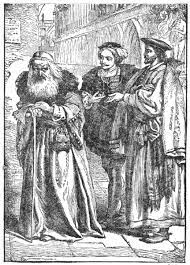
Shakespeare’s play, ‘The Merchant of Venice’ is one of my favourites from The Bard’s collection. While not without controversy, the characters do a wonderful job personifying several human values. After reading the play and performing a few lines in a classroom setting, my English teacher took our class to Stratford, Ontario to watch and learn. I remember being breathless throughout most of the scenes. We all felt somehow smarter after the performance, even a bit older. On the return trip, a small knot of us nerds gathered at the back of the bus to debate. We concluded that the opposite of Greed was not Charity, but Grace. (That’s why being greedy is so disgraceful) We didn’t do a High Five back then, but we knew we were cool.

Currently, in our bathroom there is a strip of wise sayings meant to start our day off on the right foot. One square offers a challenge: “Instead of Perfection, Seek Grace.” Sometimes it is easier to offer grace to another when we see they are in need of forgiveness or human comfort. To recognize in ourselves those same needs seems selfish. To attend to our own hurt, feels self serving. Etymologically, Grace comes from the latin word Gratis which suggests a gift freely given. Here is where we can begin: By recognizing that we are all members of a community, deserving of grace that is unreservedly given to all who assemble here.

A family tradition my wife and I followed when my three sons were growing up was saying grace at dinner. It wasn’t really a religious observance so much as an expression of gratitude. We would each offer a story of our day, highlighting who or what we were thankful for. Conversation often flowed gracefully to individual experiences. Our eldest described his frustration over a Lego model that didn’t turn out properly.“It looked different from the instruction picture,” he shrugged. “Just like people!” Amen.