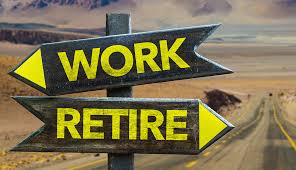
Re: Retire

I’ve been retired from a career in teaching for seventeen years. I’m not tired of it. Back in 2006 I had reached the magic formula that gave me a full pension so I embraced the moment to call it quits. I told my friends, family, students, whoever would listen. During one of my last recess duties a six year old came up to me with her friends in tow. “You’re not going to be a teacher anymore?” asked one kid. I nodded. “I told you he’s retarded.” stated another little scamp. I reminded them all that the R word wasn’t polite and that I would be retired after Christmas. “See!” one student shouted as they scattered through the playground. I still miss the children, but not the job.

I wonder what the word retire really means. After a working life in education, I took a job with my wife in joint resident management of a condominium. During those five years in a new community I also did a lot of volunteering. I wasn’t as idle as the designation of Retired might suggest. I wasn’t even technically a senior citizen yet. I had relocated, reconnected, reestablished, renewed, reconsidered and revamped my life. Those labels don’t appear on drop down menus from online surveys of employment status. My life didn’t end when I halted my career. Some of my most active years were still ahead.

Workers are being slammed/shamed by some employers these days for being selective about how they see work after Covid19. There is a workers’ revolution underway and it’s about a quality labour environment. Union membership is on the rise again as a reflection of employees wanting a greater stake in their workplace choices. Consideration of preservation and equality of retirement benefits is part of the negotiation demands. We are currently living in an age of record profits for companies and share holders and yet workers, who create the wealth, are being scorned for wanting better employment conditions. Labour must be honoured.

Life long learning is a banner slogan and a quest that I take seriously. It used to be that some folk might be called ‘retiring’ in attitude or behaviour. I’m not someone who is reticent about revealing my feelings. I consider myself to be an introvert in general, yet I will never retire from standing up for a just cause. Education is key to my continuing to feel that I have a place in my community and my society. Right now I am doing lots of reading; a great activity during one’s retirement years!

There were times during my full time working days when I wanted to sing out and declare to my boss ‘Take this Job and Shove it!’. When I was on the countdown to my last day of teaching I cut out a large ad from a local furniture store; Don’t Pay Until 2006. I pinned the reminder to my cork board behind my desk. Children in my classroom may have had trouble with the concept of being retired, but I sure didn’t.


Re: Work

Work is forever in a state of flux. In the past three hundred years we’ve gone from farming/market communities, through industrialization, to the technological revolution and now the gig economy with the challenges of AI on the horizon. In the past a boy might only follow in his father’s footsteps, career wise, or he might pursue a calling and enter a religious order. Girls were further restricted in occupational choice. For some a life’s work is one of service with little or no remuneration, other’s may pursue professions that provide financial rewards.

I viewed my work as a teacher as employment that enabled me to have job satisfaction, a wage that afforded me a comfortable living as well as time for my family. This workable arrangement allowed me what is now commonly referred to as Work/Life balance. I rarely thought of my work as a chore, more like a practice that I continually improved upon. I knew some colleagues and friends whom I would call workaholics. Any workplace can have those types who seem to be singularly focussed on pleasing the boss, getting it perfect, climbing the ladder, making money or retiring early. I was never wanting to sacrifice my home time in the name of professional ambition.

Life at home was not without its work component. My partner at the time revelled in being called a homemaker, a position without pay but one of considerable value. It was easy for me to contribute to the home-work since she had managed the job so well. Working from home means something different today, but my jobs back then were helping to raise three boys, being a home handyman, and chipping in on daily household chores. This may sound like Leave It To Beaver, https://www.youtube.com/watch?v=sgtiPOk83Ek . I would say all five of us had a very solid working relationship. As my lads got older, they found their way to contribute to the labour that is necessary within a family environment.

The COVID-19 pandemic is giving the world pause to rethink its cultures of work and play. I was amazed at my ignorance regarding a news bite from Northern Italy where people in a certain village were always without a regular paying job. The reporter referred to this arrangement as ‘informal work’. With the coronavirus lockdown they could no longer go about their town and scrounge for temporary tasks to provide cash, as was their custom. Would we all not feel safer as a society if governments could recognize the value of a guaranteed income? I feel lucky everyday for the pension my career has provided.

With my working life behind me I can play. I sometimes need a guide. My grandchildren wake each day knowing how to play naturally. They step from their beds and explore their world without inhibition. Their bodies move almost continuously. As they absorb their surroundings each touch and sniff brings them awareness and learning. Their young minds work intuitively at building relationships between their inner and outer environment. Work & Play in harmony.

Re: Strike

One hundred years ago, in a Canadian city once referred to as ‘the Chicago of the North’, the working class had had enough. A general strike was called in Winnipeg with switchboard operators, called ‘Hello Girls’, being the first to refuse their labour. This work stoppage was the biggest and longest of similar strikes throughout North America. While the original intention was to seek redress for poor working conditions through collective bargaining, this strike soon included non-unionized workers, returning WWI soldiers and thousands of other people who felt disenfranchised. Much like today, those living in 1919 experienced a disgusting disparity between rich and poor: The few had much. The many had very little.

Strike is a word that conjures up decisive action. One of the first movie musicals I enjoyed as a child was ‘Strike Up the Band’ starring Judy Garland and Mickey Rooney cast as two young folks with enough energy to change the world, perhaps even take it over with their enthusiasm.

Striking can be subtle but still forceful. When someone in the fashion industry strikes a pose they are trying to capture a moment of body posture to maximize drama. In one of Madonna’s masterful music videos, ‘Vogue’ she works her image to maximum effect. https://www.youtube.com/watch?v=GuJQSAiODqI

Strikes can be lucky if they connote finding gold, or unfortunate if they come in threes. My mom and dad were two pack a day cigarette smokers (to my knowledge they never indulged in Lucky Strikes). One summer afternoon, my father took me to a baseball game (this was a rare treat for me as my parents were part of the lower class). What I remember most was the abundance of cigarette butts that piled up around his feet. We stood and sang ‘Take me out to the ball game’ at the seventh inning stretch, yelling this line amidst Dad’s coughs, ‘and it’s ONE, TWO, THREE Strikes you’re OUT!’

I grew strong in spirit during my brief time as a Boy Scout. My favourite activity was camping. It was where I first learned to build my own fire. We were taught how to keep our matches dry so we could get the kindling going on the first strike. What I learned in my scout troop I applied with happiness to camping trips with my parents, and later as a young father of three boys. When it came time to strike camp there was always a sadness. Packing up the shelter that was our tent seemed too sudden a thing after we had spent such quality time under its protective embrace.

In the nineteen fifties, I learned about the hazards of a nuclear strike. In the event that missiles were launched in our direction we were taught to hunker under our school desks. What naivety! My nine year old self wanted to trust that my teacher knew how that bit of metal and wood would protect her students. My almost seventy year old self shakes his head when thinking how ignorant people can be.