Re: Drawer

This word must be hard for ESL students. I taught elementary school kids and they would have more trouble with words if they were hard to pronounce. Drawer has a sound like shore when it’s used in sentences about places to put things. But an artist can be a draw-er, which makes me think of someone involved with practising law, which puzzles me even more because that person is a lawyer, which is consistent with someone who works with wood who might be a called a sawyer. Poor students! Imagine the questions if I assigned The Adventures of Huckleberry Finn and his friend Tom who explored the Mississippi River while dressed in muddy cotton drawers!

My dad was a drawer. He would draw on his life experiences to tell fabulous tales. In that sense he was a collector of curiosities & thoughts, in another sense of the word he actually drew stuff. He used a pencil to sketch or a brush to add colour to his surroundings. His drawings were his perception of the world, put on paper. He was sometimes commissioned to replicate a favourite dwelling. One house-proud person was so delighted by his pastel reproduction she exclaimed, “That’s exactly how I see it when I’m turning into the driveway.” When he told me this story and showed me the photo he had taken, I noticed he had left out a telephone pole, and a hydrant, from his final sketched landscape. I understood he was a drawer in that instant. He allowed that the homeowner would draw her own conclusions, all the while anticipating her human need for fantasy.

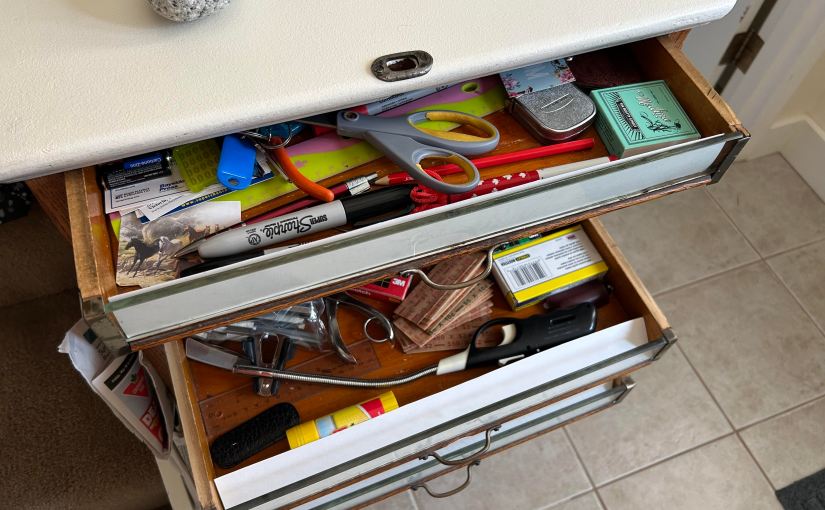
Everyone has a junk drawer, sometimes in the kitchen, sometimes in the bedroom. Like a magpie we collect stuff and toss them here for when we think we might need them. Even things that have no use. If you can’t afford a place with an attic or basement crawlspace, a drawer will do to hide those old love letters, secret things, or stuff not worthy of the knickknack shelf. My mom had a glassed-in corner curio-cabinet with shelves that could be pulled out for closer examination. She kept her thimble and teaspoon collections in these suede-lined drawers. I can picture her in my childhood memory excitedly drawing on a cigarette as she talked about the origins of these treasures. She let the ash fall where it may.

Thanks to my dad’s influence, story telling later became a big part of my teaching curriculum. I often read fairytales to instigate study of other subjects. I remember one student designing an efficient water well, for a science fair project, after hearing Diamonds & Toads by Charles Perrault being read in class. Together, other students did their research and discovered there were many fables based on the drawing of water from wells. My essay is about to draw to a close. Let your imagination wander.

Re: Artifact

My mother-in-law has been giving some thought to what she might like to take with her when she moves one last time. When I asked her which of her keepsakes were most important to her she said immediately, “My pictures!” I could relate to that sentiment since I have been in charge of family photography. Recently I digitalized all of that wealth so that my next move will be easier.

The task of cleaning out storage lockers, cupboards, closets, attics or sheds can be onerous and honouring. Through the layers of dust, artifacts of a personal nature are revealed. Letters and journals can be examined to make a time stamp, like rings on a tree stump, showing what was going on in our past, in times passed. Sorting comes easy when items literally break apart in your hands. Things that someone once thought might retain value, are not even yard sale worthy. Then again the adage,’One man’s junk is another man’s treasure’ continues to contain a nugget of truth.

I met up with a fellow who ran a New Immigrant Fellowship based around learning how to use a bicycle. My in-laws created a new memory for themselves by donating the wheels they had used when they were still able to peddle. In my job as cleaner/sorter in this downsizing adventure it is helpful to work with someone who sees value in letting go. I believe some of our curios are meant to make someone else smile. Clothes can be laundered and given away. Garden tools can be offered up to create new gardens of earthly delights.

My special mom has treasures from her daughter and grandkids that help her remember things hard to recapture. She wants to pass on family heirlooms. She has a pottery figurine she likes to have right next to her bed. It’s curious what each of us counts as treasure. I used to wonder what my birth mother was thinking as she stroked an old deckle edged Kodak black&white photograph. It was one taken of her sister, its corners now softened to the consistency of linen.

What we keep may be ‘art-in-fact’. Respect must be shown to the original owner of the relic. Museums around the world are coming to terms with this truth; that their cultural artifacts (some involving human remains) may have been procured under false pretences. Governments are seeking to rectify and reconcile with Indigenous People who have had their heritage put on display. Justice for these situations may be found through repatriation; a giving back of what was not ours to begin with.

I can’t imagine what I might leave behind as an artifact. I’ve already discarded things I once thought useful but no longer found important enough to shelve or even seal in a box. I can be very sentimental when exposed to an idea. I can cry when I see an artist earnestly creating. Generally though, old things are just curiosities to me. I’m an old thing after all, and pretty curious to boot.