Re: Walk

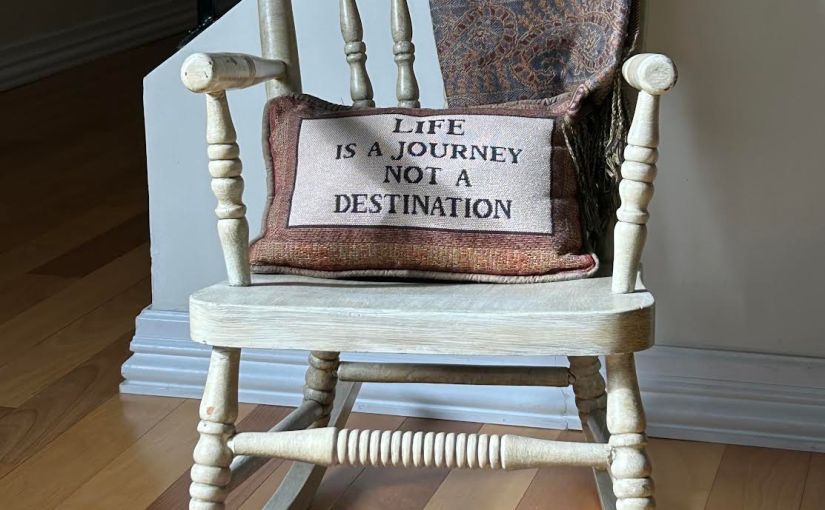
In my time at University it was popular to hang posters with inspirational sayings. I remember seeing the one with a set of footprints in the sand describing how someone might walk with you in times of trouble. Another poster showed various pathways to talk about the road less travelled. Still another suggested the end result was not as important as the journey itself. Walking was central to many of these themes, and woe be the person who didn’t walk their talk, ideologically or in campus conversation. No one wants to be labelled a hypocrite!

There are many songs that depend on the word Walk to drive the message: Who among us has had boots made for walking, or been advised to just walk away like Renée. Maybe we’ve walked like an Egyptian after two many drinks or walked 500 miles just to be the one who falls down by your door. I’ve walked the line between good and evil, just to please the one I wanted to love me back. In the olden days if a boy walked you to the car or to your doorstep he was considered a keeper.

My 95 year old special mom sets a good example by going on a daily walk around the block. She takes seeds in a bag for any bird friends she finds along the way. As do other elders, she has a stable walker with handles suited to her height, a seat, and wheels she can brake so she doesn’t roll away when she chooses to sit and take a rest. I go with her sometimes but I find her slow pace a challenge to my balance. In a metaphorical sense I am taking a walk with her during this twilight part of her life. Watching her deal with the changes that come with aging is a privileged learning experience.

I’ve felt fortunate to have legs that can carry me to where I wish to go. Now in my eightieth decade I neither have the will nor the ability I once had to cover great distances. I have a friend who has mastered the famed Camino de Santiago trail. My son has tramped the beautiful West Coast Trail of Vancouver Island. My hikes have been much less impressive but I have enjoyed the ground I’ve covered. I have taken part in fund-raising walks and once, in late elementary school, I spent time training on a track in the manner of Olympic walking. I wasn’t fast enough to make the team but my hip-work impressed my weekend extra-curricular dancing instructor so much that he designed a special dance character for me. I was a cop-on-the-beat in a dance recital routine that had me walking around a Paris neighbourhood dressed Charlie Chaplin style: Rubber legged, bum waggling, and twirling my truncheon. The audience loved it!

Alas my 15 minutes of fame on that stage would not have propelled me to a career in show business or to be noted on Toronto’s Walk of Fame. But here I am talking about my walks.

Re: I

I is a word and a single letter that carries a lot of punch. I is declarative: I was! I am! I will be! Translated to Latin: Ego eram, ego sum, I erit. Whenever bullying teachers asked rhetorically, “Just who do you think you are?” I always wanted, but lacked the courage, to respond with a preteen snarl, “Me, myself and I!”

There is a certain trinity to who we are. Christians are taught that Jesus was the father, son and holy ghost all rolled into one being. Sigmund Freud contended that all individuals are psychologically composed of an Id, an Ego and a Superego. I especially like the last term because it sounds and looks like a comic book hero. When I think of my responses to people and events I often consider whether it’s my inner child, my parent voice or my authentic adult self that is creating my thoughts.

In the context of the power of the word I, its homonyms are cool to think about too. Aye is something you shout with positivity when you are casting an oral vote or voicing agreement with your pirate captain.  Eye is the centre of things, as in a storm, calming, focussed. An eye is a body’s tool to gather information. William Shakespeare wrote that the eye is the window to the soul.

A single letter as a word with meaning is startling to ESL students. Only one other letter in our 26 word alphabet is a word unto itself. The letter A is what I used to call a helper when I taught early readers. Officially referred to as an indefinite article, the word A is important when distinguishing the difference between say, A baby and THE baby. Watching an episode of the British television series Call The Midwife, I was amused to hear the nurses refer to the newborns with the single word ‘Baby’. What a lovely declaration to start a wee one’s life!

During classes that I took to prepare myself for working as a Guidance Counsellor, I learned a lot about using the word I and I encouraged the students I worked with to use it when they started a sentence: ‘I don’t like what Johnny’s doing at recess.” “I feel bad when Jenny says that to me.” During these dialogues it became chaotic if most of the sentences began with the word You: “Ah, you said!” “You took my things!”

In previous generations talking about yourself was discouraged, even frowned upon. It was thought that if you proclaimed that you were good at something then your head might swell. Whenever my mom thought I was getting too big for my britches she used the Biblical quote, ‘Pride goeth before destruction and a haughty spirit before a fall.’  She didn’t think a person could be an I, without being selfish.

Sir Paul McCartney, here in an interview with Stephen Colbert, speaks well about the reality of his fame while being aware of his kid self and the lazy adult persona, Paul. Let it be.

https://www.youtube.com/watch?v=vdGlGwlgxTk

Re: Legacy

I’ve had some amazing students in my classrooms. Some children have burned so brightly I’ve wondered at the time if this moment in their lives would eclipse all other accomplishments. Collectively, what they have left to me, is an affective legacy. Just as I have been part of my students’ lives they have shared themselves in ways that have influenced who I am today. 

Lately the term ‘Legacy’ has come up in news reports to describe what a particular politician might leave behind as they vacate their office. Lessons may have been learned from their tenure in government. If the leader was of great stature they may have created change that will live on in national policies and the consciousness of the citizenry. Hopefully these achievements will be referred to before the death of the individual. Contributions are worthy of repeating long before funeral speeches are written. 

While some wealthy people have used philanthropy to improve their social legacy, only history will say whether their overall impact as human beings will be revered or frowned upon. Gaining inheritance money or being a child of a celebrity can often be viewed as riding on someone else’s coat tails. Children of parents who have gone to prestigious universities in the United States are able to get Legacy Status for admission and thereby skipping the line. Recently people of privilege went a step further using bribery to receive bogus scholarships for their children.

Every Canadian knows of the legacy of Terry Fox, a one legged runner who attempted to cross our giant country to raise money for cancer research. His achievement and humility are factors that make his name appear on lists of top ten important Canadians, something he hadn’t envisioned or desired when he began the straightforward act of running. His legacy inspired Steve Fonyo to continue his run of a lifetime. Each year many run in Terry’s honour and hundreds of thousands contribute to boost this financial legacy. Individuals are often praised for what they leave behind. Groups of individuals can also be recognized for making a lasting contribution. Banners in stadiums attest to past achievements in sport. Plaques, stars in pavements or statues we erect can’t tell the whole story behind the individual honoured for their legacy.

Like the over used word ‘Hero’ we may be in a time when we hunger for an example of greatness so much that we might use ‘Legacy’ too easily. And yet no other word can be relevant to describe Captain Tom Moore as an example of a person’s actions leaving behind an imprint for the ages. https://www.youtube.com/watch?v=TPxOjHgqFrY . Capt. Tom’s example inspired others, such as John Hillman of Oak Bay, to add to his own personal legacy by raising money for a cause by the simple act of walking. https://www.youtube.com/watch?v=T7s4JshbjUA .

Sir Isaac Newton once wrote, “If I have seen further it is by standing on the shoulders of Giants”. Ultimately we increase the value of any legacy by continuing the work that has been started. 

Re: Fame

A nerdy game I used to enjoy playing in high school started with the question, ‘Would you rather have fame, fortune or power when you grow up?’ It wasn’t really a game, more like a continuation of the more childish Aladdin’s magic lamp suggestion, ‘If you had three wishes…’.

I loved camping with my parents (I had my own ‘Famous’ brand rucksack and cooking equipment). I enjoyed learning about the woods and the ways of the world as a boy scout. I got into scraps while in uniform and one time I remember shouting as I got pummelled, “I’m going to be famous!” The bully just laughed, but I felt buoyed by my hopeful prediction. Even when I was older I felt that youthful sense of optimism when I saw myself through the eyes of the characters in the musical Fame. https://www.youtube.com/watch?v=nqMmquNLnHg

In my youth, I thought it would be way cool to be famous. I saw only positives to being recognized wherever I went. The other two options didn’t appeal. I was actually frightened by the prospect of having more money than I thought I could handle. Likewise with power, I couldn’t see having dominance over another. I never felt my influence extended any further than the tip of my nose. But fame! Now that would give me access: Right this way sir. Of course we have room for you. Follow me I’ll show you to your table. Certainly we can make that happen.

There used to be a common saying, Big Fish in a Small Pond, that indicated you could be well known in your small community while no one in the wider world would have heard of you. Today I’m wondering if the reverse is true, due to social media. The potential for a small voice to be amplified through Twitter or Facebook can potentially enable a metaphorical small fish to make a big splash in the world’s ocean of varied opinions. I suspect that is why online platforms are so popular. I enjoy giving my opinion, whether it leads to nods or shakes of the head. The possibility is there to get more than just the 15 minutes of fame that Andy Warhol prophesied. The internet has expanded the idea of the nineteenth century speakers’ corner in Hyde Park, England for good and for ill. https://www.youtube.com/watch?v=l4yHwCaptL0

I remember one of my elementary school teachers often using the proverb, “Oh how the mighty have fallen.” I can’t quite figure out why some people enjoy seeing celebrities come down a notch or two. But I guess fame is currency so if you feel you have been de-famed, you can seek restitution from your detractors in court by suing for defamation of character. If you fail in your suit, your reputation will live on in infamy, like those who bombed Pearl Harbour.

Everything has a down side. For instance, being famous would make it hard to find privacy. Achieving balance on the FAME spectrum from anonymity to renown may be difficult. I shall ponder further.