Re: Poignant

I love the sound of this word as I speak it.

For me it does not evoke sadness as much as curiosity. I have a strong sense of wonder about the world and our place in it. The word poignant suggests a duality; a bitter-sweet quality perhaps of the reality found in the passage of time. I can almost smell the emotion found in this word. It is the scent of an old homestead, a field at the end of summer, sunset on a beach.

To Kill A Mockingbird by Harper Lee is a story of poignancy. It is one of the few books that I have read more than once. I have watched the film of the same title starring Gregory Peck many times and each time I come away wondering about the yin and yang of life. Seen through the eyes of young Scout the world is a curious and wonderful place while under the protective embrace of her father Atticus Finch. Yet as the story unfolds there is a discomfiting feeling that makes one draw in the covers closer. I wonder can the light and the dark aspects of life co-exist in harmony. Do we need to see the dark before appreciating the light? Poignancy can bring me to a place emotionally where I feel I can clear my attic of stored up thoughts and feelings.

In the sixties there was a series on television called Mr. Novak. It was about a high school teacher played by James Franciscus. His character was an English/Drama educator, as I recall. During one of the episodes he gave his students an assignment to tell a story that would define the word pathos. One of his students wrote of her grandfather who was nearing the end of his life. In her story, she described him as a collector. Today we may conclude that he was a hoarder. When he died she found herself in his attic space, helping her parents sort through his stuff. She came across several large balls of twine that had been wound using knotted pieces of assorted string of variable length. Near this collection she found a shoe box filled with smaller bits of string. On the lid of the box, in careful printing, was the label, ‘Pieces too small to save’.
I remember weeping over this scene as I watched the program. It taught me, even at such an early age, of the power of drama and that there are two sides to this gold coin of life.

Some days, weather wise, the sky is a bright blue. But most days the sky is cloudy or overcast, maybe even looking poignant. When I was married to my bride on the beach of a Caribbean Island the sky was a creamy white colour. It was a moving ceremony and afterwards we lingered by the surf edge as a photographer recorded our bliss. We were touched by the circumstances that had brought us together.

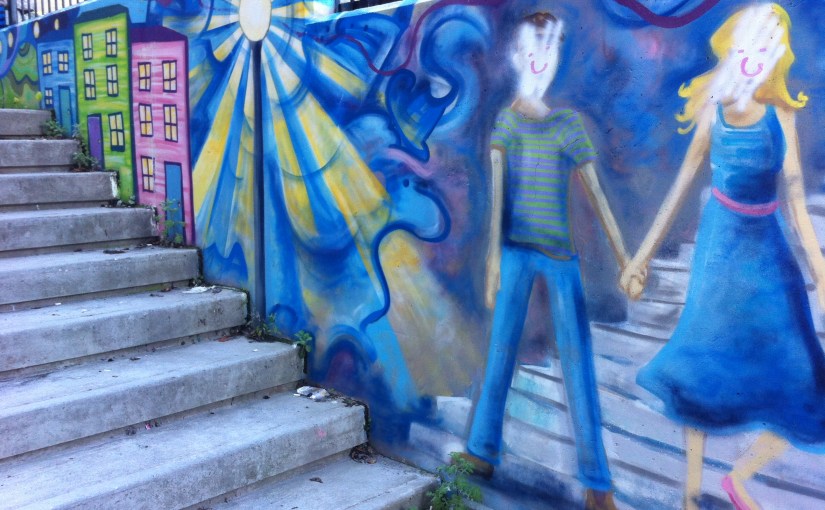
We reflected on the meaning of time, us two, holding hands, barefoot in the sand.

Re: Influence

Sometimes we have to wait until our funeral to find out if we have positively affected someone else’s life.

We like to think we have an influence on others but usually all we can hope for is a chance to submit input. I once heard someone say, “My authority ends at the tip of my nose”. I took that to mean he did not seek influence over others. I believe he was afraid that he might be perceived as manipulating. I can see that because I never wish to be coerced. I am often on my guard when it seems someone wants to sell me on their particular way of living. However, while we may not seek to be influenced or influential, it happens nonetheless. We reveal our desire to have input when we recommend a book, film or play. It’s not pushing your agenda when you offer a suggestion or preference. Our friends, family and fellow citizens take note of how we are in the community. Our behaviour can have a huge impact on their lives. We don’t have to be a person of high profile to recognize and value our own potential for influence.

Fictional characters can be influential. I find myself relating to the behaviours exhibited by Data and Spock in the Star Trek films. Which came first I wonder; me wanting to be like them or seeing myself in them? Our local library holds an annual Free Comic Book Day where young ones are invited to stop by the main branch where they can, among other things, get an autograph from one of several costumed superheroes. Influence is at work here as well as decisions regarding what to wear when Halloween rolls around.

A teacher colleague who had risen to become a Superintendent of Schools was asked if she thought anything had changed with her promotion. She said, “I have to be careful what I say now because everyone is listening.” This statement made me feel happy for her but at the same time sad for all those who have had an opinion, on anything, but did not get an audience for their view.

Sports figures are often quoted as saying they want to be a positive role model. I trust their intent, but some of that motivation may be due to keeping their eye on product endorsement contracts. Other brave souls who have stepped forward to bring awareness to a cause proclaim they can now be the voice for those who are disregarded. We live in community and that requires a recognition that others may have a different world view. We all have a voice that needs exposure. Waiting for the right opportunity can help. Having the courage and confidence to believe you have a part in this play of life, like none other, is a responsibility.

When I recognize that another has helped me see things differently I find a way to acknowledge that fact. That they had an influence on my life is something I need to reveal before they can no longer hear me.

Re: Perception

Lee Atwater, 80’s political strategist, is credited with first using the phrase, “Perception is reality.”
This is one of the most misused and manipulative ideas of my lifetime. Twin it with Oprah Winfrey’s “Speak Your Truth” and it is no wonder society is currently in a confused state.
When I read Noam Chomsky’s book ‘Manufacturing Consent’ these two phrases came to mind and I wondered how often we are tricked, as if by magicians, into believing the lie that is right in front of us.

A police officer might tell you that interviews with witnesses standing within a few feet of each other at an accident scene will provide multiple interpretations of what happened. How can their perceptions be so different? At University, I once took part in an Extrasensory Perception experiment but now, as I age, I am losing some of my normal senses. I feel the need to check and double check if I have heard or seen something correctly. I know from experience what is real yet being a senior puts my perception in doubt.

I love watching young children gain awareness that others see the world differently. The baby blanket over the head does not make you invisible any more than turning your back makes a problem go away, but these things must be learned. As you grow, the excitement of sharing what you have just perceived gets keener. Sometimes you want to exclaim, “Did you see that? “ We are hardwired to share our discoveries, and yet it is frustrating to try to show others what we are seeing, in reality and metaphorically, when they cannot.

These days I find myself on the look-out for prophets. I believe Mr. Chomsky to be one. The term ‘seer’ has fallen out of use but that word captures best the prescience of some individuals who may show us things that we cannot see, for now at least. It is not for the seer to cry warning but to make the way clearer for us to come to our own conclusions. The false prophet only wants to sell us something. I do not wish to be led, only informed.

The film Dead Poets Society is a work of art that has taught me a lot about perception. The scene of the youths leaning in at the trophy case only to see the photos of those champions long gone staring back at them says much about one’s point of view. Oh and what sights you can see while standing on the top of your desk!

My perception of the world is changing as I adapt my life experiences to present realities. I feel hurt by some of the things I perceive, yet I try not to rush to conclusions. I wonder if some illusions may even be necessary for my mental health. The world can seem like a magical act at times, creating distractions that divert my attention from the truth.

I’ll trust my vision while relying on others to confirm/contradict my view, what else can I do?

Re: Regret

Cue the Paul Anka song ‘My Way’: Regrets/I’ve had a few/but then again/too few to mention. This song offers some suggestions about this word and what it means to people. When I hear Frank Sinatra sing it I can’t help but reflect on the arrogance of believing a man must only do it his way. This can set the stage for abuse.

I don’t think anyone can live free of regrets. I once moved our family dog out of the way with my foot. I had to answer the door, the animal was barking and about to trip me up. He fell down some stairs and it made me feel ashamed of my impatience. Another time I wrestled my teenaged son to the ground in an effort to make him mind what I was saying about where he was going one night. Another son felt my verbal frustration when I thought he wasn’t pulling his weight at a campground. I’ve made amends for these moments when I have lost my temper to my boys and to our dog (who got extra walks with me and enjoyed the treats I had in my pocket). To this day though, when I recall these moments of poor behaviour, my chest still hurts.

Anka’s lyrics, read in the context of the #metoo era, scare me.
They reveal a sense of entitlement that males, and white males particularly, continue to anticipate. Going your own way can make you feel self reliant but likely makes others feel redundant. I sometimes feel I have to atone, as a male, for another male’s abuse of power and privilege. I feel uncomfortable being lumped in with those who are not being respectful. I want to shout, “That’s not me!”

I feel very fortunate to have been the son to a father who was often described as a gentleman. The best part of me comes from this man who always spoke respectfully of, and to, women. Growing up I found my mother to be a challenge to live with, but I only heard my dad disparage her once. He would have felt lost in this world where the idea of sexual equality is in such flux.

I recently chatted with a female neighbour about all this judging going on in a world that has long needed a cultural realignment. When I said I wasn’t sure what I could do to help, she said, “Just keep showing your support.” I didn’t feel any better. Was I perceived as needing a pat on the back for being one of the good guys? I regretted not having the right words to express my multiple feelings.

There is a great line in the movie Chariots of Fire, where the lead character is asked if he has any regrets. He responds that he has had several; but no doubts. I’d like to believe that I am strong enough in my own character and aware of my impact on others that I can move through life without doubting my actions. My dad would say, “Start with kindness.”

Re:Semantics

A word creates a thousand pictures.

I like this twist on the maxim about pictures being worth a thousand words. I have gotten into hot water over a single word. A word I have used has made a person cry. Some words have been taken out of context and others have captured the precise meaning behind my feelings. I have been involved in conversations where an individual, in frustration, has thrown up their hands exclaiming,
“It’s all Semantics!”

Exploring the meaning of words has been a pastime, a hobby, a passion, a vocation (when I taught elementary school aged special needs children).
I appreciate the nuances of meaning in other languages and love when I am introduced to a new word that has entered the lexicon of my mother tongue. For example, in my conversations in the late 80s, I tried to use glasnost, a Russian word meaning transparency, in an effort to feel I belonged to the efforts of change in Communist Europe. That makes me a word poser I guess, but it is not my intent to use words as a mask, only to help me express who I am in as honest a way as possible.

A single word can be so simple yet so complex. U.S. President Bill Clinton once famously said, “It depends upon what the meaning of the word ‘is’ is.” Elements of culture can have a profound impact on how a word is interpreted or used. Some words become exclusive to a particular group. Some words have been isolated in usage to the point of being socially quarantined for fear of offending, for example the ’N’ word.

A listener’s personal history may be triggered by a particular word causing them to spiral off on a mental journey and totally lose track of the current discussion. This can be where a discussion can become more about, “but this is what you said!” and less about finding common ground and understanding through meaning. It’s a wonder we can have a conversation at all without a dictionary or thesaurus in our hand, but that would be impossible, silly, formal or unintentionally snobbish.

In another lifetime I may have enjoyed devoting more time to the formal study of etymology, but in the end it’s the semantics of word use; the coming to a mutually agreed understanding of the meaning behind the word choice that fascinates me, every time I have a conversation with another English speaking person.

Yesterday someone surprised me with this phrase; “My word is my bond.” Imagine if there was ever a time when what someone said was taken as true because trust was inherent. Even the phrase, ‘You can take my word for it’ is suspect in our modern world, sounding like something a used car salesman might utter to close the deal.

Words can cement a relationship if they have a mutually understood meaning. You might feel I ‘get’ you when we are working from the same cleverly designed and shared internal dictionary. At that point you might say, “Word!”.

Re: Art

Re: ART
Art makes me whole and it continues to help me make sense of the world in which I live.

One of my favourite questions to ask someone I meet for the first time is; “How do you express your artistic side?” Responses range from details of their latest projects to “I don’t do art.” The latter response actually can produce the best discussion and usually results in the admission that the respondent does indeed ‘do’ art. Most people participate in art activities without even realizing it. We do art when we sing in a choir (or the shower), when we write a letter or craft an email or Tweet, when we dance at a ceremony, when we carve a totem, when we read to our children, when we plan a meal, when we decorate our house or garden.

Art shouts, “Here I am!” Art exists whether it’s funded or not. Art can be used as protest. Many artists have died without achieving financial success. Many have died FOR their Art. Humans are essentially creators. Art is an act of creation. To me, Art is an act of love.

It’s often said that Art adds to our economy. While there is truth to Art’s economic value, I confess to being upset when Art is quantified in this way. For example film is regularly judged by the value of the opening weekend box office. This fact gives a limiting perspective: The artistic quality of the work is lost in a pile of numbers. I believe Art has more than a financial value.

Art brings understanding. I know I can point to several Art experiences in my lifetime that have created an awareness, sometimes even a shift in my belief system. Watching a play, a dance performance, or a musical ensemble has sometimes opened my mind to another perspective and brought clarity of thought. When I engage with a character in a book or film I come away with feelings of joy, empathy, sadness. These feelings often inform my interactions with others and ultimately improve my relationships.

Art has a proven health value like its sister in Culture: Sport. When I taught special education, I sometimes worked alongside an Art Therapist who helped me connect with my students through music, puppetry or visual art. I am aware of Alzheimer’s Societies that have run successful programs using Art to help their clients. My community has a drama program at its penal institution that awakens inmates to the value of Art in their lives. If Art can heal, conversely, lacking Art in our lives may make us ill.

As an individual and as a community we need only decide how we want to participate. Many municipalities have vibrant community arts councils where you can decide with others how Art can be explored. Abundant support can lead to a vibrant art scene.
Communities that recognize that Art is fundamental to society’s Culture will prosper because its citizens will become more active in all aspects of communal living.

Art shows us who we are.